Yurt buying guide: frames, covers, sizes and costs
A good yurt has a hardwood lattice wall, radial rafters, a strong compression crown, a heavy treated canvas cover and an insulating liner, set on a level round platform. Size it by what goes inside: a 16 ft yurt (about 18.7 m²) suits a couple, a 20 ft (about 29 m²) a suite or small family. Ours are priced on enquiry, with a wool-blend liner included.
6 min read · Updated
What makes a true yurt
The yurt comes from the nomadic peoples of Central Asia, the Mongolian ger being the best-known version. An expanding lattice wall, the khana, opens out into a circle. Rafters run from the top of the lattice to a central crown ring, which holds them in compression. The outward push of the rafters on the lattice is resisted by a tension band or cable round the top of the wall. Over this frame go the insulation and the cover.
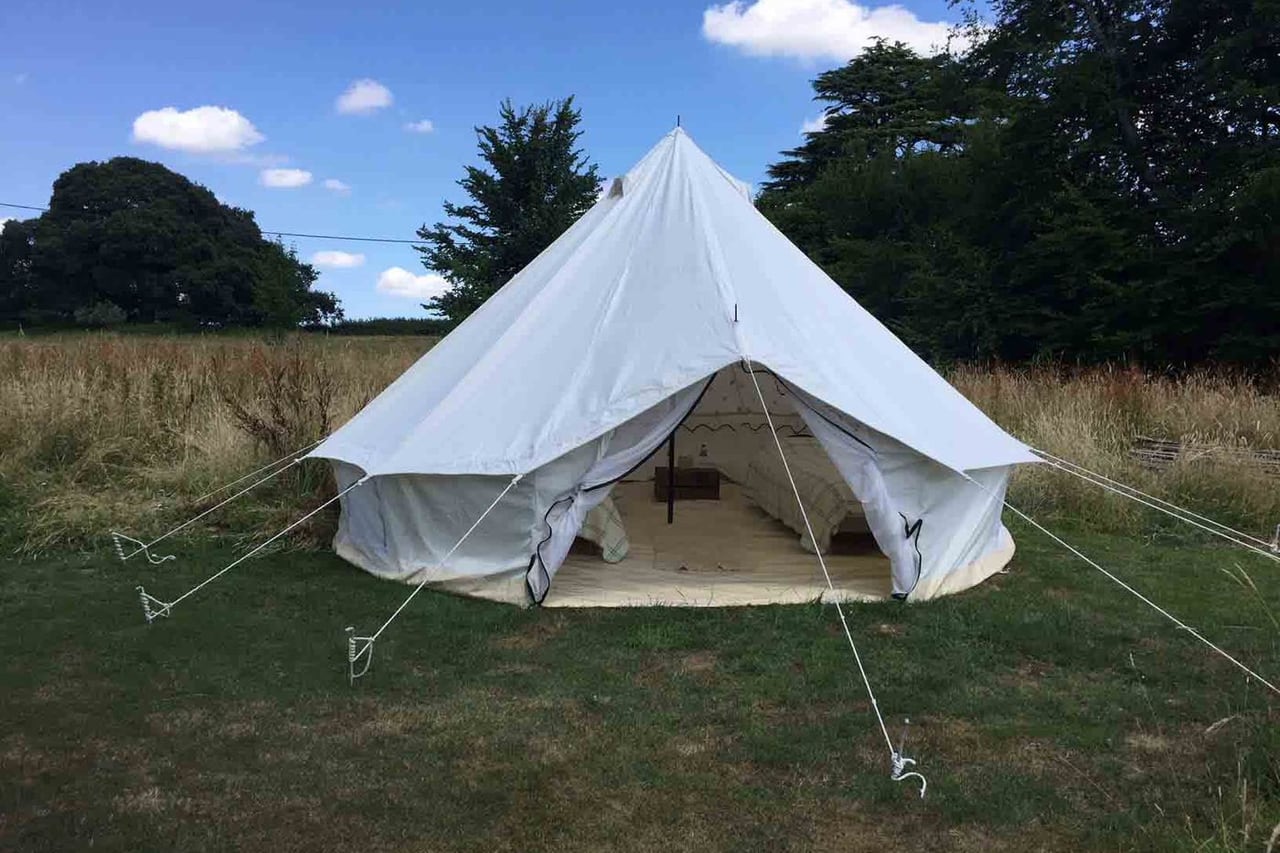
Plenty of round tents are sold as yurts without a lattice wall or a crown. They can be good tents, but they do not have the yurt’s warmth, quiet or permanence. When you compare quotes, ask what the wall is made of and how the rafters are held.
Our Yurt 16 FT and Yurt 20 FT are true yurts: seasoned hardwood lattice and rafters, a steel-ringed compression crown, a wool-blend insulating liner and a heavy treated cotton cover.
Sizes, floor area and what fits
Yurts are sized by diameter. The wall is vertical, so furniture can sit near the edge, which makes a yurt’s floor more usable than a cone-shaped tent of the same size. Prices are ex-works catalogue guide prices; freight, duty, the platform and furnishing are extra.
- 16 ft: a king bed, two bedside tables, a small sofa or two chairs, and a stove.
- 20 ft: all of that plus a seating area, a dining table or a screened washstand. Ordered for flagship keys, wellness pavilions and owners’ residences.
| Model | Diameter | Floor area | Cover | Typical use | From |
|---|---|---|---|---|---|
| Yurt 16 FT | About 4.9 m | About 18.7 m² (201 sq ft) | 480 gsm treated cotton | Couple’s room, therapy room, studio | On enquiry |
| Yurt 20 FT | About 6.1 m | About 29.2 m² (314 sq ft) | 520 gsm treated cotton | Suite, small family, wellness pavilion | On enquiry |
Frame materials and finish
Timber quality decides how a yurt ages. Look for seasoned hardwood, straight-grained and well finished, with lattice joints that are fixed but free to pivot. Green or soft timber can twist and crack once it dries out in a heated yurt.
The crown carries every rafter, so it must be strong and accurately made. Ours is steel-ringed for that reason. Check how the crown is covered: most yurts have a clear dome or a canvas cap that opens for ventilation. Ask about the door too, since a solid timber door frame makes a yurt feel more like a room and locks properly.
Covers, insulation and condensation
The cover is the part that wears, so its specification matters. Our yurts use 480 gsm (16 ft) and 520 gsm (20 ft) treated cotton canvas, which is heavier than we use on bell tents because a yurt usually stays up for long periods. Cotton breathes, so moisture from guests and a stove can escape rather than condensing on the inside. See canvas GSM explained for what the weights mean.
Between the frame and the cover sits the insulation. Ours is a wool-blend liner, which keeps the room warm in winter and slows heat gain in summer. In a very cold climate you may want an extra layer; in a hot one, open the crown and lift the walls for airflow. Our guide to insulating a canvas tent for winter covers the options.
Yurt platform size and design
A yurt needs a level, round or polygonal platform at least as large as its diameter, plus a little for a step or apron. Timber decks are the usual choice; a concrete slab works where the ground is stable and the floor will be finished inside. The edge of the deck should let water fall away from the base of the wall, and the lattice should be fixed down so it cannot lift in wind.
Build the deck from the yurt’s own drawing, and run power and any plumbing through the floor before the yurt goes up. Our platform and deck design guide has more detail.
Stoves, power and bathrooms
Many yurts are heated by a wood stove. The flue normally leaves through a heat-proof flashing in the roof, away from the crown, and the stove stands on a non-combustible hearth with the clearances the maker specifies. Fit a carbon monoxide alarm and check what your insurer requires; see our guide to a wood stove in a canvas tent.
A bathroom rarely goes inside a 16 ft yurt. Operators either screen a small washroom inside a 20 ft or build a separate bathroom pod or cabin alongside, linked by a covered walkway.
Yurt checklist before you order
For a site with several yurts, or a yurt in a size or colour outside the catalogue, start with our custom tent configurator or send us a note through the contact page.
- Is the wall a true lattice, and what timber is it?
- How are the rafters held, and how strong is the crown?
- What weight and treatment is the canvas cover?
- Is insulation included, and what is it made of?
- Is the door a rigid frame that locks?
- What drawings come with it, and can you buy a replacement cover on its own?
Questions buyers ask
How long does a yurt last?
A well-made hardwood frame kept dry lasts many years. The canvas cover wears faster and is replaced on its own when it needs to be.
Can a yurt stay up all year?
Yes, that is what the heavier cover and insulation are for. Keep snow and leaves off the roof, keep it ventilated and inspect the cover each season.
How long does it take to put up a yurt?
Once the platform is built, a small crew can usually erect a yurt in a day. The first one takes longest; the order of lattice, door, rafters, crown, liner and cover soon becomes routine.
Is a yurt warm in winter?
With its insulating liner and a wood stove, a yurt is one of the warmest canvas structures you can buy. In extreme cold, add a second insulation layer and an insulated floor.
Can a yurt be shipped overseas?
Yes. It breaks down into lattice bundles, rafters, crown, door frame and cover bales and travels well in a consolidated container load. Our guide to importing tents from India covers the process.
What is the difference between a yurt and a ger?
A ger is the Mongolian form of the yurt. Both use a lattice wall and crown; the details of rafters, crown and cover differ between regions and makers.