Bell tent sizes explained: 4m, 5m, 6m and beyond
Bell tents are sized by floor diameter. A 4m bell (about 12.6 m²) suits a double bed and one couple; a 5m (about 19.6 m²) takes a king bed, chairs and a luggage rack and is the glamping standard; a 6m (about 28.3 m²) is big enough to partition into sleeping and sitting areas or to sleep a family. Our prices run from $275, $350 and $450 respectively, ex-works.
6 min read · Updated
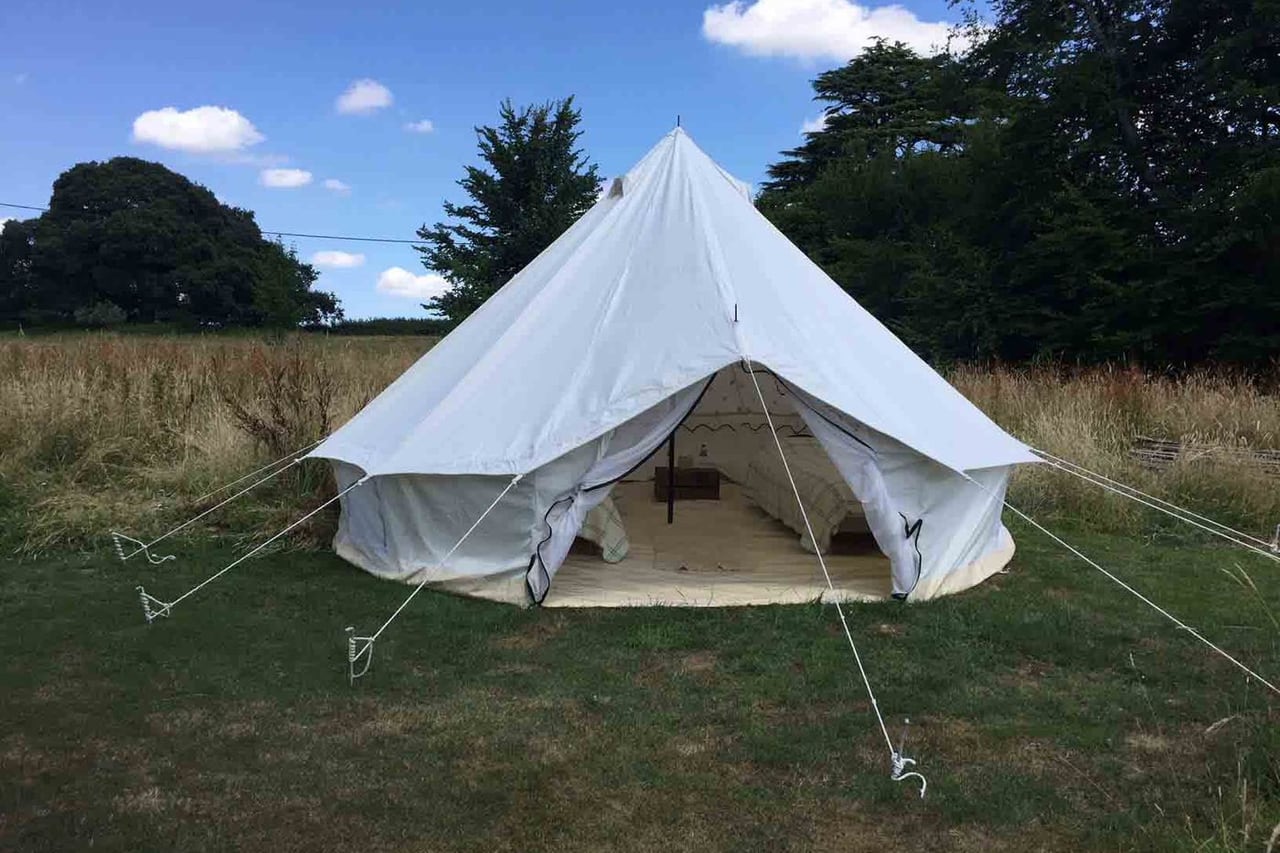
How bell tents are measured
The size of a bell tent is the diameter of its floor. A 5m bell is a five-metre circle at ground level. Floor area grows with the square of the radius, so each extra metre of diameter adds more space than the last: going from 4m to 5m adds about 7 m², while 5m to 6m adds nearly 9 m².
Usable area is smaller than the nominal figure. The wall is short, and the roof slopes down to meet it, so the outer band of floor is fine for a bed or a bench but not for standing. Centre height also rises with diameter, which is what makes larger bells feel so much roomier. Check the drawing for exact wall and centre heights before you plan furniture.
Pitch footprint is bigger again. Guy ropes run out from the wall, so allow a circle well beyond the floor diameter. As a rule of thumb, add about a metre and a half all round, and more on exposed sites where you want lower rope angles.
Bell tent sizes at a glance
These are our three catalogue sizes, all in treated cotton canvas with a galvanised pole set and a zip-in PVC groundsheet. Prices are ex-works guide prices; freight, duties and furnishing change the landed cost.
| Size | Floor area | Canvas | Groundsheet | Typical use | From |
|---|---|---|---|---|---|
| 4m | About 12.6 m² (135 sq ft) | 360 gsm | 540 gsm PVC | Double bed, one couple | $275 |
| 5m | About 19.6 m² (211 sq ft) | 360 gsm | 540 gsm PVC | King bed, chairs, luggage rack | $350 |
| 6m | About 28.3 m² (304 sq ft) | 400 gsm | 610 gsm PVC | Partitioned suite or family | $450 |
The 4m bell tent
The 4M Bell Tent is the smallest tent we make that still feels like a room. It takes a double bed, a bedside table each side and a little floor for bags. It is also the size most properties buy first, because it lets them test demand for very little capital.
Use it for couples on short stays, as an extra room beside a family tent, for festival and event accommodation, or as a children’s tent. It is light enough to move around a site easily and fits through narrow access.
The 5m bell tent
The 5M Bell Tent is the one the hospitality trade keeps returning to. A king bed, a pair of chairs and a luggage rack fit without crowding, and there is still room to walk round the bed. It packs into a single vehicle load, which matters when one person is pitching a field of them at the start of the season.
For a family, a 5m sleeps a double bed plus two singles, or four on camp beds. If your site sells couples’ breaks, this is the size to standardise on.
The 6m bell tent
At six metres, the 6M Bell Tent has enough floor to divide the interior, with sleeping on one side and seating or a washstand on the other. That is why resorts running a full-service tent specify it almost exclusively.
We make it in heavier 400 gsm canvas with a heavier centre pole and a 610 gsm groundsheet, because a larger canopy catches more wind and carries more weight when wet. It needs two people to pitch comfortably and a little more care in choosing a sheltered spot. It is mostly bought for families of five or six, small group bookings and premium couples’ tents.
Bell tents larger than 6m
Bell tents above six metres exist and are used for gatherings, workshops and communal spaces. As the diameter grows, the canvas area, pole load and wind load grow quickly, so the pole, the canvas weight and the guying all have to be specified up rather than simply scaled.
For sleeping, most operators find two 5m tents more flexible than one very large bell. For a communal space, consider a Tipi 20 FT or a framed structure. If you do need a large bell, our custom tent configurator is the place to start a drawing.
Choosing the right size for your site
Think about furniture before you settle on a size. Measure your bed, wardrobe and seating and plot them on a circle; it quickly shows whether a 5m will work or whether you need a 6m. Then plan each pitch with its guy ropes and a path to the door. If you would like help with a mixed order, contact us with your guest profile and site plan.
Consider the labour each size needs. A wet 6m canvas is a heavy two-person lift, takes longer to dry and needs more shelf space over winter than a 4m. If your team will be striking and storing tents every autumn, that labour belongs in the decision as much as the nightly rate. Our guide to storing a canvas tent covers drying and packing.
- Couples and short breaks: 5m. The 4m works if price is the priority.
- Families: 5m for up to four, 6m for five or six.
- Premium tents with a seating area or washstand: 6m.
- Events and festivals: 4m and 5m, because they pitch fast and fill gaps.
- Mixed site: a core of 5m tents with one or two 6m as the top category.
Questions buyers ask
How many people sleep in a 5m bell tent?
Comfortably, a couple with a king bed and furniture, or a family of four with a double and two singles. Camping-style, it takes more, but glamping guests expect space.
What size bell tent is best for glamping?
The 5m is the most common choice for paying guests because it balances space, cost and ease of pitching. The 6m suits premium and family tents.
How much space do I need to pitch a 5m bell tent?
Allow roughly an 8m circle as a rule of thumb, to include guy ropes and walking room. Exposed sites need more.
Is a 6m bell tent harder to put up?
It is heavier and needs two people, but the method is the same as a 5m. The bigger canopy means you should be more careful about shelter and guying.
Can bell tents be joined together?
Two bells can be linked with a connecting canopy or awning between the doors, which some family sites use. We can quote a connecting piece as a custom item.
Why is the 6m bell tent made in heavier canvas?
A larger canopy carries more weight when wet and catches more wind, so we move from 360 gsm to 400 gsm canvas and use a heavier pole and groundsheet.