How to choose a medieval pavilion
Choose a medieval pavilion by deciding first what it is for (living history, festival camping, film or a wedding), then the shape that suits that use, then the size and canvas weight. Round pavilions are the all-rounder, square and rectangular tents furnish and line up more easily, and wedge or A-frame tents are the light, cheap sleeping option. Our medieval range starts at $175 for a wedge, and the Tudor pavilion starts at $1,100, ex-works.
6 min read · Updated
What will you use the medieval pavilion for?
Most buyers who end up unhappy with a medieval tent bought the right tent for somebody else. A living-history society, a LARP group, a film designer and a wedding venue all ask for “a medieval pavilion”, and they need different things from it.
A reenactor will be judged on period detail and will pitch the tent every few weekends. A festival camper needs something that survives a wet week and fits in a car. A production needs several matching units that photograph well and go up fast. A venue or hotel wants one striking structure that stays up for a season and passes a fire inspection. Write down which of these you are before you look at shapes, because it settles most of the later decisions.
Pick the shape: round, square, oval, wedge or A-frame
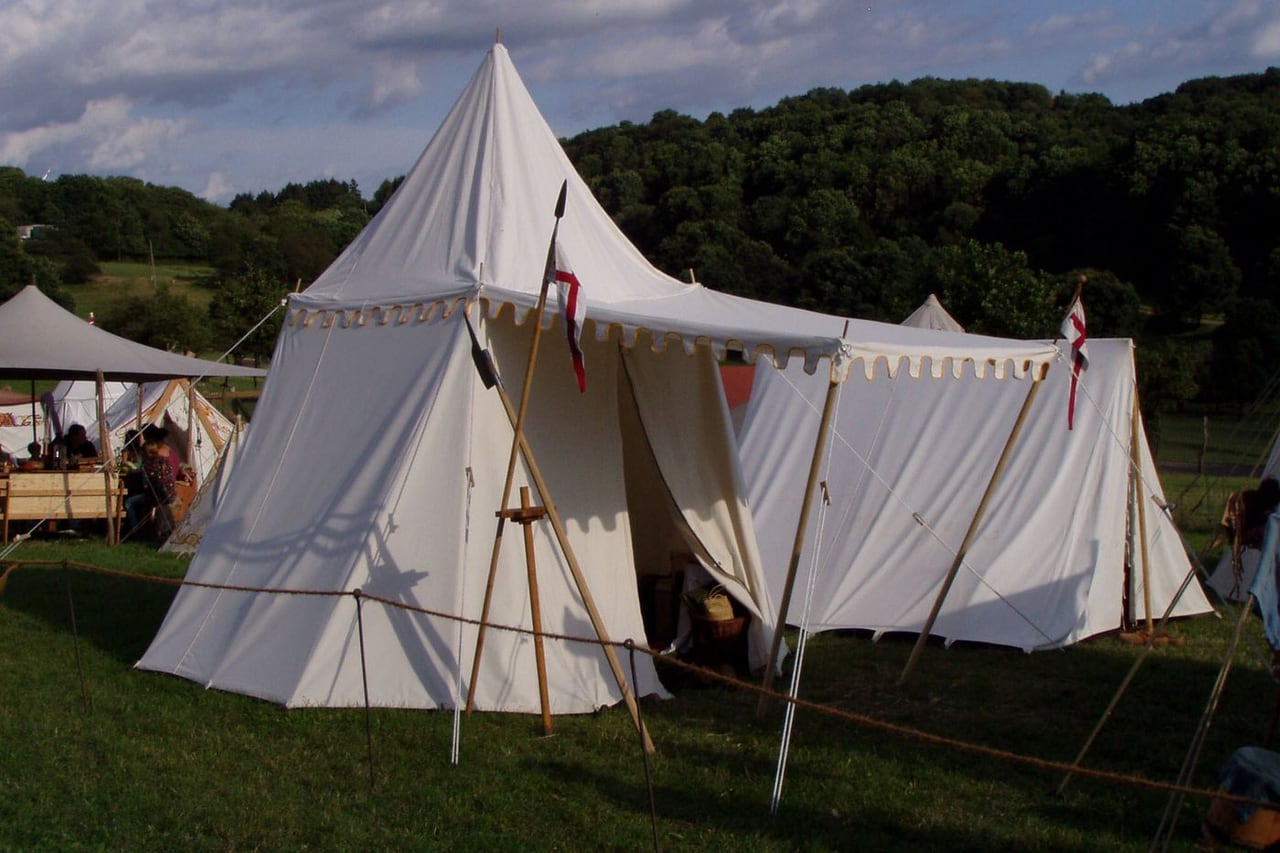
Shape decides how much of the floor you can stand on, how many poles you carry and how the tent looks in a row. The Round Medieval Pavilion is the shape most people picture: a cone roof on a single centre pole, straight walls, and a scalloped valance. Straight walls matter more than they sound, because they let you put a bed or chest right against the edge.
If you need to furnish a tent like a room or pitch several side by side, look at the Square Medieval Tent. For sleeping only, a wedge on a ridge pole is lighter, cheaper and quicker to pitch. The full range is on the medieval tents page, and our guide to medieval tent sizes and shapes goes deeper on floor area.
| Shape | Canvas | Poles | From | Best for |
|---|---|---|---|---|
| Round pavilion (M01) | 400 gsm treated cotton | Single centre pole | $260 | General camp living, small weddings |
| Square tent (M02) | 400 gsm treated cotton | Four-post frame | $410 | Furnished rooms, matched rows |
| Rectangular tent (M03) | 440 gsm treated cotton | Twin poles, ridge | $471 | Feast halls, command tents |
| Oval tent (M04) | 440 gsm treated cotton | Twin poles | $425 | Large living space with no corners |
| Wedge tent (M05) | 360 gsm treated cotton | Ridge and two uprights | $175 | Sleeping, rank-and-file camps |
| Double bell wedge (M06) | 400 gsm treated cotton | Ridge and two uprights | $360 | A roomier sleeping tent |
| Viking A-frame (M08) | 440 gsm treated cotton | Carved crossed poles | $210 | Early medieval encampments |
How big a medieval tent do you need?
Count beds and furniture before you count people. A rule of thumb we give buyers: allow the footprint of every bed, chest and table you will bring, then add roughly the same again for walking space. Two people with a rope bed, a chest and two stools are comfortable in a small round pavilion. Add a table for meals out of the rain and you have moved up a size.
Each shape comes in several standard sizes. The round pavilion is made in six (codes CETM-01A to CETM-01F), the Tudor pavilion in four and the Imperial in three. Ask us for the current size sheet with floor diameters, wall heights and pole lengths, because pole length is what decides whether the tent fits your vehicle.
Canvas weight and treatment for medieval tents
Our medieval tents are cut from treated cotton canvas: 360 gsm for the wedge, 400 gsm for the round, square and Anglo-Saxon patterns, 440 gsm for the rectangular, oval, Viking and Regent tents, and 480 gsm for the Tudor and Imperial pavilions. Heavier cloth costs more and weighs more, and it holds its shape better on a tall roof, resists abrasion at the pole and copes with more seasons of sun.
The treatment is a mill-applied finish against rot, mould and UV, with a water-repellent finish on top. Cotton canvas sheds rain because the fibres swell when wet and close the weave, so a new tent should be wetted and dried once before its first event. Our guide to why new canvas tents leak explains that weathering process.
If the tent will be used where the public gathers, ask about fire-retardant cloth at the quote stage. It is far easier to specify it than to treat a finished tent later.
Poles, rope and the period details people notice
Poles on our medieval range are seasoned hardwood, with steel added only in the multi-pole Imperial frame. Wedge, Viking and Anglo-Saxon tents come with hemp guy rope and wooden runners; the Viking and Anglo-Saxon patterns have hand-worked eyelets rather than brass, which matters to groups who are judged on visible detail.
For a reenactment tent, ask for tie or toggle door closures instead of zips, and plan to hide any groundsheet under rushes, rugs or straw. For a festival or wedding tent, brass eyelets and a zip are practical choices nobody will object to.
Transport, storage and who pitches it
A medieval pavilion is canvas plus a bundle of long timber. The canvas packs into a bag; the poles set your vehicle size. A single-pole round tent is the easiest to move, while a square tent brings a frame and a twin-pole tent brings a ridge. Ask whether long poles can be jointed with a sleeve if you travel by car.
Two people pitch a wedge or a small round pavilion comfortably. The Tudor and Imperial pavilions need a crew and come with an installation drawing. Store everything bone dry: cotton canvas packed damp will mark with mould within days.
Medieval pavilion prices and ordering
Catalogue prices are ex-works guide prices for the smallest size. Larger sizes, linings, decoration, fire-retardant cloth, freight and import duties all change the landed cost, so treat the list price as the start of the conversation. Groups often save by ordering matching tents in one shipment.
If none of the standard shapes fits your brief, our custom tent configurator lets you set dimensions and finish. For a quote on a standard pavilion, send the shape, size code, quantity and delivery country through the contact page.
Questions buyers ask
What is the best all-round medieval tent?
For most buyers it is a round pavilion. One centre pole, straight walls and a familiar silhouette make it easy to pitch, easy to furnish and acceptable at most period events.
Is a medieval pavilion waterproof?
Treated cotton canvas is water-resistant once it has been weathered, which means wetted and dried so the fibres swell into the seams. Keep the roof tight and avoid touching the inside of the canvas in heavy rain.
Can I live in a medieval tent for a week-long event?
Yes, that is what most of them are used for. Choose 400 gsm or heavier canvas, leave room for a raised bed, and plan to dry the tent fully when you get home.
Do you make medieval tents to custom sizes?
Yes. Rectangular tents can be lengthened in two-metre bays, and any shape can be quoted to your dimensions through the configurator or by sending a drawing.
How much does shipping add?
It depends on volume, destination and whether you ship alone or consolidated with other goods. We quote freight separately, and duties are set by your country’s customs authority.