Why a new canvas tent leaks, and how weathering fixes it
A new cotton canvas tent often drips at the seams or mists in its first heavy rain because the fibres and stitch holes have not yet swollen shut. Weathering fixes this: pitch the tent, soak it thoroughly, let it dry completely and repeat two or three times. Most other apparent leaks are condensation, a wall touched from inside, or water pooling on a slack roof, and each has its own cure.
6 min read · Updated
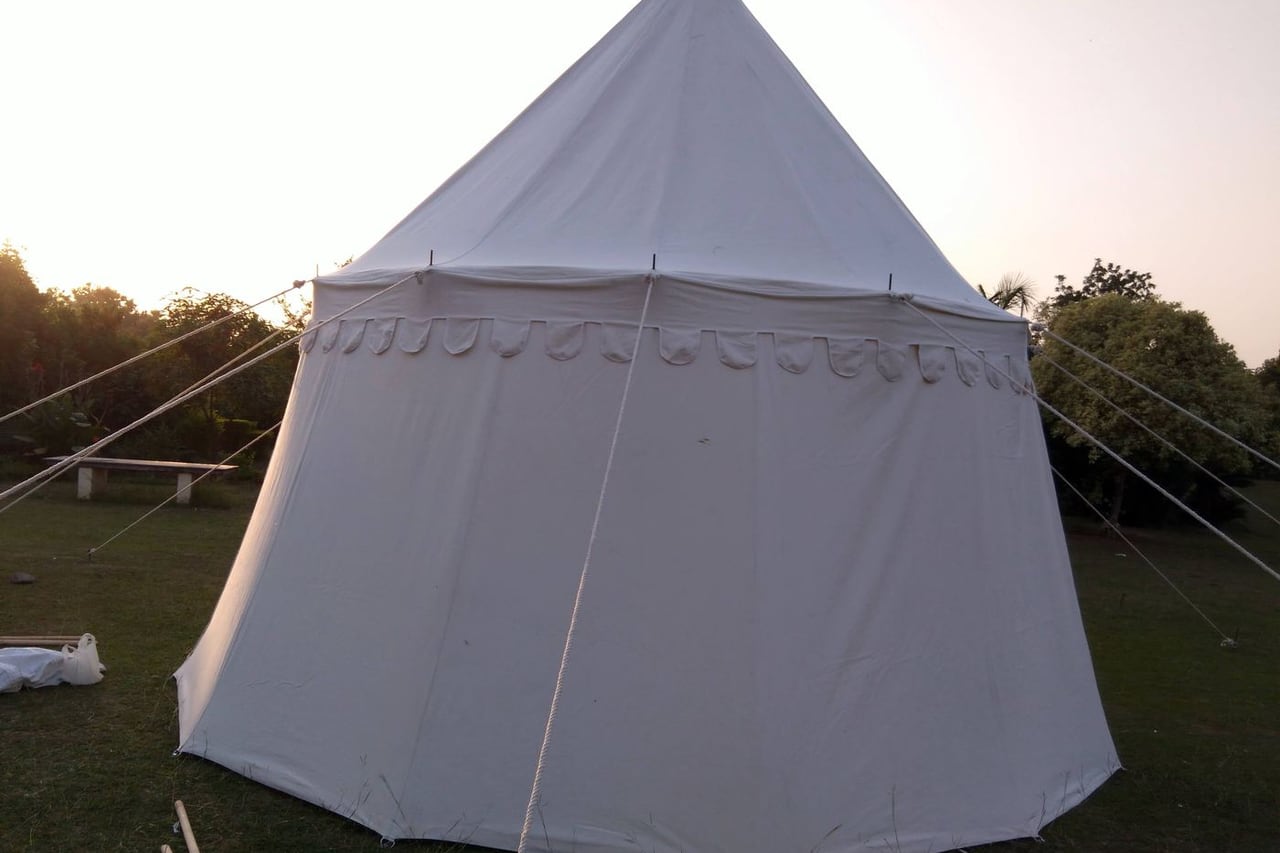
Why cotton leaks before it is weathered
A cotton bell tent keeps water out mainly by swelling. Each cotton fibre absorbs water and thickens, and in a tightly woven cloth that closes the gaps between the yarns. Stitching does the same: the needle punches holes through the cloth, and the thread and the cloth around it swell to fill them. Until that has happened at least once, a new tent can show drips along the seams, a fine mist through the roof in heavy rain, and wet patches around eyelets.
This is normal for any cotton tent, ours included, and it is why we say on our craftsmanship page that a canvas tent must be weathered once before it is trusted. It is also why the water column figure for treated cotton is quoted for the cloth after it has swollen. Our hydrostatic head guide explains how those figures are tested.
How to weather a canvas tent
Do it at home or on site, before anyone sleeps in it and long before paying guests do.
- Pitch the tent properly, with the groundsheet zipped in, walls square and guys tensioned so the roof is taut.
- Soak it thoroughly with a garden hose on a normal spray, or leave it out in a good rain. Every panel and every seam should be wet through.
- Leave it standing until it is completely dry, including the seams and storm skirt.
- Repeat two or three times. Watch the seams from inside on each soaking; drips should reduce and stop.
- Slacken the guy ropes a little while the canvas is wet, because cotton and cotton rope shrink as they take up water, then re-tension once dry.
- Dry it fully before packing it away. A weathered tent packed wet will still go mouldy.
Is it a leak, condensation or something else?
Before deciding a tent leaks, work out where the water is coming from. Most complaints in a tent’s first season are one of these.
| What you see | Likely cause | What to do |
|---|---|---|
| Drips along seams in the first rains | Not yet weathered | Weather it two or three times |
| Fine mist through the roof in a downpour, new tent | Fibres not yet swollen | Weather it; mist stops as cloth tightens |
| Drips from one spot where something touched the wall | Wicking through a contact point | Keep beds and kit off the walls |
| Droplets over the whole roof on a cold, still night with no rain | Condensation | Open vents; reduce moisture inside |
| Puddle on the groundsheet near the wall | Rain running off the wall onto a groundsheet edge | Check the groundsheet sits inside the wall line |
| Wet patch under a sagging section of roof | Water pooling on a slack pitch | Re-tension and correct the pitch |
| Damp cloth everywhere and no beading on an old tent | Proofing worn | Clean and re-proof |
Why touching wet canvas causes drips
When canvas is wet, the water is held in the cloth by surface tension. Press a finger, a pillow or a suitcase against the inside and that contact draws water through, and it will keep dripping from that spot for as long as the rain lasts. It is the oldest lesson in canvas camping and still the most common cause of a single drip. Keep beds, furniture and luggage a hand’s width from the walls. In a 5 m bell tent that means placing the bed towards the centre, not tight to the wall.
How a slack pitch lets water pool on the roof
A bell tent pitched with the centre pole off vertical, the walls out of square or the guys slack will develop flat areas where rain collects, and standing water eventually finds its way through any cloth. Re-pitch with the door zipped closed so the shape is correct, then tension the guys evenly around the tent.
Framed tents have the same issue on a larger scale. On a safari tent or Swiss cottage, the roof fabric must be tensioned evenly across the frame, and leaf litter in valleys clears before it dams water. Pooling destroys more canopies than rain does, which is why our marquee and pergola roofs have a fall cut into the pattern.
Leaks at zips, groundsheets and poly-cotton seams
Zips are not waterproof. Storm flaps over the door zip should be closed and lying flat in rain. Around the centre pole, water can track down the pole cap if the apex is not seated properly. At the base, rain that runs down the walls must fall outside the groundsheet; our separate groundsheets are cut fractionally inside the tent line for exactly that reason, and a groundsheet poking out beyond the wall will collect water and channel it inside.
Poly-cotton swells less than pure cotton, so safari tents and cottages rely more on the water-repellent finish and on the seams being tight. They still benefit from a soaking before use. If a poly-cotton tent leaks at a seam after weathering, a brush-on seam sealer is the fix.
Weathering a fleet of glamping tents before opening
A glamping operator installing ten or twenty new tents should build weathering into the installation schedule, not leave it to the first guests. Pitch the units, soak them with a hose or a sprinkler set on the roofs, let them dry and repeat over a few days of good weather. Walk inside each unit during the soaking with a torch and look along every seam, around the apex and at the door. Note any seam that is still dripping on the third cycle and deal with it before the tent goes on sale.
If the site has a hard opening date, allow at least a week of dry weather between pitching and the first booking, so no guest spends a first night under a dripping seam.
When a leak is a real fault
If a tent still leaks at the same seam after three good weathering cycles, a correct pitch and nothing touching the walls, that seam may need attention. Send photographs, the tent model and a description of where the water appears through our contact page and we will tell you whether it is a re-stitch, a seam seal or a replacement panel.
Questions buyers ask
Is it normal for a new canvas tent to leak?
Yes. Seams and stitch holes in new cotton canvas often drip until the tent has been wetted and dried a couple of times so the fibres swell shut.
How many times should I weather a canvas tent?
Two or three full wetting and drying cycles is the usual rule of thumb. Keep going until the seams stay dry during a soaking.
Should I seal the seams of a new cotton tent?
Not before weathering. Cotton seams normally close up on their own; use seam sealer only on a seam that still leaks after weathering.
Why does my tent drip inside when it is not raining?
That is condensation from breath, cooking or wet clothing meeting cold canvas. Open the vents and keep wet items out of the tent.
Can I weather a tent in my garden with a hose?
Yes. A normal garden spray is ideal. Avoid a jet or pressure washer, which can damage the proofing.