Tents for film and TV productions: a guide for art departments
Film and TV productions need period tents that match each other, go up quickly, photograph well and meet the set’s fire-safety requirements. Most camps are built from a few large hero pavilions, such as a Tudor or Imperial, surrounded by cheaper round and wedge tents as background. Order early, specify fire-retardant cloth if the safety officer requires it, and agree the colour and ageing before cutting starts.
6 min read · Updated
What a production needs that a reenactor does not
A living-history group buys one tent and lives with it for twenty years. A production buys a camp, needs it on a fixed day, and often needs it to look as if it has been through a campaign.
Consistency comes first. Twelve background tents should read as one army, so they need the same cloth, the same colour and the same valance pattern. Speed is next: an art department rigging a field camp before dawn wants tents that two crew can pitch from a drawing. Then camera: the silhouette has to work in a wide shot, and if scenes are shot inside, the interior needs height and a lining that does not look modern.
We recently supplied medieval-style pavilions to First Warrior Productions in Sydney, and the brief from productions is usually the same one: a convincing camp, on time, at a cost the budget allows.
Hero tents and background tents for a film camp
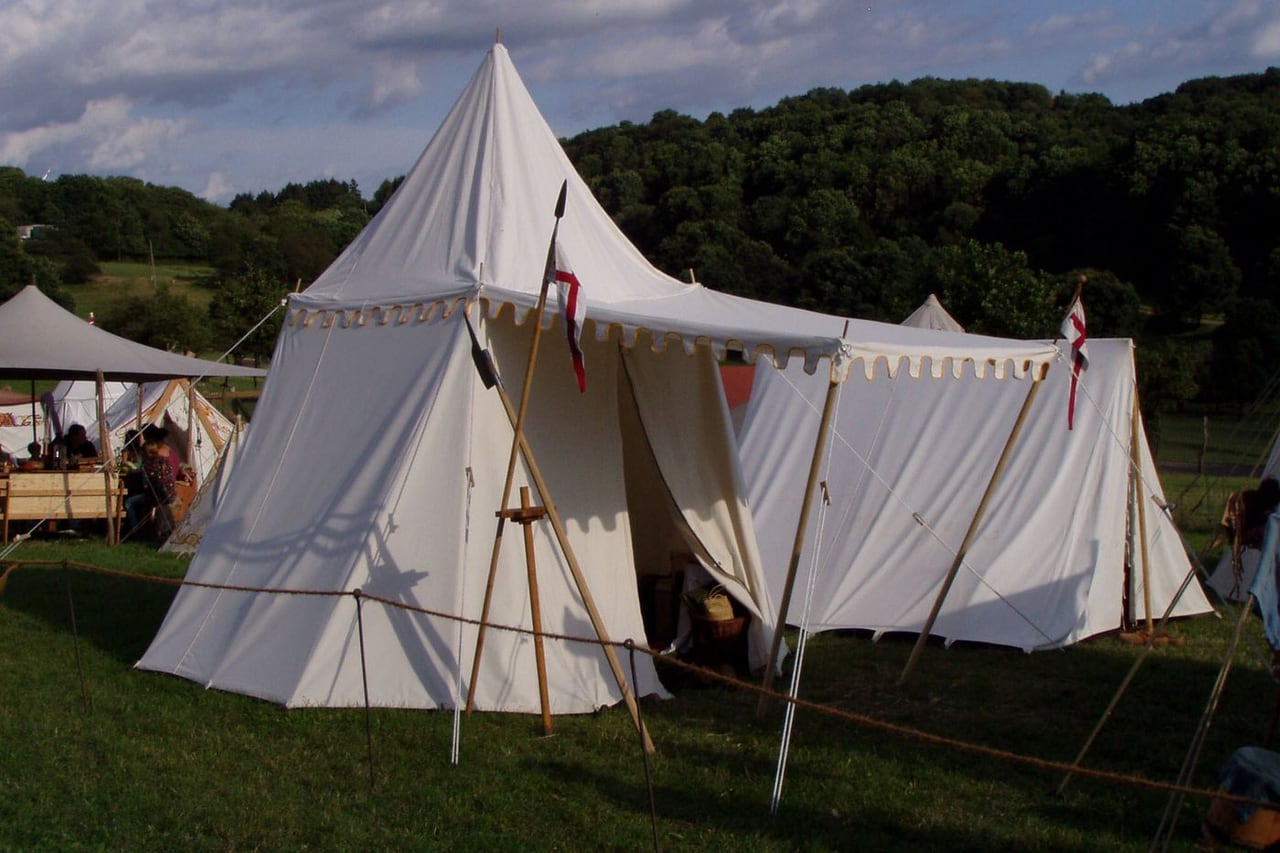
Split the camp into tents the camera will study and tents it will pass. Hero tents carry close-ups and interior scenes, so spend on them: the Tudor Pavilion and the Imperial Medieval Pavilion are lined, valanced and tall enough to light inside.
Background tents fill the frame. Round pavilions and wedge tents give a camp its density for much less money, and a mix of the two looks more real than a single shape repeated. A camp in period illustration is rarely uniform: a few great pavilions, more middling ones, and rows of plain shelters behind.
For deep background, some productions dress only the camera-facing side, or use the smallest sizes further back to force perspective. Tell us your shot plan and we can suggest where the money is best spent. Spare canvas for repairs is cheap insurance on a long shoot, and our treated tent canvas is sold by the metre in the same family of cloth.
| Role | Suggested tent | Canvas | From |
|---|---|---|---|
| Commander’s or royal tent | Tudor Pavilion (M10) | 480 gsm, lined | $1,100 |
| Court or council scenes | Imperial Medieval Pavilion (M11) | 480 gsm, lined | $500 |
| Noble’s tent, interior shots | Regent Medieval Tent (M09) | 440 gsm, lined | $425 |
| Mid-ground camp | Round Medieval Pavilion (M01) | 400 gsm | $260 |
| Soldiers’ lines | Wedge Medieval Tent (M05) | 360 gsm | $175 |
| Early medieval or Norse camp | Viking Tent (M08) | 440 gsm | $210 |
Fire safety and certificates on set
Most sets will have a safety officer who asks for a fire certificate for any fabric structure people work in, especially near practical fires, braziers or hot lamps. Untreated and standard-treated cotton canvas will burn, so if the brief includes fire near the tents, specify fire-retardant cloth when you order.
Which test applies depends on where you shoot. In the US, tent fabrics are commonly assessed against CPAI-84 and drapery against NFPA 701; in Australia the AS 1530 series is the usual reference; in the UK, BS 5438 is one of the standards used for vertically hung textiles. Confirm the exact requirement with your safety officer or the local fire authority before ordering, then ask us for the matching certificate. Our page on fire-retardant canvas describes the cloth.
Ageing and colouring tents for camera
New natural canvas reads very clean and bright on camera. Most art departments want tents that look used: stained at the hem, smoked near the door, faded on the roof. Agree with us whether you want the cloth dyed a darker base shade, or delivered natural for your scenic team to break down on location.
Think about light as well. Natural canvas is translucent, so on a sunny day the inside of an unlined tent glows warm and even, which cinematographers often like. A lined pavilion is darker and more controllable for interior scenes, and the lining hides seams and frame fittings that would otherwise show in a close shot. If a director wants night interiors lit from within, a pale unlined tent will show the light through the walls from outside, which can be an effect in itself.
If your team ages the tents, test the method on an offcut first. Heavy paint stiffens canvas and can crack when the tent is packed, while thin dye washes and dry-brushing keep the cloth flexible. Remember that finishes applied after delivery may affect the fire certificate, so check with the safety officer before treating certified cloth.
Lead times, samples and shipping
Build in time for a sample. A swatch of the exact cloth and colour, and a sample of the valance, will save you from a camp that does not match the costume palette. Standard pavilions are quicker than custom commissions; confirm the current schedule when you enquire.
Freight is the other long pole in the plan. Sea freight from India is the economical choice for a full camp; air is faster for a few urgent hero tents. Customs treatment varies by country, so ask your customs broker how tents are classified and whether any temporary-import arrangement suits the shoot. For Australian productions, the Australian Border Force publishes the import rules.
Should a production buy or hire tents?
Hiring makes sense for a one-off few days. If a series will return to the same camp over several seasons, or the tents need ageing that a hire company will not allow, buying usually works out better, and a well-stored canvas camp can be resold or kept in a prop store. Dry the tents completely before storage; mould ends more production tents than wear does.
Send your designer’s references, the number of tents in each role and the shoot dates through the contact page, or build a one-off shape with the custom tent configurator.
Questions buyers ask
Can you match tents to our production designer’s drawings?
Yes. Send the drawings and references; we will confirm which details we can match and quote standard or custom builds.
Are your medieval tents fire-retardant?
Standard treatment is for rot, mould, UV and water repellency. Fire-retardant cloth is available, and we supply the certificate for the standard it was tested to.
Can we film inside the tents?
The lined pavilions, the Regent, Tudor and Imperial, are the usual choice for interior scenes because they have height and a finished inside surface.
How many people does it take to pitch a hero pavilion?
The Tudor and Imperial pavilions need a crew and come with an installation drawing. Round and wedge tents can be pitched by two.
Can we pitch the tents on a studio floor?
Yes, though pegs will not go into concrete. Plan for weights or a ballast system on every guy point, and check the load each one needs with your rigging team.
Have you supplied productions before?
Yes. Our most recent medieval order was a set of medieval-style pavilions for First Warrior Productions in Sydney, Australia.