Viking and Anglo-Saxon tents: history, design and buying
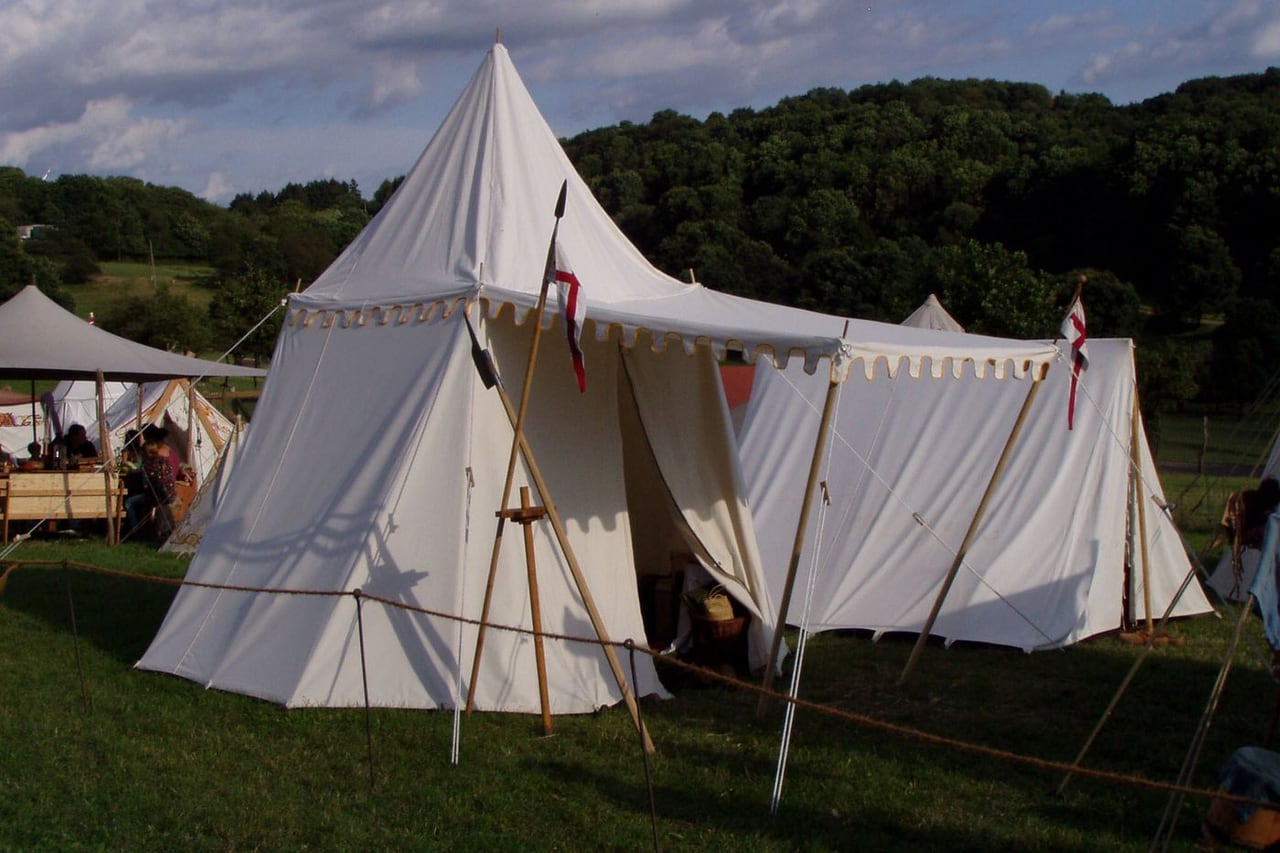
Viking and Anglo-Saxon tents are A-frame tents: two pairs of crossed gable boards joined by a ridge pole, with cloth draped over to the ground. The design follows the timber tent frames found in the Gokstad and Oseberg ship burials in Norway. No Anglo-Saxon tent frame is known to survive, so “Anglo-Saxon tent” is a living-history name for the same basic form. Our Viking tent starts from $210 and our Anglo-Saxon tent from $225, ex-works.
6 min read · Updated
What the Norse ship burials tell us
Two burials carry most of the weight. The Gokstad ship, excavated in 1880 near Sandefjord, and the Oseberg ship, excavated in 1904, are both Viking-age burials from southern Norway, dated to the ninth and early tenth centuries. Among the grave goods were timber parts of tent frames: gable boards, ridge poles and fittings.
The Gokstad gable boards end in carved animal heads, which is where the beast-head terminals on modern Viking tents come from. The tent cloth itself did not survive in a form that shows its cut, so the covering on every reconstruction is an educated guess. Wool is often proposed as the likely cloth; linen is also argued for.
Those frames were found in high-status burials. Whether ordinary people on campaign or at market slept in anything like them is not known, which is worth remembering when a group outfits a whole camp in carved frames.
Why Anglo-Saxon tents look so similar
Living-history groups portraying Anglo-Saxon England have a problem: there is no excavated tent to copy. Some late Anglo-Saxon manuscript drawings include tents, and these are often read as simple ridge or A-frame forms, though drawings of that kind are stylised and hard to measure from. Groups have therefore borrowed the well-documented Norse frame, often with plainer crossed poles in place of the carved heads.
Our Anglo-Saxon Tent follows that convention: carved hardwood crossed head poles at each gable, 400 gsm canvas and hand-worked eyelets. The Viking Tent has a steeper pitch, heavier 440 gsm cloth and carved beast-head terminals, and is built to stand for a full festival season.
Viking tent vs Anglo-Saxon tent
Both are made in six sizes. The main differences are pitch, cloth weight and the look of the gable boards.
| Viking Tent (M08) | Anglo-Saxon Tent (M07) | |
|---|---|---|
| Canvas | 440 gsm treated cotton | 400 gsm treated cotton |
| Gable poles | Carved beast-head terminals | Carved crossed head poles |
| Roof pitch | Steeper | Standard A-frame |
| Eyelets | Hand-worked | Hand-worked |
| Guy rope | Hemp, wooden runners | Hemp, wooden runners |
| Sizes | Six (CETM-06A to 06F) | Six (CETM-05A to 05F) |
| From (ex-works) | $210 | $225 |
How an A-frame tent works
Each gable is a pair of boards crossed near the top, forming an X. A ridge pole rests in the crotch of the two Xs, and the cloth hangs over the ridge and is pegged along both sides. There are no vertical walls, so the cloth itself carries the tension, and the frame stands partly because the canvas holds the boards in place.
The steep sides shed rain and snow well. Headroom is only at the centre, so you sit or kneel near the sides and stand under the ridge. Most of the floor is good for sleeping and storage. Pitch the tent with one gable end into the prevailing wind; side-on, the long flat face catches gusts.
Cloth, colour and finishing
We make both tents in natural treated cotton, which most Viking-age and early medieval groups accept as a stand-in for wool or linen. It breathes, sheds rain once weathered, and can be dyed. Some groups favour a plain undyed tent; others add a dyed or striped cover, which is a matter for your group’s own standards rather than strong evidence either way.
The hand-worked eyelets and hemp rope are there because these tents are bought almost entirely by people who will be inspected. If your group bans visible metal, ask us to confirm every fitting before we cut. Our guide to historically accurate medieval tents has a fuller checklist.
Living in an A-frame at an event
Plan the inside around the low sides. A bed along each side, chests at the foot, and the centre aisle clear is the usual layout. Fires belong outside: there is no smoke hole, and cotton canvas burns. Light the inside with a lantern; a battery LED in a period-looking housing such as our Brass Camp Lantern is accepted at many events after hours, but check your event rules.
Bring a loose groundsheet and hide it under fleeces or straw. Slacken the guys a little in rain, because cotton shrinks as it wets, and tighten them again as it dries.
Looking after the frame and cloth
The carved gable boards are the part people admire and the part most easily damaged. Carry them wrapped, never loose in a trailer with pegs and iron, and oil the timber once a season with a plain oil such as linseed so it does not dry and split. Check the crossing joint each time you pitch; it takes the full load of the ridge and the cloth, and a cracked board should be replaced before the event, not during it.
Dry the cloth fully before storage, even if that means pitching it in the garden the week after an event. Brush off mud when it is dry rather than scrubbing it wet, and never use detergent, which strips the water-repellent finish. A long, narrow bag such as our Pole Bag keeps the ridge pole and stakes together, and a canvas storage bag lets the cloth breathe in a way plastic does not.
Hand-worked eyelets take more care than brass. If one starts to pull, restitch it straight away with waxed linen thread; left alone, it will tear into the cloth under a strong gust.
Buying Viking tents for a group
Groups that order several tents together tend to get a better-looking camp, matched in cloth and colour, and share one freight cost. Tell us how many of each size you need and whether any members need custom lengths. Send the order details through the contact page, or browse the full medieval tents range first.
Questions buyers ask
Is the Viking tent design based on real finds?
Yes. The frame follows the timber tent parts from the Gokstad and Oseberg ship burials in Norway. The cloth cover is a reconstruction, since no cut tent cloth survived.
Is there evidence for Anglo-Saxon tents?
There are manuscript images of tents but no surviving frame. The Anglo-Saxon tent sold for living history borrows the Norse A-frame form.
Can you stand up in a Viking tent?
Under the ridge, yes, in the larger sizes. The sides slope to the ground, so headroom drops quickly away from the centre.
Should a Viking tent be wool?
Wool is often suggested by researchers, but it is costly and heavy as tent cloth. Most groups accept natural cotton canvas.
How long does it take to pitch one?
Two people with some practice can pitch a small A-frame quickly, once the gable boards are paired and the ridge is in place.