Historically accurate medieval tents: what the evidence shows
A historically accurate medieval tent follows the shape, construction and decoration shown in the evidence for a particular period and region, mostly manuscript illuminations and paintings, plus a few archaeological finds such as the Norse ship burials. Very little medieval tent cloth survives, so every reconstruction involves judgement. The details that matter most are silhouette, visible seams and fixings, rope and pegs, door closures and keeping modern kit out of sight.
6 min read · Updated
What evidence survives for medieval tents
Almost no medieval tent survives complete. Cloth rots, and tents were used until they wore out. What we have falls into three kinds of source, and each has limits.
Archaeology gives the most solid evidence for the early period. The Gokstad and Oseberg ship burials in Norway, excavated in 1880 and 1904, contained timber tent frames, and those finds sit behind most Viking-age tent reconstructions today. Our guide to Viking and Anglo-Saxon tents covers them in detail.
For the high and late Middle Ages, the main evidence is pictures. Illuminated manuscripts such as the thirteenth-century Morgan Bible (often called the Maciejowski Bible) and the many fifteenth-century copies of Froissart’s Chronicles show round, oval and bell-ended pavilions in camps and at tournaments. Written records such as royal household accounts and inventories add details on cloth, rope and the people who looked after tents, though they rarely describe a shape.
Pick one period and region and stay with it
The most common accuracy mistake is mixing centuries. A ninth-century A-frame with carved gable heads and a fifteenth-century striped pavilion with a dagged valance belong to different worlds, and a knowledgeable visitor will notice. Decide which period and region your group portrays and look for images from that window.
Artists also drew what they knew, so a manuscript painted in Flanders in 1470 may show Flemish tents even when the story is set in ancient Troy. That is useful: it tells you what tents looked like where and when the picture was painted, which is the date to use.
Fabric: linen, hemp, wool and the cotton compromise
Medieval tent cloth was most likely linen or hemp canvas in western Europe, and wool is often suggested for Norse tents. Cotton was known and traded in medieval Europe, but it was not the normal tent cloth in the north. Modern living-history tents are nonetheless made almost entirely in cotton canvas, because it is affordable, breathes, takes treatment well and looks right from a few paces.
We cut our medieval tents in natural treated cotton, from 360 to 480 gsm depending on the pattern. Many societies accept cotton as long as it is natural in colour or dyed in a period-plausible shade and has no visible synthetic sheen. If your group requires linen, raise it at the quote stage so we can discuss cost, weight and how linen behaves in wet weather.
Construction details that look period-correct
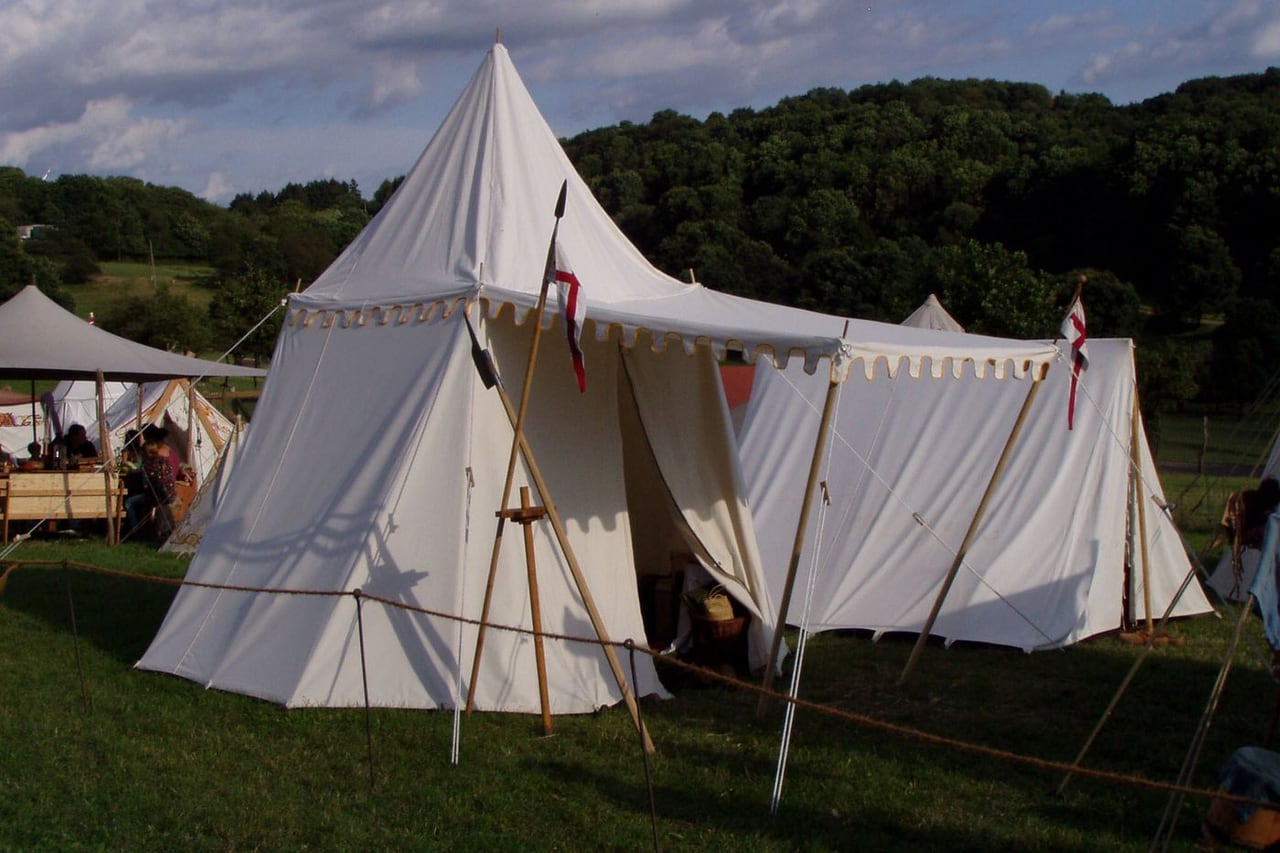
Silhouette carries most of the effect, and after that the small things people see up close. These are the points we are asked about most often by groups who will be inspected:
- Eyelets: hand-worked eyelets look right; brass grommets are a modern tell. Our Anglo-Saxon Tent and Viking tent have hand-worked eyelets as standard.
- Rope: natural fibre such as hemp, never coloured synthetic. Our wedge and A-frame tents ship with hemp guy rope and wooden runners.
- Pegs: wooden, or iron forged to a simple period shape. Hide steel pegs if you must use them in hard ground.
- Closures: ties, toggles or loops in place of zips and hook-and-loop tape.
- Seams: flat-felled seams in the canvas are consistent with period sewing. Visible machine stitching is generally accepted; the stitch line matters less than the seam layout.
- Valance: dagged or scalloped edges appear widely in later medieval images, but not in every period, so check yours.
How were medieval pavilion roofs held up?
Pictures show the outside of a pavilion clearly and the inside almost never. That leaves a real gap in the evidence: how was a wide round roof held out to its full diameter? Modern makers use two main answers. Some fit a wooden spoked wheel near the top of the centre pole, so the roof rests on spokes like an umbrella. Others hold the roof out with the walls and wall poles alone, and let guy lines from the eave do the work.
Both pitch well, and both are used at events with strict standards, because nobody can prove either wrong. If your group has a view, tell us, and we will build to it. If it does not, choose on practical grounds: a spoked roof holds its shape better in wind and on large diameters, while a roof without spokes packs smaller and has fewer parts to lose.
The same caution applies to wall height, door shape and the number of guy lines. Painters simplified, and a tent drawn with four guy lines may well have had twelve. Use the pictures for silhouette and decoration, and let structure follow what stands up in a modern field.
Colours, stripes and decoration on medieval tents
Illuminations show plenty of undyed cloth, and also striped, parti-coloured and heraldic tents with pennons on the finial. Whether painters exaggerated colour for effect is debated, but decorated tents for people of rank are well attested in pictures. Stripes were made by piecing coloured panels together, which is how we would make them today too. Our guide to painted and heraldic canvas covers methods and care.
Hiding modern kit at a reenactment
Accuracy at events is usually about what can be seen from the public line. A groundsheet keeps your bedding dry; cover it with rugs, straw or rush matting and tuck the edges in. Use period-looking boxes for modern camping gear, and keep cool boxes and phones under a cloth. Many events expect nothing modern to be visible during public hours, so check the rules before you pack.
Ordering a tent to your group’s standard
Send us the images your group works from, with the manuscript or painting named, and tell us which details your authenticity officer checks. We will say plainly which elements we can match and which would need a custom build. For anything outside the standard shapes, the custom tent configurator is the place to start, or write to us through the contact page.
Questions buyers ask
Were medieval tents really made of canvas?
The word canvas comes from the Latin for hemp, and linen and hemp canvas were the likely cloths in western Europe. Modern reproductions use cotton canvas as an accepted compromise.
Is a cotton canvas tent acceptable for reenactment?
At most events, yes, if it is natural or plausibly coloured and the visible fittings are period. Some groups set stricter rules, so check with yours before ordering.
Did medieval tents have floors?
There is little evidence for sewn-in floors. Reenactors use a loose groundsheet hidden under rugs, straw or rushes.
What is the most period-correct pavilion shape?
It depends on the century. Round and bell-ended pavilions are common in later medieval illuminations, while A-frame tents follow the Viking-age finds.
Can you copy a tent from a specific manuscript?
We can work from an image and quote a custom build. Send the source and any measurements you have, and we will say what can be matched.
Did medieval pavilions use a spoked wheel at the top?
Nobody knows for certain, because illuminations rarely show the inside of the roof. Many modern makers use one because it holds a wide roof in shape.