Medieval tent sizes and shapes explained
Medieval tents come in seven basic shapes: round, square, rectangular, oval, wedge, double bell wedge and A-frame. Shapes with vertical walls (round, square, oval, rectangular) give usable floor to the edge, while wedge and A-frame tents only give full headroom along the ridge. Size by furniture rather than people, and check pole lengths against your vehicle before you choose.
6 min read · Updated
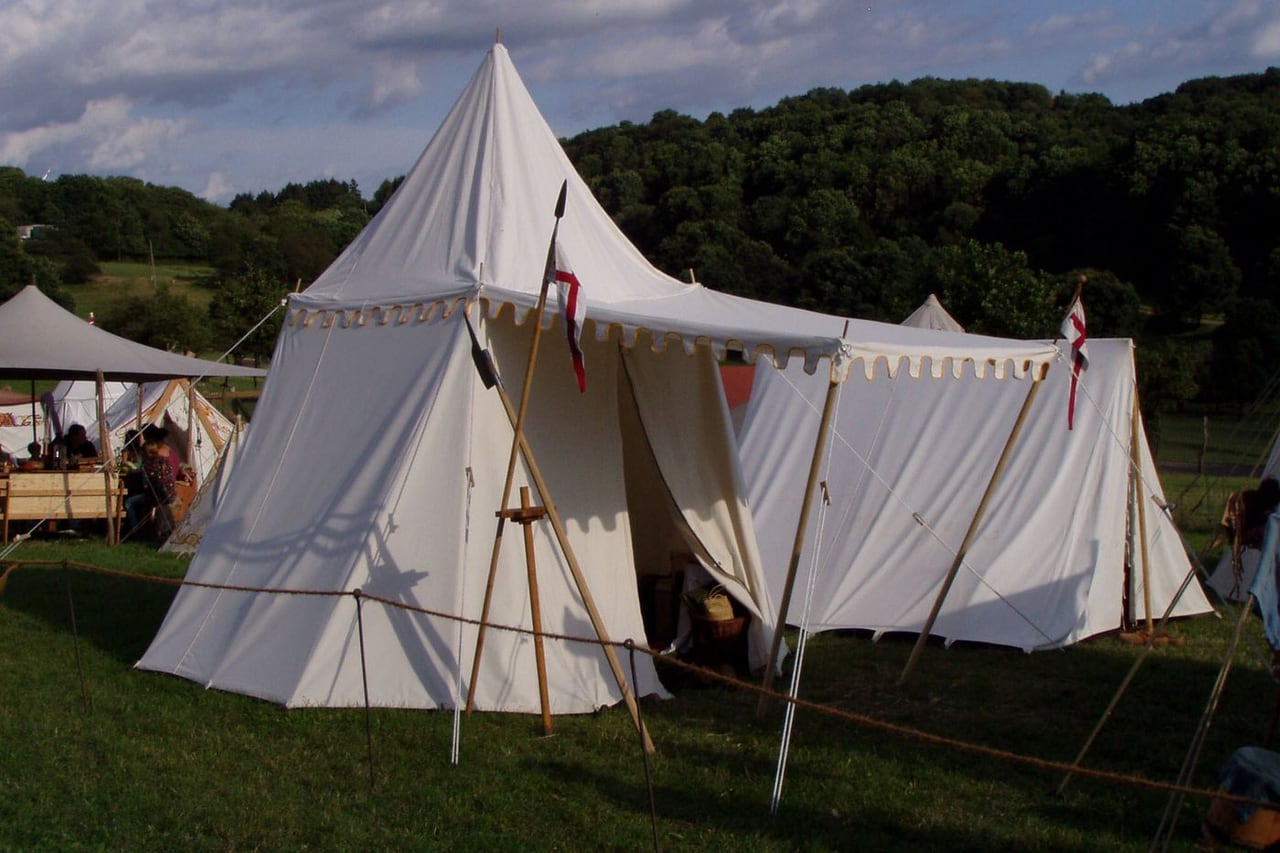
The seven medieval tent shapes
Every medieval tent we make is a variation on two ideas: a roof held up by poles over straight walls, or cloth draped over a ridge to the ground. The first group are pavilions; the second are wedges and A-frames.
Pavilions include the round tent on a single centre pole, the Oval Medieval Tent on two poles, the square tent on a four-post frame with a pyramid roof, and the rectangular tent on twin poles with a ridge. Wedge-type tents include the plain wedge, the double bell wedge with a rounded end at each gable, and the Viking and Anglo-Saxon A-frames with crossed gable poles.
| Shape | Plan | Walls | Usable floor | Standard sizes |
|---|---|---|---|---|
| Round (M01) | Circle | Vertical | To the edge | Six |
| Oval (M04) | Stretched circle | Vertical | To the edge | Six |
| Square (M02) | Square | Vertical | To the edge, easy to furnish | Six |
| Rectangular (M03) | Long rectangle | Vertical | To the edge, extendable | Six |
| Wedge (M05) | Rectangle | None | Full height at ridge only | Six |
| Double bell wedge (M06) | Rectangle with round ends | Low walls in bells | More than a plain wedge | Two |
| A-frame (M07, M08) | Rectangle | None | Full height at ridge only | Six each |
Why shape matters more than the stated floor area
Two tents with the same footprint can feel completely different inside. In a walled pavilion, you can stand at the wall, set a bed against it and hang things from it. In a wedge or A-frame, the outer strip of floor sits under a low slope, useful for sleeping or storage and nothing else.
Round tents waste a little floor at the curve when you furnish with square pieces. Square and rectangular tents avoid that, which is why encampments that want neat rows of furnished tents buy squares. The oval sits between: generous, no corners, and more graceful than a rectangle.
What size medieval tent for each use
These are rules of thumb from what buyers tell us works, not fixed limits:
- Sleeping only, one or two people: a wedge, an A-frame or the smallest round pavilion.
- Living in for a week, two people: a round or square pavilion with room for a bed, a chest, a small table and two stools.
- Family or shared tent: an oval or larger round, or a double bell wedge if you want a lighter pack.
- Meals and gatherings for a group: a Rectangular Medieval Tent, which can be lengthened in two-metre bays to suit a long table.
- Court, ceremonies or a hundred people standing: the Imperial pavilion, which is made in three sizes.
Height, poles and transport
Tall tents look better and need longer poles. The centre pole of a large round pavilion or a Tudor pavilion is long timber, and that is what decides whether you need a van or a trailer. Ask for pole lengths on the size sheet, and ask whether a pole can be made in jointed sections with a sleeve if you travel by car.
Height also affects wind. A tall roof catches more of it, so taller tents need more guy lines and careful pegging. Our guide on how to pitch a medieval tent covers guying and tension.
How our medieval tent size codes work
Each shape has a family of size codes. The round pavilion runs from CETM-01A to CETM-01F, the oval from CETM-03A to 03F, the wedge from CETM-07A to 07F, and so on. The double bell wedge comes in two sizes, the Regent and Tudor pavilions in four, and the Imperial in three. The letter rises with size.
Catalogue prices are for the smallest size of each shape, so a round pavilion is from $260 and a rectangular tent from $471 ex-works. Request the size sheet for floor dimensions, wall heights and prices by code.
Planning a medieval camp layout
A camp looks right when its tents look related, even though period images show a mix of shapes and sizes within one camp. What ties them together is a shared cloth colour, a consistent valance style and a clear hierarchy, with the largest and most decorated tent in the middle or at the head of the row.
For a society encampment, a practical pattern is one large shared tent for meals and wet weather, a round or square pavilion for each household, and wedges for single members and storage. A rectangular or oval tent works well as the shared space because it holds a long table. Pitching tents door to door around a shared fire area, with guy lines kept clear of the walkways, is both safer and better looking than a straight line.
If two tents need to connect, for example a sleeping tent behind a day tent, ask us at the quote stage. Joining canvas well takes planning at the cutting table, and is not something to improvise with rope in the field.
Decide the camp’s colour and valance before anyone orders, so tents bought a year apart still match. Keep the cloth reference and trim details from the first order and quote them on every repeat order, so new tents can be matched as the group grows.
Fitting tents to your plot
At events, pitches are often allocated by area, and guy lines count. A round pavilion’s guys spread beyond the walls in every direction, so the footprint you need is larger than the tent. Wedges and A-frames guy mainly along their sides, which suits tight rows.
If a standard size will not fit your plot or your brief, the custom tent configurator takes your dimensions. For anything else, send your plot size and use through the contact page and we will suggest a shape.
Questions buyers ask
What is the most popular medieval tent shape?
The round pavilion. It is the simplest pavilion to pitch and the shape most people recognise.
Which medieval tent gives the most usable space?
For a given footprint, square and rectangular pavilions, because vertical walls and corners let you furnish right to the edge.
How much space do guy lines need?
Allow a margin beyond the walls on every guyed side. The size sheet and installation drawing give the peg positions for each code.
Can a rectangular medieval tent be made longer?
Yes. It can be extended in two-metre bays to order.
What is a double bell wedge tent?
A wedge tent with a semicircular bell at each end, which adds floor space for little extra pitching effort.
Should I buy one large tent or two smaller ones?
Two smaller tents give privacy and are easier to carry and pitch on a small plot. One large tent is cheaper per square metre of floor and better for meals and gatherings, so many households end up with one of each.