Army tent types explained: ridge, frame, command and storage
Armies use a small family of tent types: ridge tents for sleeping small groups, framed tents for accommodation and offices, command post tents for operations, wide-span shelters for vehicles and stores, and individual shelter sheets. Each is defined by its frame, its fabric and how quickly a trained team can pitch it. The right choice depends on how long the tent stays up, how far it travels and the climate it faces.
6 min read · Updated
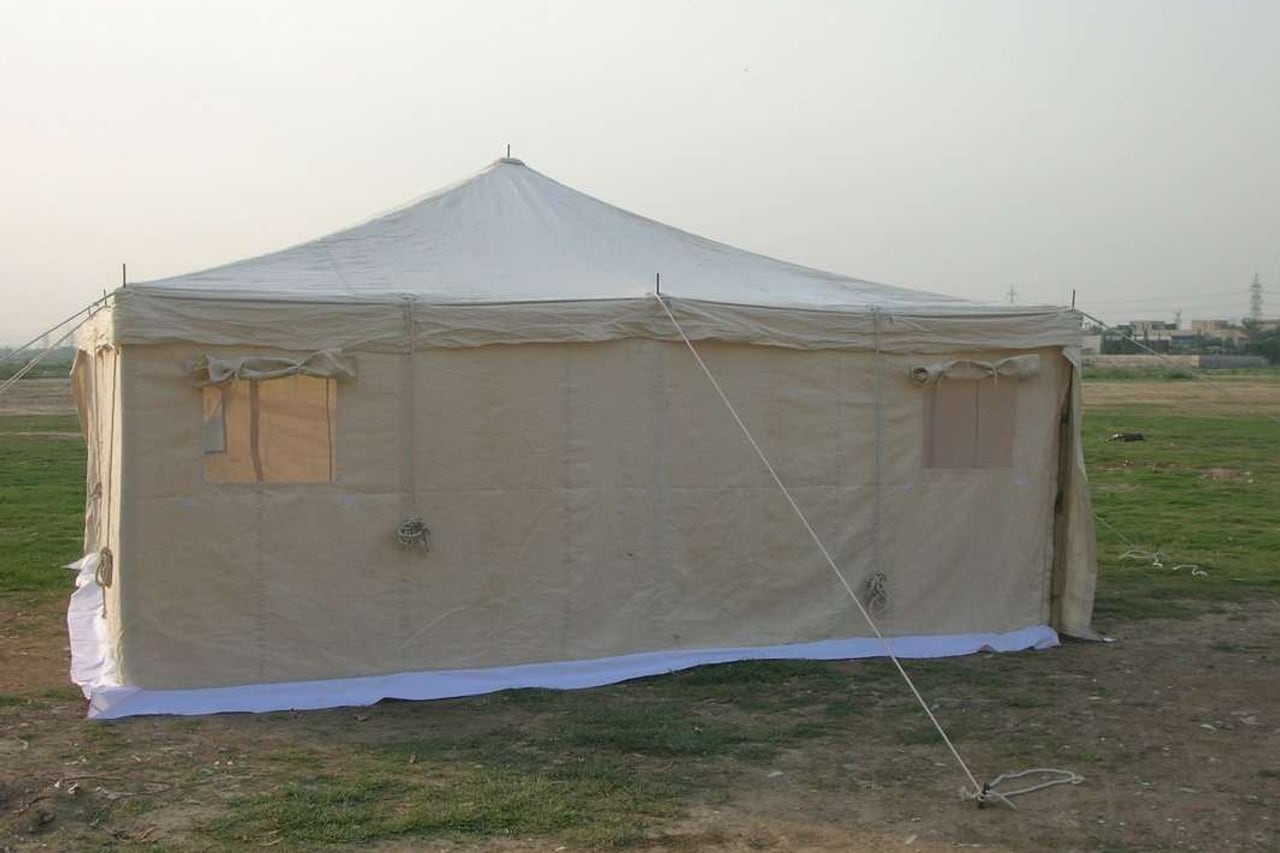
How military tents are classified
Military tentage is usually grouped by job rather than by shape. A quartermaster thinks in terms of accommodation, working space, storage and individual shelter, and then picks a structure that suits how mobile the unit is. A patrol carries its shelter; a battalion headquarters moves by truck; a forward base may stand in one place for a year.
Within each job, the trade-offs are the same: weight against floor area, speed of pitching against stability, and canvas against coated synthetics. You can see the main types we build in our army and military tents section.
| Type | Typical use | Structure | Fabric | Price |
|---|---|---|---|---|
| Ridge tent | Sleeping 2 to 4, short stays | Two uprights and a ridge pole | 400 gsm treated cotton canvas, double fly | On enquiry |
| Frame tent | Accommodation for 10, long stays | Galvanised clear-span frame | 440 gsm treated canvas | On enquiry |
| Command post | Operations, briefing, offices | Galvanised tubular frame | 440 gsm FR-treated canvas, blackout lining | On enquiry |
| Storage shelter | Vehicles, stores, workshops | Hot-dip galvanised wide-span frame | 650 gsm PVC-coated polyester | On enquiry |
| Basha sheet | Individual shelter | Tied to trees, poles or rifles | 210D ripstop nylon, 2,000 mm PU | On enquiry |
Ridge tents: the oldest pattern still in service
The ridge tent is two uprights, a ridge pole and a canvas roof pulled tight by guy lines. Armies keep it because it is light for its floor area, it needs no specialist parts and anyone can repair it with a needle and thread. A double fly adds an air gap that helps in heat and cold alike.
Our Army Ridge Tent for four uses 400 gsm treated cotton canvas, galvanised steel poles and a sewn-in sod cloth, which is a strip of fabric along the base of the walls that is weighted with earth or turned inward under the groundsheet to stop draughts.
The weakness is headroom. You can only stand along the centre line, and the guy lines take up a lot of ground, which matters on a crowded camp layout.
Frame tents for accommodation
A frame tent hangs its canvas from a steel or aluminium frame with vertical or near-vertical walls. The floor is usable right to the edges, there is no centre pole in the way of bunks, and the tent stands with far fewer guy lines. This makes frame tents the standard choice for semi-permanent camps, training areas and border posts.
Our Frame Tent for ten uses a hot-dip galvanised clear-span frame, 440 gsm treated canvas, a PVC floor tray and mesh-screened windows. It takes longer to pitch than a ridge tent and moves by truck rather than by hand, and in return people can live in it for a season.
Frame tents also take accessories well: liners for cold weather, partitions to divide sleeping from storage, and floor trays that keep out water and insects. If the tent will stand on one site for months, consider a raised timber or composite floor under the tray, which keeps bedding dry after heavy rain.
Command post tents
A command post tent is a framed working tent with full standing height, a blackout liner so light does not show at night, and sealed ports for power and data cables. Doors at both ends let tents be joined into a complex. The fabric is usually flame-retardant treated because the tent is full of electrical equipment and people.
Our Command Post Tent pitches in under an hour with four people. We cover the design choices in more depth in our guide to command post and frame tents.
Storage and vehicle shelters
Stores, workshops and vehicle parks need wide clear spans and doors a truck can drive through. These shelters use PVC-coated polyester rather than canvas because the fabric is fully waterproof, easy to clean and stable over long spans. Our Military Storage Shelter has roll-up gable doors and can be ground-anchored or ballasted on hardstanding.
Read our guide to storage shelters and warehouse tents before sizing one, because snow and wind loads drive the frame specification.
Basha sheets for individual shelter
A basha is a lightweight sheet with tie points around its edge and across its centre. A soldier pitches it as a lean-to, an A-frame over a hammock or a cover for a stretcher. It is the cheapest item in the shelter system and often the most used. Ours is 210D ripstop nylon with a 2,000 mm polyurethane coating and nineteen reinforced tie points, printed in camouflage.
Bashas are bought in large numbers and replaced often, so the details that matter are the ones that wear: the stitching at the tie points, the seam tape and the coating’s resistance to cracking when folded cold. Ask for a sample and fold it tightly a few dozen times before you approve it. Our Camouflage Basha Sheet is priced on enquiry.
How to choose an army tent type
Start with three questions: how long will the tent stand, how will it be moved, and what weather must it survive? Short stays with movement on foot point to ridge tents and bashas. Long stays with vehicle transport point to frame tents. Anywhere with heavy snow, the frame and fabric must be specified for the load, as we did for the cold-weather tents we have supplied to the Indian Army in Ladakh.
Camouflage is a separate decision. Plain olive is cheaper and easier to repair; printed patterns are specified where concealment matters. Our camouflage fabric guide covers the options. When you have a specification, send it through our contact page for a compliance sheet and a sample.
Questions buyers ask
What is the most common army tent type?
For accommodation in established camps, framed tents are the most widely used today. Ridge tents remain common for small groups and training because they are light and simple.
Why do armies still use cotton canvas?
Canvas breathes, so it suffers less condensation than coated synthetics, and it can be repaired by hand in the field. It is heavier, which is why coated fabrics are used where weight or wide spans matter more.
What is a sod cloth?
A strip of fabric sewn along the bottom of the walls. It is turned inward under the groundsheet or weighted with earth to block draughts and keep out water and insects.
Can army tents be made in plain colours instead of camouflage?
Yes. Olive, khaki and sand are common plain colours, and many buyers choose them for training and non-tactical use because they cost less.
How long does a military canvas tent last?
With treated canvas, sound storage and regular repair, many years of intermittent use. Continuous pitching in strong sun shortens fabric life, and storing a tent damp is the quickest way to ruin it.
Do you build to a defence specification?
We build to the specification in your tender document and return a clause-by-clause compliance sheet before sampling. Any deviation is stated in writing.