Command post and frame tents: specifying a working tent
Command post and frame tents are framed structures with vertical walls and full standing height, used as headquarters, offices, briefing rooms and accommodation. The main choices are frame material and span, fabric (usually treated canvas, often flame-retardant), blackout lining, cable entries, linking between tents and how many people it takes to pitch. Specify for the length of deployment and the climate, and make sure several tents can be joined.
6 min read · Updated
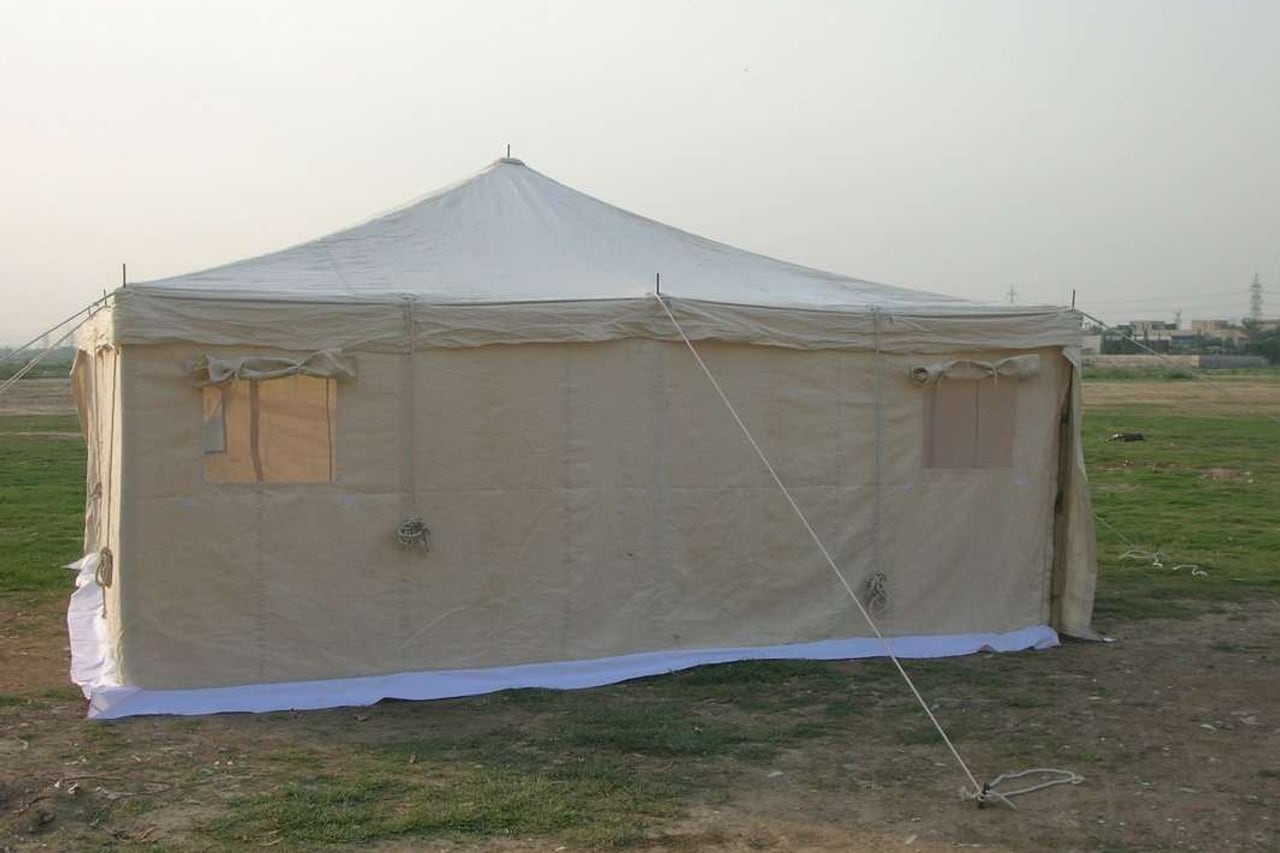
What a command post tent does
A command post tent is a working room. It holds people, tables, screens, radios and maps for long hours, often at night and in poor weather. It must be quick to set up, easy to join to other tents and dark when needed so no light shows outside. Frame tents for accommodation share most of the same design, with bunks instead of desks.
Our Command Post Tent uses 440 gsm FR-treated canvas over a galvanised tubular frame, with a blackout inner lining and sealed cable entry ports at both ends. Four people pitch it in under an hour.
Frame design: tubular, clear-span and modular
Military frame tents come in a few basic designs. Tubular steel frames with push-fit or pinned joints are rugged and inexpensive, and parts can be repaired or replaced in the field. Clear-span frames, using larger sections and trussed or arched rafters, leave the whole floor free of internal poles. Modular systems use standard bays so tents can be extended by adding sections.
Our Frame Tent for ten uses a hot-dip galvanised clear-span frame so bunks can be laid out freely. For much larger spaces, an aluminium clear-span hall such as our Exhibition Clear-Span Hall extends in three-metre bays.
| Frame | Strengths | Limits |
|---|---|---|
| Tubular galvanised steel | Cheap, rugged, field-repairable | Heavier; spans limited |
| Clear-span galvanised steel | No internal poles, usable floor | More parts; truck transport |
| Aluminium clear-span | Long spans, lighter per metre | Higher cost; needs trained crew |
| Modular bay systems | Extendable; standard spares | Joints need care to stay weathertight |
Fabric, lining and fire safety
Treated cotton or poly-cotton canvas is the usual outer for command and accommodation tents because it breathes, stays quieter in wind than coated fabrics and can be repaired with a needle. A canvas of around 440 gsm gives a good balance between weight and durability for repeated pitching.
Because these tents house electrical equipment and many people, the fabric is often flame-retardant treated. Specify the standard the buyer requires and ask for test certificates for the production lot. The blackout lining does two jobs: it keeps light in at night and it insulates. A lining that hangs with an air gap from the outer fabric reduces condensation and moderates temperature.
A tent full of people and electronics gets hot quickly, even in mild weather. Plan cooling or ventilation from the start, with ducting ports placed where the air conditioning or heaters will stand outside. In cold regions, an insulated lining and a sealed floor tray make heating far more effective; the cold-weather tents we supplied to the Indian Army in Ladakh taught us how much heat goes into the ground.
Cable ports, windows and doors to specify
Retrofitting these after delivery is difficult and rarely weathertight, so include them in the specification.
- Sealed cable entry ports at each end, so power and data enter without leaving a gap.
- Windows with mesh and blackout covers that close from inside.
- Doors at both ends, ideally sized and positioned to match other tents for linking.
- Internal attachment points for lights, cable runs and map boards.
- Ducting ports where heating or air conditioning will be used.
Linking tents into a complex
Headquarters, field hospitals and training camps often join several tents. Matching door sizes and a linking section or connecting collar let people move between tents without going outside. Plan the layout before ordering: which tents connect, where generators and vehicles stand, and where guy lines and drainage will run.
When tents link, consistent frame heights and fabric colours matter. Order linked tents from the same supplier and, where possible, the same production run.
Drainage deserves attention in a linked complex. Where two roofs meet, water collects at the join, so the linking section needs its own fall or gutter. Floor trays should be at the same level so water cannot run from one tent into the next, and the whole complex should sit on ground that falls away from the doors.
Pitching time and crew
A tender often states a maximum pitching time for a set number of trained people. Pitching time depends on the frame design, the number of parts and how well they are marked. Colour-coded or numbered frame parts, captive fittings that cannot be dropped and clear pictorial instructions cut pitching time a great deal. Ask any supplier to demonstrate pitching on the sample, and time it.
Packing affects pitching time too. Frame parts packed in labelled bags by assembly stage, canvas folded so it unrolls in the right direction, and pegs and tools in a separate bag all save minutes on site. Specify bag sizes and weights that two people can lift into a truck, and markings that tell the crew what is inside without opening the bag.
Specifying and ordering a command post tent
Before you send an enquiry, decide how long the tents will stand, how they will travel, the climate, how many will link and what equipment and power they will carry. Our army and military tents section shows the standard designs; the Command Post Tent and the Frame Tent for ten are priced on enquiry, ex works. Linings, ports, packing, freight and duties change the final cost.
For a tender, send the specification through our contact page and we will reply with a compliance sheet. For a non-standard size, start with our custom tent configurator. Our guide to tent procurement for government tenders covers the purchasing side.
Questions buyers ask
What is the difference between a command post tent and a frame tent?
A command post tent is a frame tent fitted out as a working space, usually with a blackout lining, cable ports and linkable doors. A frame tent for accommodation uses a similar structure with fewer working features.
How many people does it take to pitch a command post tent?
Our Command Post Tent pitches in under an hour with four people. Pitching time for any tent depends on crew training and site conditions.
Can command post tents be air conditioned?
Yes, if they have ducting ports and an insulating lining. Plan the power and ducting positions when you specify the tent.
Are command post tents flame retardant?
Often, because they contain electrical equipment and people. Ours uses FR-treated canvas; confirm the standard your buyer or authority requires.
What canvas weight is used for frame tents?
Around 440 gsm treated canvas is common for command and accommodation tents, as in ours. Heavier cloth lasts longer but adds weight and cost for each pitch.
Can I link different sizes of tent?
Yes, if the door openings and linking sections are designed to match. Specify linking at the outset rather than adapting later.