UNHCR-type family tent specification explained
A UNHCR-type family tent is a double-fly canvas shelter for one displaced household, typically around 16 m² of covered floor, with a pole set, groundsheet and repair kit packed in one bale. The specification fixes fabric, floor area, ventilation, packing and the tests a sample must pass. Always work from the current official document issued by the agency, because these specifications are revised and the version in your tender is the one that counts.
6 min read · Updated
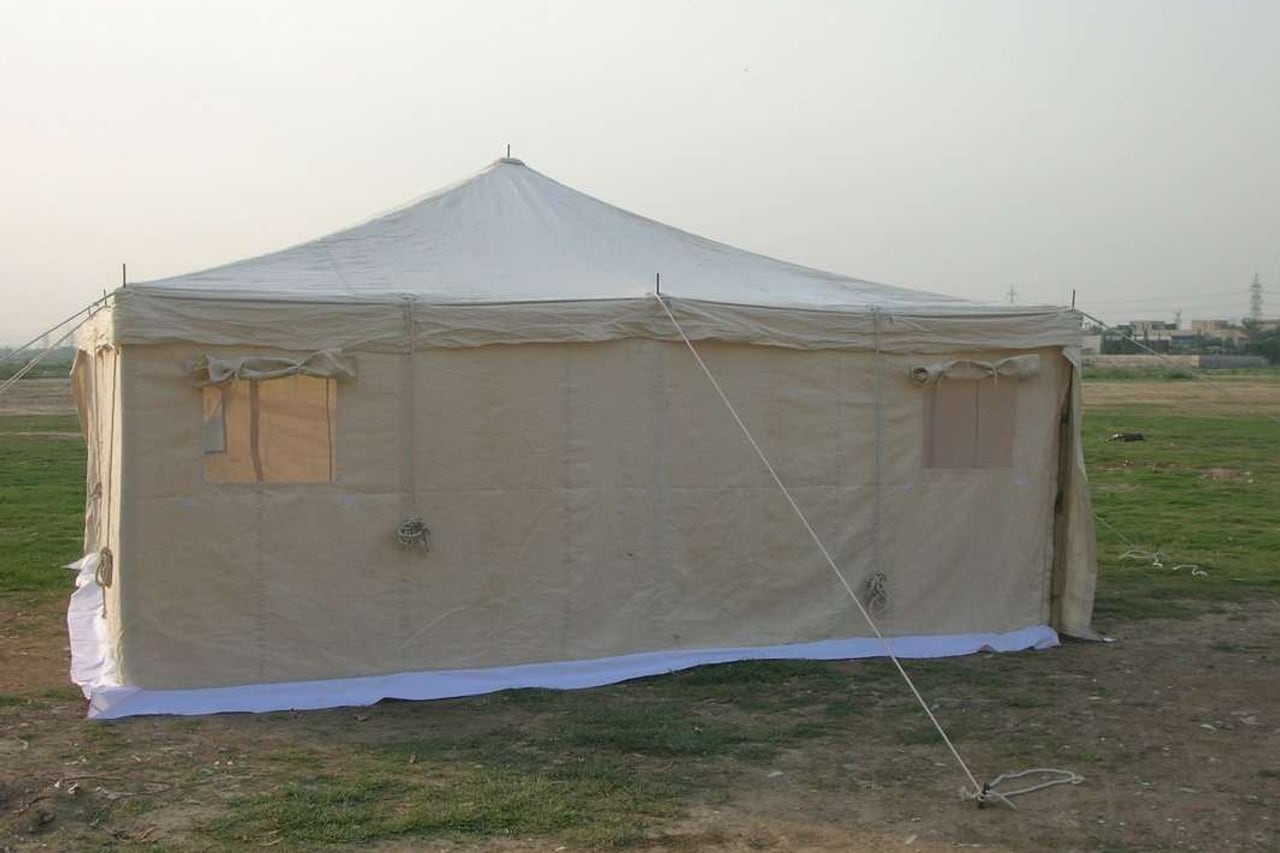
What a UNHCR-type tent means
UNHCR publishes technical specifications for the core relief items it buys, and the family tent is the best known of them. Other agencies, governments and NGOs borrow the same pattern because it has been proven in the field, field staff already know it, and it makes one supplier easy to compare with another. A buyer who asks for a “UNHCR-type” tent usually means a tent built to that pattern. It does not mean a tent UNHCR itself bought.
A manufacturer can build to the published pattern without being an approved supplier to the agency itself, so ask which one you are being offered. We make our Family Relief Tent to the familiar double-fly pattern. For a tender, we build to the full specification document you send us, and we do not work from a summary of it.
Specifications are revised as field experience comes back. Fabric weights, packing dimensions and test methods change between editions, so copy the exact edition number into your purchase order and keep the document on file for inspection.
The parts of a family tent specification
Most family tent specifications are organised the same way. Reading them section by section shows where suppliers tend to cut corners.
| Element | What the specification fixes | What to check on a sample |
|---|---|---|
| Floor area and height | Minimum covered living area, centre and side wall heights | Measure the pitched floor yourself; do not rely on the label |
| Outer fly | Fabric type and weight, water repellency, rot and UV treatment | Lab report for weight and water penetration on the actual lot |
| Inner tent | Fabric, door and window positions, mesh screening | Mesh fitted on every opening; door zips or ties work freely |
| Groundsheet | Material, weight, how it joins the inner tent | Upturned edges or a sewn-in bathtub, no open seams at corners |
| Poles and pegs | Material, coating, diameter, number and length | Galvanising coverage, pegs that do not bend in hard ground |
| Ventilation | Number and size of vents, smoke outlet position | Vents open and close, do not admit driven rain |
| Packing | Bale size, weight, markings, number of pieces | Weigh and measure a bale; count the parts against the list |
| Accessories | Repair kit, guy ropes, instructions, carry bags | Pictorial instructions that need no language |
Floor area per person and the Sphere standard
The Sphere Handbook, the humanitarian sector’s common reference for minimum standards, sets a guideline of at least 3.5 m² of covered living area per person in most climates. A 16 m² family tent therefore houses roughly four to five people on that measure. Larger households need two tents or a bigger unit, and Sphere notes that more space is needed in cold climates where people cook and spend more of the day indoors.
Covered area is not the same as the footprint of the guy lines, and it is not the same as the area under the vestibules if those are too low to stand or sleep in. When you compare quotes, compare usable covered floor at a stated height. Two tents described as “16 m²” can differ by several square metres of liveable space.
For a fuller treatment of space planning across a camp, read our guide to planning shelter for disaster response.
Why family tents use poly-cotton canvas
Family tents are made from cotton or cotton-polyester canvas because it breathes. A family of five cooking, sleeping and drying clothes inside a sealed plastic shelter produces heavy condensation; a woven canvas lets most of that moisture pass while still shedding rain once the fibres swell. The polyester content adds tear strength and reduces shrinkage. Our family tent uses 380 gsm cotton-polyester canvas for the outer fly.
The fly fabric must be treated against rot, mould and ultraviolet light, and many specifications also set a minimum water penetration resistance measured by hydrostatic head under a method such as ISO 811. Ask for the test report on the lot that will be shipped, not a generic report from a previous year. If you need to compare canvases in detail, our canvas and tent fabrics range lists the weights and treatments we work in.
Fire behaviour is a separate question. Some agency specifications call for flame-retardant treatment and others do not. Follow the document in front of you and ask for the test certificate against the standard it names.
The double fly, groundsheet and ventilation
The double fly defines the pattern. An outer fly sheds rain and sun; an inner tent, hung a hand’s width beneath it, keeps condensation and drips off the occupants and creates an air gap that moderates temperature in both directions. In hot regions that gap keeps the tent bearable at midday.
The groundsheet is usually a heavy woven or PVC-coated sheet stitched or toggled to the inner tent with upturned edges. It takes more abuse than any other part. A spare ground sheet tarpaulin under the tent is cheap insurance on stony ground.
- High and low vents on opposite ends so warm, damp air can leave and fresh air can enter.
- A protected opening for a stove flue where the specification allows heating.
- Mesh on every window and door to keep out mosquitoes and flies.
- Privacy partition or inner curtain, which many families value more than any other feature.
Packing, marking and the repair kit
A family tent travels by sea, road and finally on someone’s back, so the bale specification needs as much attention as the tent. It fixes the maximum weight and volume, the wrapping, the number of bales per pallet and the markings in the agency’s required languages. Get any of it wrong and a container that should hold a planned quantity holds fewer, and the receiving warehouse rejects the shipment.
The repair kit is usually a cloth patch, a needle, thread, spare cord and spare pegs. It looks trivial, yet it is what lets a tent last its expected life in a camp. Check it is in every bale, not every tenth.
How we handle a family tent order
We start with your specification and send back a clause-by-clause compliance sheet with any deviations stated plainly. Then we make a pre-production sample from the actual fabric lot, so your inspector tests what will be shipped. Our Family Relief Tent is priced on enquiry, ex works; specification changes, packing requirements, freight and duties all move the landed cost.
If you are preparing a tender or framework agreement, send the document through our contact page and say how many units, where they are going and by when. For cold destinations, see our Winterised Relief Tent, which adds a liner, a snow-rated frame and a stove port.
Questions buyers ask
Is a UNHCR-type tent the same as a tent approved by UNHCR?
No. “UNHCR-type” describes a tent built to the agency’s published pattern. Approval as a supplier is a separate process run by the agency, so ask any manufacturer which one they are offering.
How many people does a 16 m² family tent house?
On the Sphere guideline of at least 3.5 m² of covered living area per person, about four to five people. In cold climates the guidance calls for more space per person.
Where do I find the current specification?
From the agency that issues it, through its procurement or supply pages. Use the edition named in your tender, because older copies circulate widely online.
Can the tent be customised?
Yes, within the specification. Colour, markings, door positions and packing can change, but any deviation from the tender document should be agreed in writing before production.
How long does a family tent last in the field?
It depends heavily on sun, wind and how the family maintains it. Treated poly-cotton canvas outlasts plastic sheeting, but UV exposure is the main limit, and the repair kit makes a real difference.