Emergency relief tent buying guide
Buy relief tents for the climate and the length of stay you expect. For most deployments that means a double-fly poly-cotton family tent, with winterised units for cold regions and framed tents for clinics, schools and distribution points. Check the specification, packing and repair kit as carefully as the price, and hold enough stock, or a framework agreement, to respond as soon as the next emergency starts.
6 min read · Updated
Start with the people and the place
A relief tent is a household’s home for months, often longer than planned. Before comparing products, write down who will live in the tents, the climate across the whole expected stay, how the tents will reach the site and who will pitch them. A tent bought for the dry season in a region with a hard winter will fail its occupants within months.
Ask too whether a tent is the right answer at all. Where families can stay with hosts, or rebuild with tools and sheeting, a shelter kit or cash support may serve them better. Tents earn their place where people are displaced onto open land and need a dignified shelter quickly. Our guide to planning shelter for disaster response covers that decision.
The three tents most agencies need
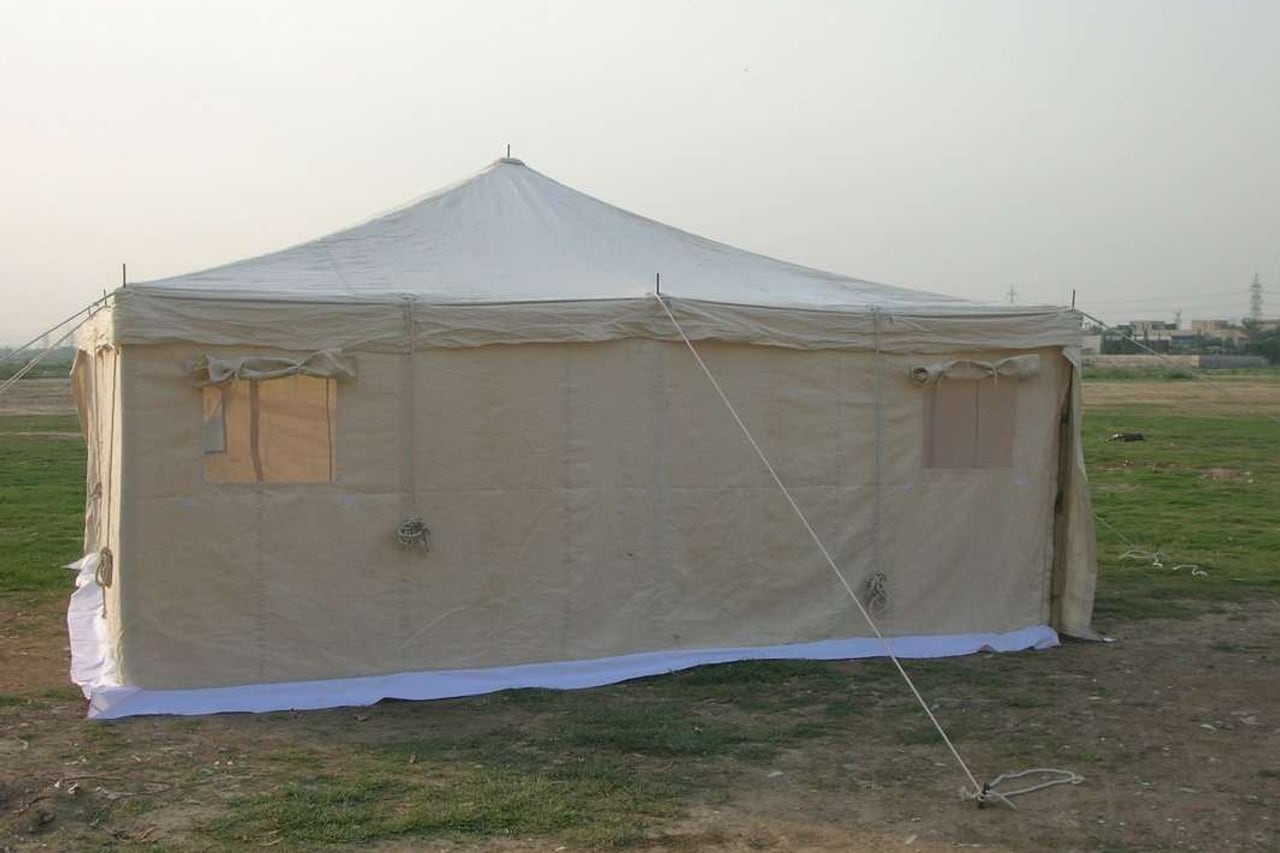
Most relief stockpiles hold three kinds of tent. The family tent is the bulk of the order. Winterised units replace or supplement it where temperatures fall below freezing. Larger framed tents serve as clinics, classrooms, registration points and warehouses.
| Family Relief Tent | Winterised Relief Tent | Medical Post Tent | |
|---|---|---|---|
| Use | One household | One household in cold climates | Clinic, triage, community use |
| Fabric | 380 gsm cotton-polyester canvas | 420 gsm cotton-polyester canvas | FR-treated PVC-coated polyester |
| Construction | Double fly, steel poles | Insulating liner, snow-rated frame | Framed, welded floor tray |
| Main extras | Groundsheet and repair kit | Flued stove port with heat-shield collar | Wipe-clean lining, two doors |
| Price | On enquiry | On enquiry | On enquiry |
Fabric and construction
Poly-cotton canvas is the standard for family tents because it breathes, resists tearing and holds up to sun better than cheap plastic. Look for mill-applied rot, mould and UV treatments and a documented water penetration test. Weight in gsm is a useful guide, but two fabrics of the same weight can perform very differently; treatment and weave count as much.
Double-fly construction is worth its extra cost. The air gap between fly and inner tent cuts condensation and keeps the interior cooler under strong sun. For framed tents used as clinics or stores, PVC-coated polyester is easier to clean and fully waterproof, at the cost of breathability. Our canvas and tent fabrics section lists the cloths we cut from.
Colour has practical effects. Light colours reflect more sun and keep tents cooler in hot regions; many agencies also specify a colour that is easy to identify from the air and does not resemble military tentage. Agree the colour, and any printed logo, before the fabric is dyed, because both affect the production schedule.
Pitching, repair and field life
In the first days of a response, tents are often pitched by the families themselves or by volunteers who have never seen one. Pictorial instructions, colour-coded poles and as few loose parts as possible make a bigger difference than any fabric upgrade. Our Family Relief Tent is designed to be pitched by two untrained people in about twenty minutes.
Field life depends on UV exposure, wind and care. A tent in a sheltered camp with occasional retensioning will far outlast one pitched loose on an exposed hillside. Include a repair kit in every bale, and consider stocking spare poles, pegs and a supply of ground sheet tarpaulins to protect floors.
Packing, logistics and storage
The bale is the unit of logistics. Specify its maximum weight and dimensions so you know how many fit in a container, a truck and a helicopter sling. Ask for waterproof outer wrapping, clear marking with contents and handling instructions, and a packing list in every bale.
Pre-positioned stock must be stored dry, off the floor and away from rodents. Canvas packed damp will mildew; canvas stored well keeps for years. Rotate stock so the oldest units go out first, and inspect a sample from each batch periodically. A military storage shelter makes a practical temporary warehouse at a forward hub.
Questions to ask any relief tent supplier
Capacity matters as much as unit price. A supplier who can make a modest number of tents a week is no help when a sudden-onset disaster demands thousands. Ask for numbers and, if possible, visit or appoint an inspector to see the line running.
- Which specification and edition are you building to, and can you send a clause-by-clause compliance sheet?
- Are test reports from the lot that will be shipped, and from which laboratory?
- Can we inspect a pre-production sample made from the bulk fabric?
- What is the monthly capacity, and how quickly can you start after an order?
- What are the bale weight, dimensions and units per container?
- What is included in the repair kit, and are spare parts sold separately?
Why a framework agreement is faster than an emergency order
The best time to buy relief tents is before you need them. A framework agreement fixes the specification, the sample and the price formula in advance, so when a disaster strikes you place a call-off order and production starts immediately. Without one, you spend the first weeks of a response on quotes, samples and approvals.
A framework also lets a manufacturer hold fabric in reserve or plan production capacity around your likely needs, which no supplier can do for an order that arrives without warning.
If you are building a stockpile or a framework, send your specification and expected volumes through our contact page. Guide prices are ex works; specification changes, packing, inspection, freight and duties all affect the landed cost.
Questions buyers ask
What is the best tent for emergency relief?
For most climates, a double-fly poly-cotton family tent to the widely used UNHCR-type pattern. In cold regions use a winterised version, and use framed tents for clinics and community spaces.
How much does a relief tent cost?
Our Family Relief Tent and Winterised Relief Tent are priced on enquiry, ex works. Specification, quantity, packing, freight and duties change the delivered cost.
How quickly can relief tents be supplied?
It depends on stock, fabric availability and quantity. A framework agreement with an approved sample shortens the start considerably, so agree one before an emergency if you can.
Are plastic tarpaulins a substitute for tents?
Sometimes. Tarpaulins and shelter kits suit families who can build with local materials. They give less protection and privacy than a tent on open ground.
Can the same tent be used in hot and cold climates?
A double-fly family tent copes with a wide range of climates, but sustained freezing weather calls for a winterised tent with a liner, a snow-rated frame and a stove port.
How should relief tents be stored?
Dry, off the ground, ventilated and protected from rodents, in their original bales. Inspect a sample each year and issue the oldest stock first.