Planning shelter for disaster response
Disaster shelter planning starts with the people affected and what they can do for themselves, then chooses the right mix of support: host family and cash assistance, shelter kits, tents, or collective centres. Tents are the right answer where people are displaced onto open land and need privacy and protection quickly. Plan space to the Sphere guideline of at least 3.5 m² of covered area per person, lay out sites with fire and drainage in mind, and set up stock and supplier frameworks before the emergency.
6 min read · Updated
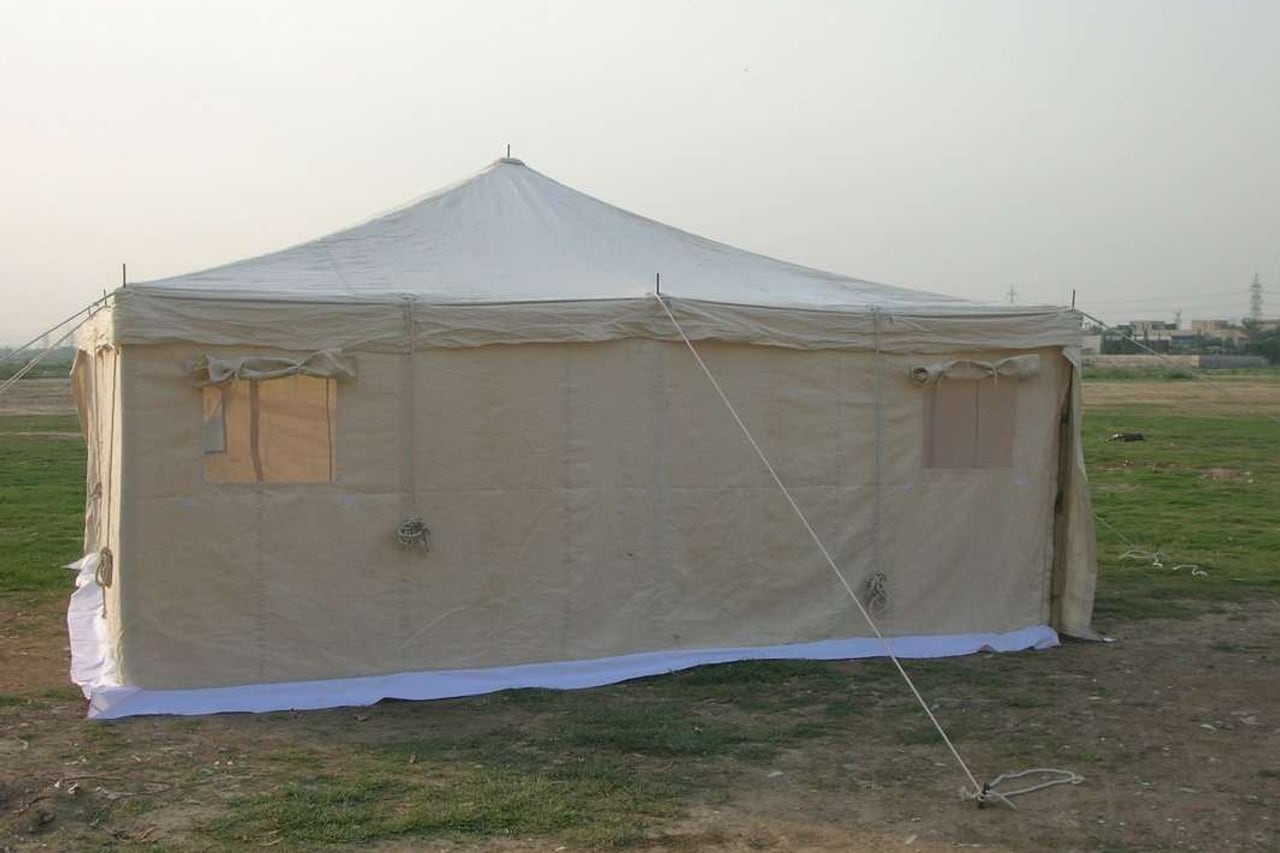
The phases of disaster shelter
Shelter after a disaster moves through phases: emergency shelter in the first days, transitional or temporary shelter while people wait, and then recovery and reconstruction. A good plan covers how households move from one to the next. Tents serve the early phase best; they are not designed to be homes for many years, though displacement often lasts that long.
The Sphere Handbook and guidance from UNHCR, IFRC and the shelter coordination system are the common references. Work from the current editions. They set out principles and standards, and national authorities and coordination bodies adapt them to each response.
Plan the exit at the same time as the entry. Tents pitched on borrowed land, schools or sports grounds must eventually come down, and families need somewhere to go when they do. Agreeing land use, the expected length of stay and the next stage of shelter with the authorities early avoids camps that become permanent by default.
Assessing shelter needs before choosing products
Start with assessment: how many people are affected, where they are, what they have lost, the season ahead, and what local materials, skills and markets remain. Talk to affected people, including women, older people and people with disabilities, about what they need.
Assessment also tells you what not to send. A shipment of tents to a region where families are mostly staying with relatives, or where timber and labour are plentiful, ties up money and transport that cash or materials would use better. Repeat the assessment as the situation changes; needs in the third month are rarely those of the first week.
- Families hosted by relatives may need cash or materials to support the host.
- Families with damaged homes may need repair kits, tools and tarpaulins.
- Families displaced onto open land need tents or shelter kits, plus site services.
- Large groups in public buildings need partitions, bedding and sanitation.
Tents, shelter kits or cash assistance
Tents give immediate, private, weatherproof shelter that needs no building skills. They are bulky to transport and have a limited life. Shelter kits of tarpaulins, rope, fixings and tools are lighter, cheaper and support self-recovery, but need local materials and skills. Cash works where markets function and lets people choose.
Logistics often decide the mix. A family tent bale is heavy and bulky compared with a roll of sheeting, and in a response where roads are cut and everything moves by air, the number of households reached per flight matters. Where trucks can reach the site, tents become far more practical.
Most responses use all three. For tents, the double-fly family tent is the standard; our guide to the UNHCR-type family tent specification explains it. For kits, heavy PVC waterproof tarpaulins and ground sheet tarpaulins are typical components.
Space standards and household size
Sphere’s guideline is at least 3.5 m² of covered living area per person in most climates, with more needed in cold climates where people cook and spend more time indoors. A 16 m² family tent such as our Family Relief Tent therefore suits about four to five people. Larger households need two tents.
Households also need space around the tent for cooking, washing and privacy, and the site needs space for roads, services and firebreaks.
Household size is not fixed. Families split, merge and take in relatives during displacement. Plan some flexibility, such as spare tents or the option to issue a second unit to large households, and record which tents house which families so distribution of other items follows the shelter.
Basic site planning for a relief camp
Planned sites are safer than spontaneous ones. Choose land that drains, is clear of flood and landslide risk and has access to water. Lay out shelters in small clusters or blocks around shared services, which supports community organisation and safety.
- Firebreaks between blocks, at the spacing set in current guidance, kept clear of structures.
- Drainage channels along roads and around tents, cleared before the rains.
- Latrines and water points within reasonable walking distance, lit at night.
- Clinics, schools, distribution points and storage on accessible sites.
- Space to expand, because populations often grow.
Community buildings, clinics and storage
Every site needs larger shelters: health posts, schools, women’s and child-friendly spaces, registration and distribution. Framed tents such as our Medical Post Tent cover these needs. Warehouses for incoming relief stock are often the first structure needed at a hub; a military storage shelter gives covered space within days.
Plan for climate. In cold regions, read our guide to winterised relief tents. In hot regions, shade, ventilation and double-fly construction matter most.
Disaster preparedness: stockpiles and framework agreements
Pre-positioned stock near likely disaster areas, framework agreements with suppliers, approved samples and agreed specifications all save days at the start of a response. Review stock levels against likely scenarios and rotate stock so it stays in good condition.
A yearly exercise shows up gaps a written plan misses. Pitch a sample of stored tents each year with the staff or volunteers who would do it in a real response, and check that every bale is complete. It is far better to discover a missing pole set or an unreadable instruction sheet in a car park than on a flooded field.
We can hold approved samples and agreed specifications ready for call-off orders. Send your planning scenario, specifications and expected volumes through our contact page. See our emergency relief tent buying guide for the product detail.
Questions buyers ask
How much shelter space does each person need?
The Sphere guideline is at least 3.5 m² of covered living area per person in most climates, with more in cold climates.
When are tents the right choice after a disaster?
When people are displaced onto open land and need immediate, private shelter, and local materials or skills for building are not available.
What is a shelter kit?
A package of tarpaulins, rope, fixings and tools that helps families build or repair their own shelter, often with local materials.
How long do relief tents last?
Typically months rather than years in harsh conditions, depending on sun, wind and care. Plan the transition to longer-term shelter from the start.
Who coordinates shelter in a large disaster?
Usually the national authorities, supported by the shelter coordination system of humanitarian agencies. Agencies should follow the standards and specifications agreed in that coordination group.
Should we stockpile tents before disasters?
Many agencies hold some stock and use framework agreements for the rest. Store stock dry and rotate it so it is in good condition when needed.