Tudor and royal pavilions: history and buying guide
Tudor and royal pavilions are tall, lined, richly decorated tents of the kind shown at the Field of the Cloth of Gold in 1520, where Henry VIII met Francis I of France. Today they are used as hero tents for film, palace hotels and events that need one unmissable structure. Our Regent pavilion starts from $425, the Imperial from $500 and the Tudor from $1,100, ex-works.
6 min read · Updated
The Field of the Cloth of Gold
In June 1520 Henry VIII of England and Francis I of France met between Guînes and Ardres, near Calais, then an English possession. Both courts brought enormous temporary camps. The English built a temporary palace at Guînes, and both sides pitched large numbers of tents and pavilions, some covered in costly fabrics. The meeting took its name from the cloth of gold, a fabric woven with gold thread, used so freely there.
The best-known image of the event is a large painting in the Royal Collection, usually dated to around 1545, which shows the English camp with tall conical pavilions, decorated roofs and valances, and royal badges. It is a later, celebratory picture rather than a survey drawing, but it fixed the image most people have of a Tudor pavilion.
Who looked after royal tents
Tents were serious business for a Tudor monarch. The royal household had an office responsible for tents and pavilions, often called the Office of the Tents, which made, stored, repaired and transported them for campaigns, progresses and ceremonies. Records connected with it are among the sources historians use for Tudor tent cloth, rope and labour, though documents of that kind say more about quantities and costs than about exact shapes.
A royal pavilion came with people to pitch it and a store to keep it in, and a modern one needs the same. Budget for a crew at every pitch, a dry place to keep the canvas between events, and a vehicle long enough for the centre pole.
Parts of a royal pavilion
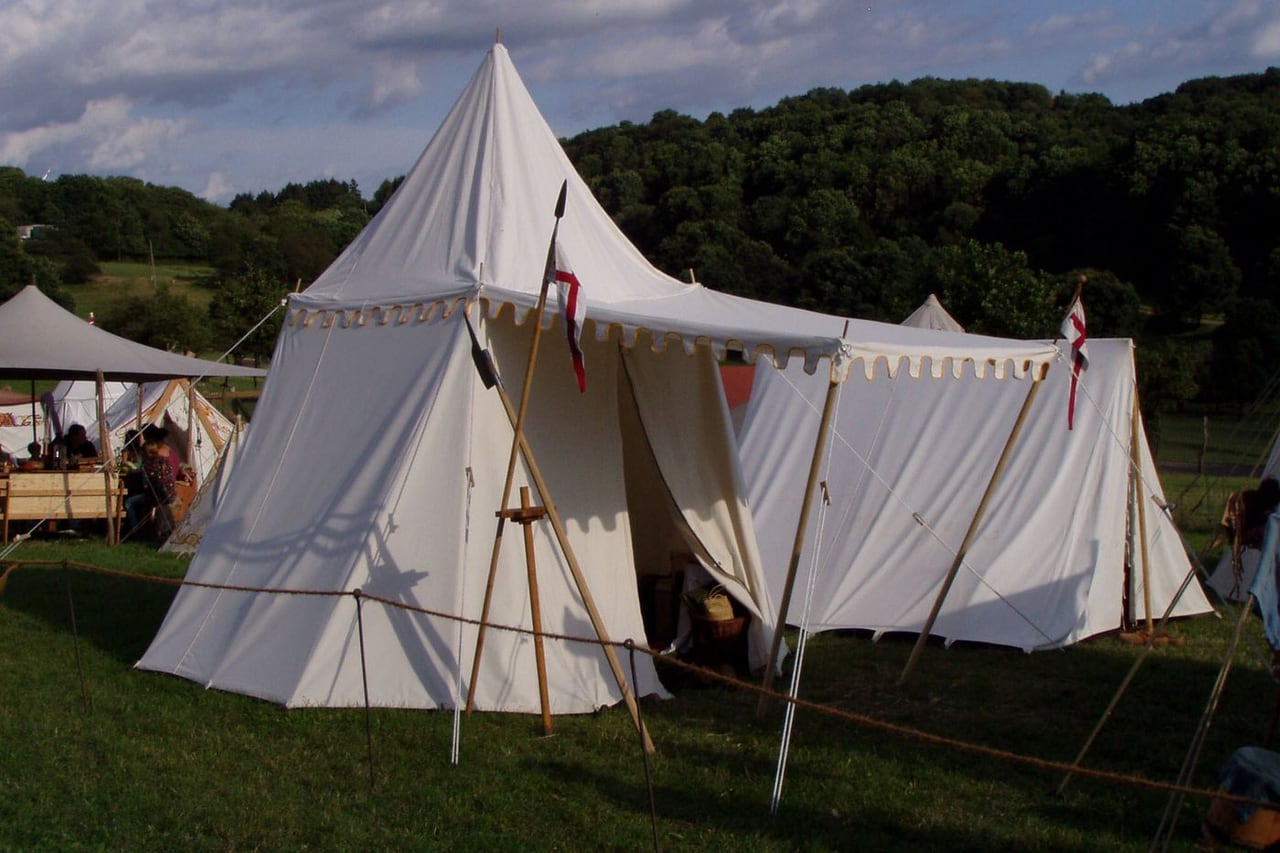
Our Tudor Pavilion follows that pattern in 480 gsm treated cotton with a seasoned hardwood centre pole, applied trim, a brass finial and a full decorative lining.
- Height: a tall, steep conical roof on a long centre pole, so the tent reads from far away.
- Valance: deep and decorated, with scalloped or dagged edges and repeated badges or charges.
- Lining: a full interior lining, which turns shelter into a room and hides the structure.
- Finial: a turned or metal finial, often with a pennon or banner.
- Cloth: heavy enough to hold the shape of the tall roof without sagging.
Regent, Tudor or Imperial: which to choose
All three are lined pavilions, built at different scales. The Regent Medieval Tent is a round pavilion dressed for a principal. The Tudor is taller and more decorated. The Imperial Medieval Pavilion is a multi-poled tent large enough to hold a hundred people standing.
| Regent (M09) | Tudor (M10) | Imperial (M11) | |
|---|---|---|---|
| Canvas | 440 gsm treated cotton | 480 gsm treated cotton | 480 gsm treated cotton |
| Structure | Single hardwood centre pole | Single hardwood centre pole | Multi-pole hardwood and steel frame |
| Interior | Full decorative lining | Full decorative lining | Full decorative lining |
| Character | A principal’s room | One unmissable structure | A full court |
| Sizes | Four | Four | Three |
| From | $425 | $1,100 | $500 |
Where royal pavilions are used today
The Tudor pattern is built for three kinds of buyer. Film and television productions use them as hero tents for commanders and kings. Palace hotels and heritage venues use them for dining, ceremonies and photographs. Event companies use them as the centrepiece of a themed wedding, festival or tournament. Our guide to tents for film and TV productions covers the production side in more detail.
Anyone wanting the Indian equivalent of a court tent should also look at the Mughal Darbar Pavilion, with cusped arch openings and a painted interior.
What a pavilion lining does
The lining is what separates a royal pavilion from a large tent. It hides the seams, the pole fittings and the underside of the roof, so the inside reads as a finished room in photographs and on camera. It also takes decoration well, because it never sees rain: a painted or printed lining keeps its colour far longer than paint on the outer cloth.
A lined tent is quieter and holds temperature a little better than a single skin, since the air gap between lining and roof slows heat moving in or out. It is also darker inside, which suits candlelit-looking interiors lit with warm electric light and gives a lighting team more control.
The cost is weight, pitching time and drying time. Both layers must be completely dry before storage, and the lining is best packed separately from the outer cloth so damp in one cannot transfer to the other.
Height, wind and anchoring
A tall pavilion catches wind. Plan anchoring from the installation drawing, use every guy point, and on hard surfaces where pegs cannot go, work out ballast with a rigger. For a tent that will stand for weeks or a season, check whether the local authority treats it as a temporary structure that needs approval, and what fire-safety evidence it expects for public use.
Lined tents also need airflow. Open doors on warm days and do not seal the lining tight to the outer cloth, or condensation can build between the two. On a long installation, walk the guy lines every morning and after any storm, and re-tension as the canvas wets and dries.
Ordering a royal pavilion
Tell us the role the pavilion plays, the number of people it must hold, the colours and any badges or arms, and whether you need fire-retardant cloth. Larger sizes, custom trim, painted linings and freight all change the landed cost. Send the brief through the contact page, or use the custom tent configurator for a non-standard size.
Questions buyers ask
What was the Field of the Cloth of Gold?
A meeting between Henry VIII and Francis I near Calais in June 1520, famous for the lavish temporary palace, tents and fabrics both courts brought.
What makes a pavilion Tudor in style?
A tall conical roof, deep decorated valance, full lining and a prominent finial, often with royal or personal badges.
How many people does the Imperial pavilion hold?
It is designed to hold around a hundred people standing in its larger sizes. Seated capacity is lower and depends on the layout.
Can royal pavilions stand for a whole season?
Yes, with good anchoring, regular checks and airflow through the lining. Check local approval rules for long-standing temporary structures.
Can you add our badge or arms to the valance?
Yes. Send artwork and colours and we will quote appliqué or painted decoration.
Is the Tudor pavilion historically exact?
It follows the Tudor pattern as shown in period images: tall conical roof, deep valance and lining. Those images are artistic, so treat it as a faithful interpretation rather than a copy of a surviving tent.