Medieval tents for weddings and themed events
For a medieval wedding, use a lined pavilion such as a Tudor or Imperial for the ceremony or feast, round pavilions for lounges and bridal preparation, and smaller tents for guests staying over. Plan space with a rule of thumb per guest, check the venue’s fire and temporary-structure rules early, and have a wet-weather plan. Our pavilions start from $260 for a round tent and from $500 for the Imperial, ex-works.
5 min read · Updated
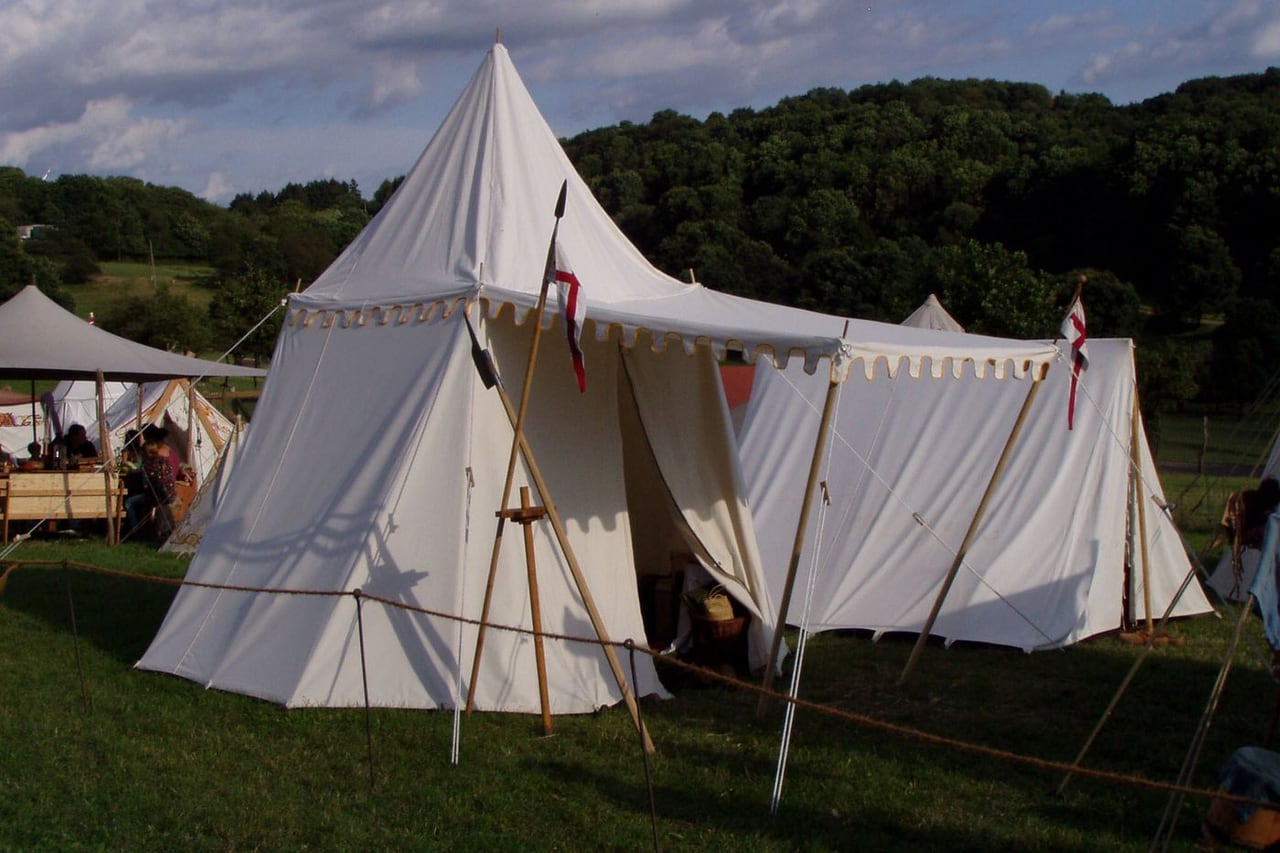
Choosing a tent for each wedding role
A themed wedding works best when every tent has a clear role. Guests understand the site at a glance, and you spend on the tents people will photograph. Typical roles are the ceremony or feast tent, a lounge or drinks tent, a bride’s or groom’s preparation tent, a musicians’ or bar tent, and guest sleeping tents for a weekend event.
The feast tent is the centrepiece. The Imperial Medieval Pavilion is lined, valanced and holds around a hundred people standing in its larger sizes. For a smaller wedding, or as a single dramatic structure for the ceremony, the Tudor Pavilion is the tent people remember. Round pavilions make good lounges and preparation tents, and a row of them reads as an encampment.
How much space do guests need?
A rule of thumb many planners use is around one square metre per standing guest, and roughly double that or more for a seated dinner once tables, chairs and service routes are counted. A head table, dance floor, band or buffet each needs its own space on top. Our marquee size guide works through those allowances in more detail.
Medieval pavilions add one quirk: centre poles. A single-pole round tent has its pole in the middle of the room, so plan a round table or a decorated feature around it. Twin-pole tents set their poles along the centre line, leaving long lanes either side that suit banqueting tables.
Venue fire rules and temporary structure permits
Check the rules before you choose tents. Many venues and local authorities require tents used by the public to be made from fire-retardant cloth and want to see a certificate. In the US, CPAI-84 is the standard commonly cited for tent fabric; in the UK and Australia, venues may reference standards such as BS 5438 or the AS 1530 series. Ask the venue or your local fire authority which they accept, then ask us for fire-retardant cloth and the matching certificate.
Larger tents or tents standing for more than a few days may also need approval as temporary structures, and some venues will want an installation drawing and anchoring plan. Ask your venue and local council what they need. Untreated cotton canvas burns, so keep candles, braziers and fire pits well away from all tents whatever the paperwork says.
Planning for rain, heat and wind
Treated cotton canvas is water-resistant once weathered, so pitch the tents and wet them before the wedding, or ask the installer to do so. Plan walkways between tents that will not turn to mud, and keep guy lines clear of routes guests will walk in the dark; mark them with lanterns or ribbon.
In hot weather, breathable cotton canvas tends to feel cooler inside than coated synthetic fabric, and walls can be rolled or tied up for airflow. In wind, tall pavilions need every guy line set and checked. Agree with the venue in advance what wind speed means the tents are cleared.
Decorating a medieval wedding tent
Lined pavilions such as the Regent Medieval Tent already look like rooms. Add rugs over a groundsheet or boarded floor, banners and drapes, long tables with linen, and warm light. Real flame indoors is a risk; a battery lantern such as our Brass Camp Lantern gives warm light without it. For lounges, low seating, cushions and wooden furniture keep the period feel.
Heraldic banners or the couple’s initials on the valance make a strong photograph. Our guide to painted and heraldic canvas explains how decoration is added.
Mixing period tents with practical ones
Not every structure has to be medieval. Caterers need a working tent, usually out of sight, and a clear-span frame such as our Outdoor Dining Marquee 10 × 20 serves well as kitchen or back-of-house space. Place period tents where guests and cameras look, and practical ones behind them.
Guest tents for a weekend wedding
A two- or three-day themed wedding often includes an encampment where guests sleep. Wedge tents and small round pavilions are the usual choice: quick to pitch in rows, cheap enough to buy or hire in numbers, and convincing as a camp around the main pavilion. The Wedge Medieval Tent starts from $175 ex-works.
Furnish guest tents simply, with a raised bed or camp bed, a rug and a lantern, and give each one a groundsheet. Leave space between rows for guy lines and for guests finding their way back after the feast.
Lead times, and whether to hire or buy
Start with the venue rules, then the guest count, then the tents. Allow time for a cloth sample, manufacturing and freight; the schedule is confirmed with your quotation. Pitch the tents once before the day to weather the canvas and to check the layout on the actual ground.
A couple holding one wedding will usually hire. Venues, castles, heritage sites and event companies that run themed events every season are the buyers, because a set of pavilions pays for itself over repeated bookings. If you are buying for a venue, choose fire-retardant cloth from the start and plan a dry store.
Send your guest numbers, tent roles and venue location through the contact page for a quote, or use the custom tent configurator for a size we do not list.
Questions buyers ask
What medieval tent is best for a wedding ceremony?
A Tudor pavilion makes the strongest single structure. For a larger feast or ceremony, the Imperial pavilion holds more guests.
How many guests fit in a medieval pavilion?
The Imperial is designed for around a hundred standing in its larger sizes. Seated numbers are lower; send us your layout and we will suggest a size.
Do medieval wedding tents need to be fire-retardant?
Many venues and authorities require it for public use. Ask the venue which standard applies before ordering.
Can we put a dance floor in a medieval tent?
Yes, but plan around the poles. In a round tent the floor goes around the centre pole; in a twin-pole tent the poles stand on the centre line, so the floor sits between or beside them.
How far ahead should we order medieval wedding tents?
As early as you can. Allow for a sample, manufacture and freight, and a few weeks to pitch and weather the tents before the date.
Can a venue use medieval pavilions every season?
Yes. With fire-retardant cloth, good anchoring and dry storage between events, a set of pavilions can serve many seasons.