Painted and heraldic canvas for medieval tents
Medieval tents can be decorated by painting the canvas, by sewing on cut cloth (appliqué), or by piecing coloured panels into stripes. Paint is quickest but stiffens the cloth and can crack at folds; appliqué and piecing are more durable and closer to how much heraldic textile work was done. Keep designs bold and simple so they read from a distance, and check how any decoration affects the fire certificate.
6 min read · Updated
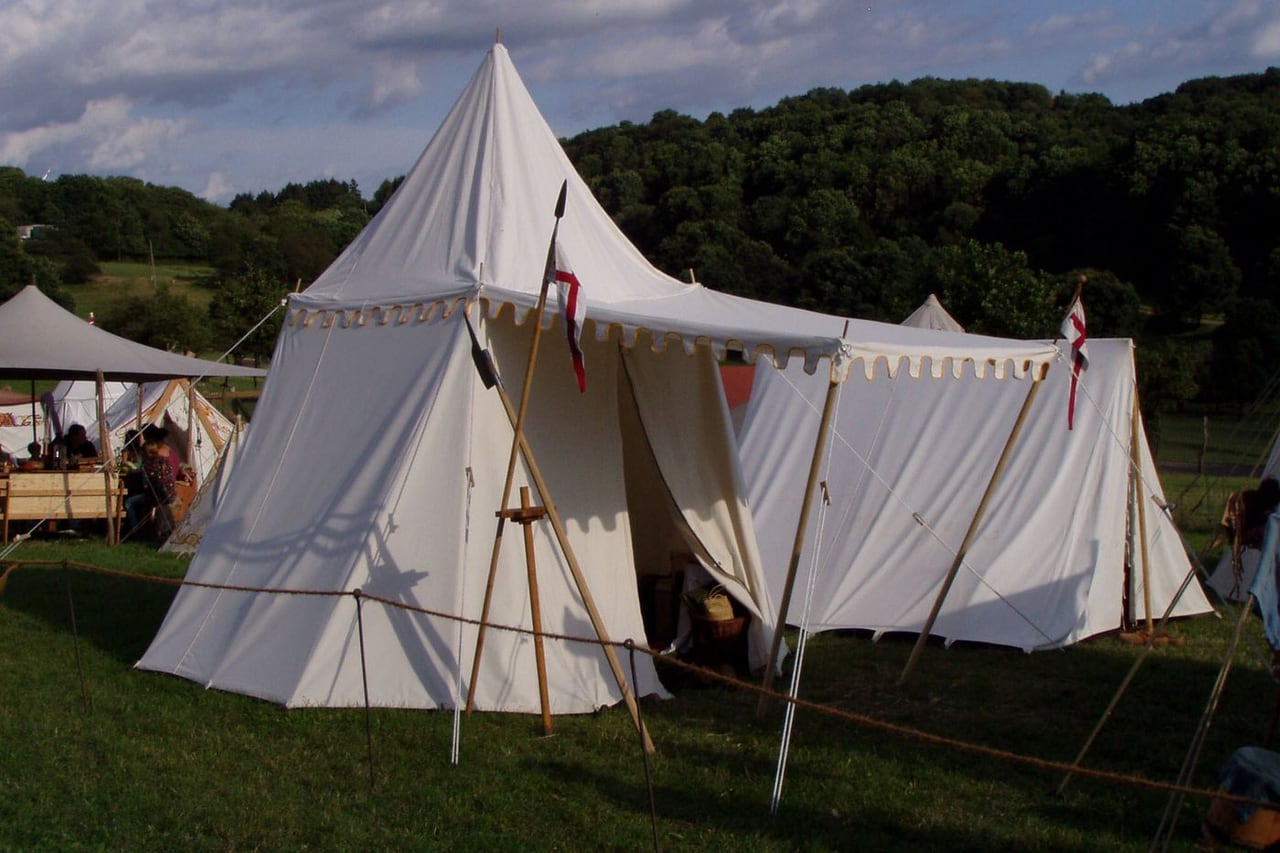
Did medieval tents carry heraldry?
Later medieval illuminations show many decorated tents: striped and parti-coloured roofs, valances with repeating charges, and pennons or banners flying from the finial. Copies of Froissart’s Chronicles from the fifteenth century are full of them, and the painting of the Field of the Cloth of Gold in the Royal Collection shows elaborately decorated Tudor tents.
How literally to read those images is debated. Painters may have brightened colours and simplified the cloth, and the tents of ordinary soldiers were probably plain. For a person of rank in the later Middle Ages, though, a decorated pavilion is well supported, and for earlier periods there is much less evidence either way.
Three ways to decorate tent canvas
Each method has a place, and many tents combine them.
- Piecing: stripes and parti-colours made by sewing panels of different coloured cloth together. It is the most durable option and does not change how the canvas behaves.
- Appliqué: shapes cut from coloured cloth and sewn onto the canvas. Good for heraldic charges, borders and valance motifs. It adds a little weight and stays flexible.
- Paint: applied directly to the canvas. Fastest for complex designs and fine lines, but it stiffens the cloth, reduces breathability where it covers, and can crack along folds over time.
How to paint a canvas tent without ruining it
If you paint, use a flexible paint made for textiles or an acrylic thinned enough to soak into the weave rather than sit on top. Thick paint forms a skin. That skin cracks when the tent is folded and can trap moisture underneath, which invites mildew. Test the paint on an offcut of the same cloth, fold it, leave it in the rain and look at it again a week later.
Paint large areas sparingly. A painted roof breathes less, which can mean more condensation inside. Charges on the walls or valance are a better place for paint than a whole roof. If you want spare cloth to test on, our treated tent canvas is sold by the metre.
Water-repellent treatments can make paint adhesion less reliable, so ask the paint supplier whether their product is suited to treated cotton canvas.
Designing heraldry at tent scale
Heraldry was designed to be recognised at a distance, and the old rules still help. The rule of tincture, which keeps metals (gold and silver, shown as yellow and white) off metals and colours (such as red, blue, green and black) off colours, gives strong contrast. A simple charge large enough to fill its field reads better from across a field than a detailed one.
Use your own arms or your group’s. In some countries arms are formally granted, for example by the College of Arms in England, and many reenactment societies keep their own heraldic registers. Painting another family’s arms on your tent is a quick way to upset people who care.
Send us vector artwork or a clear drawing with colours named. We will tell you which parts suit appliqué and which would be better painted after delivery.
Where to put decoration on a tent
The valance is the natural place for a repeating charge or badge. It hangs in view, catches the eye at a distance and is easy to replace if damaged. Our Regent Medieval Tent has a decorated valance and full interior lining, and the Tudor Pavilion carries applied trim. Stripes suit roofs and walls. A single large charge suits a door panel or a back wall facing the public.
Indoors, a painted or printed lining gives colour without affecting the weatherproof outer cloth. Hand-painted interiors and appliqué panels are part of how we make our traditional Indian tents, so the skills are in the workshop.
Colours that last outdoors
Sunlight fades dyed cloth and paint, and a tent spends its life in the sun. Expect strong reds, blues and greens on a roof to soften over a few seasons, faster in high UV regions. Walls and valances fade more slowly than roofs, which is another reason to put heraldry there. Plan for it: a slightly deeper shade at the start ages into the colour you wanted.
Dark roofs also absorb more heat, so a black or deep blue pavilion will be noticeably warmer inside on a summer afternoon than a natural one. If the tent will be used in hot weather, keep the roof pale and put the colour in stripes, walls and valance.
Natural undyed canvas changes too. It mellows from bright cream towards a warmer tone as it weathers, which many reenactors prefer. Appliqué pieces cut from a different cloth may age at a different rate from the canvas behind them, so ask us to cut charges from cloth of a similar type where possible.
Decoration and fire certificates
A fire certificate describes the cloth as it was tested. Paint, appliqué cloth and trims are extra material, and some venues or safety officers will ask whether they meet the same standard. If you need a certified tent, raise decoration at the quote stage so appliqué can be cut from fire-retardant cloth where possible, and check with the organiser or local authority what they accept for decoration added afterwards.
Caring for decorated canvas
Fold painted areas loosely or roll them, and avoid folding along the same line every time. Never pack a decorated tent wet: mildew grows fastest under paint and behind appliqué. Brush dirt off dry, and spot-clean with plain water. Detergent can lift paint and strip the water-repellent finish.
For a quote on a decorated pavilion, send artwork, shape and size through the contact page, or start with the custom tent configurator.
Questions buyers ask
What paint should I use on a canvas tent?
A flexible textile paint or a well-thinned acrylic that soaks into the weave. Test it on an offcut and fold it before painting the tent.
Is appliqué better than paint for heraldry?
Appliqué is more durable and keeps the canvas flexible. Paint suits fine detail and is quicker for complex designs.
Will painting my tent make it leak?
Painting does not usually cause leaks, but thick paint can crack and trap moisture, which leads to mildew. Keep paint thin and away from large roof areas.
Can you make a striped medieval tent?
Yes. Stripes are made by piecing panels of coloured cloth, which is the most durable way to add colour.
Can you add our arms to the valance?
Yes. Send vector artwork or a clear drawing with colours named, and we will quote appliqué or advise on painting.
Will the colours on my tent fade?
Over several seasons in the sun, yes, especially on the roof. Choose slightly deeper shades and keep the boldest decoration on walls and valance.