How to pitch a medieval tent, step by step
To pitch a round medieval pavilion, lay the roof out around the centre point, raise the centre pole through the apex, peg four opposite guy lines from the eave to hold it upright, then add the remaining guys, hang the walls and set the wall poles. A wedge tent goes up on its ridge and uprights before the corners and sides are pegged. Practise once at home, weather the canvas before the first event, and adjust tension as the cotton wets and dries.
6 min read · Updated
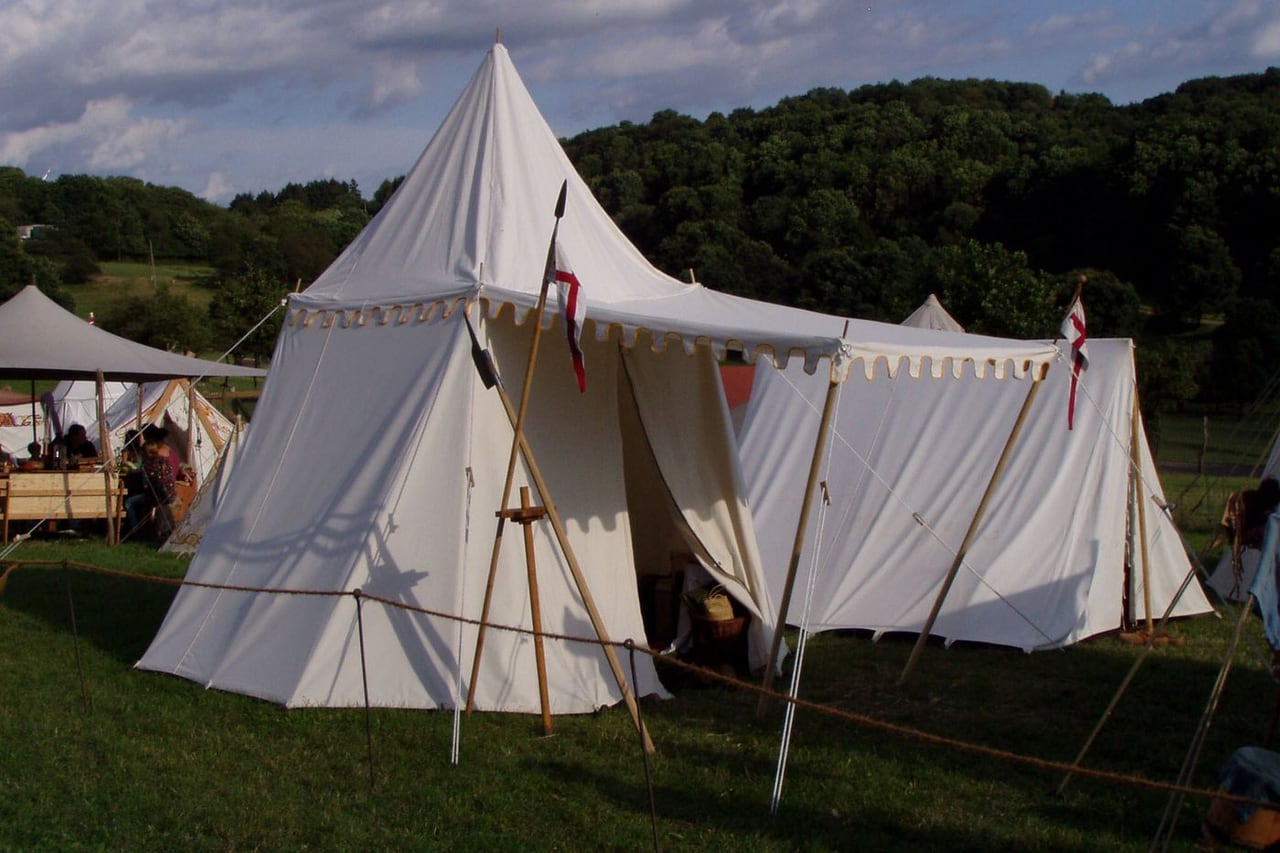
Before the event: weathering and a practice pitch
Pitch every new tent at home before you take it anywhere. You will learn the order of parts, find out which pole goes where and see how the canvas sits, without a queue of people waiting for the camp to go up.
Use that pitch to weather the canvas. Wet the tent thoroughly with a hose or let it stand in rain, then let it dry completely, and repeat once more if you can. Cotton fibres swell when wet, closing the needle holes and tightening the weave. A new tent that drips at the seams on its first night has usually just not been weathered. Our guide to why new canvas tents leak explains the process.
Choosing and preparing the ground
Choose level ground with no hollow that will collect water. Clear stones and sticks from the floor area. Look up as well as down: avoid dead branches overhead and keep well away from fire pits and cooking areas.
Face the door away from the prevailing wind. Leave room around the tent for the guy lines, which on a round pavilion spread out on every side. Check the installation drawing or size sheet for the peg radius before you claim your plot.
Pitching a round pavilion
This is the sequence for a single-pole tent such as the Round Medieval Pavilion or the lined Regent Medieval Tent. Two people can do it; three makes it easy.
- Mark the centre with a peg, and mark where you want the door.
- Lay the roof flat around the centre, inside facing down, with the door seam towards your door mark.
- If your tent has a spoked wheel, fit it to the pole and lay the spokes into their pockets in the roof.
- Pass the pole top through the apex and fit the finial, so the roof is held at the top of the pole.
- One person raises the pole to vertical and holds it; the other pegs four guy lines from the eave at opposite points, like the corners of a square.
- Check the pole is upright from two directions, then peg the remaining guy lines evenly around the circle.
- Hang the walls from the eave by their ties or toggles, starting at the door, and set a wall pole at each seam if your tent uses them.
- Peg the bottom of the walls, then go round the guy lines once more so the eave is level and the valance hangs straight.
Pitching a wedge or A-frame tent
Wedge tents such as the Wedge Medieval Tent are quicker. Lay the canvas flat, fit the ridge pole into the uprights, and slide the frame inside so the ridge sits under the ridge seam. Peg the four corners loosely, raise the uprights together, then square the corners and peg the sides. Finish with the guy lines and adjust until the ridge is straight.
Viking and Anglo-Saxon tents work the same way, except the uprights are pairs of crossed gable boards. Pair and join the boards at each end first, rest the ridge in the crossings, drape the cloth, and peg the sides evenly so both slopes carry equal tension. Point one gable into the wind.
Pitching large Tudor and Imperial pavilions
The Tudor Pavilion and the Imperial pavilion are tall, heavy and caught by more wind. They come with an installation drawing and need a crew. Follow the drawing for peg positions, raise the poles in the order shown, and have a person on each main guy line as the roof goes up. Do not try to raise one of these short-handed in a breeze.
Pegs, guy lines and tension
Drive pegs at an angle with the head leaning away from the tent, so the load pulls the peg deeper rather than out. In soft or sandy ground, use longer pegs; in very hard ground, steel pegs may be the only option, so hide them under turf or straw at a period event. On paving or a venue floor where nothing can be driven in, every guy point needs ballast instead, and the weight per point should come from the installation drawing or a rigger. Line each guy line up with its seam so the load runs along the strongest part of the cloth.
Tension is a daily job. Slacken all guy lines a little when rain starts, because wet cotton shrinks, and tighten them again as the canvas dries. In strong wind, add extra guys if your tent has spare points and check every peg. If the forecast is severe, strike the tent; canvas and timber are cheaper to protect than to replace.
Striking and packing a medieval tent
Strike in reverse order: walls first, then guys, then lower the pole with someone steadying the roof. Brush off grass and mud while the canvas is dry, and fold it the same way each time. Keep poles and pegs in their own bags, such as our Peg & Stake Bag, so iron and timber do not rub the cloth.
If you strike in rain, unpack the tent and dry it within a day or two at home. That habit, more than any other, decides how long a canvas tent lasts.
Questions buyers ask
How many people does it take to pitch a medieval pavilion?
Two for a round pavilion or wedge, three to make it comfortable. The Tudor and Imperial pavilions need a crew working from the installation drawing.
How long does it take to pitch a round medieval tent?
Allow longer the first time. With practice, two people pitch a small round pavilion well within an hour.
Why is my new medieval tent leaking?
It probably needs weathering. Wet it thoroughly and let it dry once or twice so the cotton swells into the seams.
Should guy lines be tight or loose?
Firm in dry weather, slightly slackened in rain, because cotton shrinks when wet and can tear at an eyelet if left drum-tight.
Which way should the door face?
Away from the prevailing wind, so rain does not drive in and the tent does not fill like a sail when the door is open.
What do I do if I have to pack the tent wet?
Unpack it within a day or two and pitch or hang it until completely dry, including the seams and wall hems.