Glamping business plan: costs, occupancy and payback
A glamping business plan comes down to four numbers: the all-in capital cost per room, the nightly rate you can achieve, the occupancy you can realistically sell and the cost of running the site. Simple payback is total capital divided by annual net operating income. Occupancy matters more than anything else, so model at least three scenarios and make sure the low one still works.
6 min read · Updated
Capital cost per room: what to include
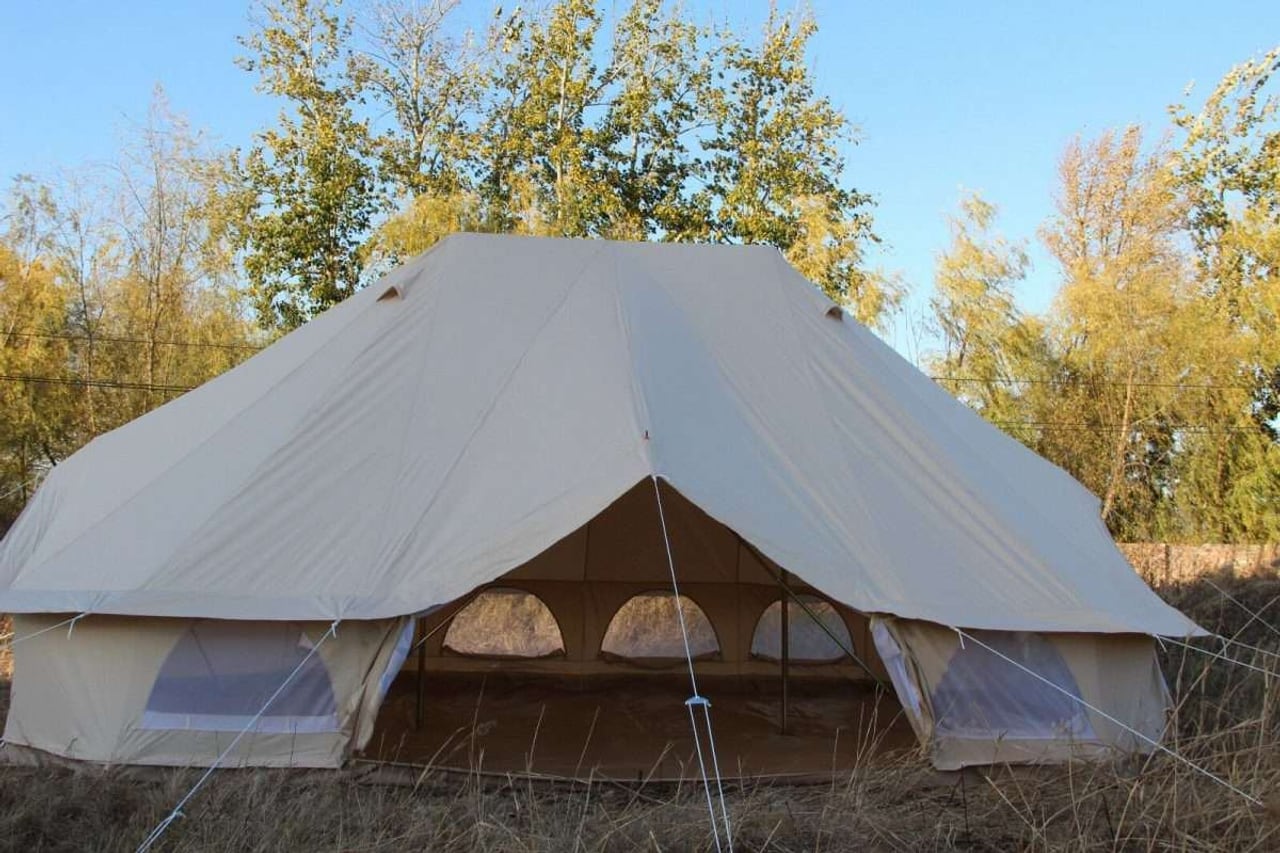
Start with a per-room capital cost that includes everything a guest touches, then add site-wide items once. The tent is the easiest figure to get and often the smallest. Our Safari Suite Tent is from $1,200 ex-works and a Swiss Cottage 10 × 20 $530, but the deck, bathroom and furnishing around them will cost more in most countries.
- Per room: tent, freight and duty share, platform, bathroom and plumbing, electrics, bed and furniture, linen and amenities, installation.
- Site-wide: access road, parking, utility connections, drainage or treatment, reception or communal tent, staff accommodation, landscaping, professional fees and permits.
- Pre-opening: website, photography, launch marketing, staff training, opening stock.
- Contingency: a percentage on top, because groundworks always uncover something.
Revenue: rate, occupancy and season
Revenue is rooms × open nights × occupancy × average nightly rate. Each of those deserves its own line of evidence. Set the open nights by your season and by whether the units are winterised. Set the rate from comparable properties, not from what you hope to charge. Base occupancy on weekday and weekend patterns separately, because most leisure sites fill Fridays and Saturdays long before Tuesdays.
Add secondary income where it is real: breakfast hampers, hot tub hire, firewood, events and private hire of the whole site. Keep it out of the base case until you have evidence guests will buy it. Our guide to pricing glamping tents per night covers rate setting in more detail.
Operating costs: what it costs to sell a night
Split operating costs into variable and fixed. Variable costs rise with every occupied night: laundry, cleaning labour, consumables, utilities, payment fees and booking-platform commission. Fixed costs are paid whether or not anyone stays: core staff, insurance, business rates or property tax, software, marketing, routine maintenance and loan interest.
Two lines that new operators often leave out are canvas replacement and frame maintenance. A cotton or poly-cotton cover pitched all year in strong sun will need replacing long before a frame or deck does (see our guide to glamping tent lifespan). Put an annual amount aside so the replacement is a planned cost rather than a surprise.
Do not forget the off-season. If the site closes for winter, someone still has to check the decks, drain the plumbing, clear snow or fallen branches, and pay insurance and loan repayments. Striking and storing bell tents takes labour, and so does pitching them again in spring; if your covers stay up on framed units, they still need an inspection after every storm. Put these costs in the months they actually fall, because cash flow in a seasonal business is lumpy and the first spring, before bookings have built, is often the tightest point.
A worked payback example
The figures below are illustrative assumptions chosen to show the arithmetic. They are not a forecast or a benchmark for any market; replace every one with your own. Assume six safari-style rooms at an all-in capital cost of $25,000 each ($150,000 total), 200 open nights a year, an average rate of $180, 12% lost to commissions and payment fees, $35 of variable cost per occupied night and $40,000 of fixed operating cost a year.
| 40% occupancy | 50% occupancy | 60% occupancy | |
|---|---|---|---|
| Room-nights sold (of 1,200) | 480 | 600 | 720 |
| Room revenue at $180 | $86,400 | $108,000 | $129,600 |
| After 12% commissions and fees | $76,032 | $95,040 | $114,048 |
| Variable costs at $35 a night | $16,800 | $21,000 | $25,200 |
| Fixed operating costs | $40,000 | $40,000 | $40,000 |
| Net operating income | $19,232 | $34,040 | $48,848 |
| Simple payback on $150,000 | 7.8 years | 4.4 years | 3.1 years |
How occupancy changes the payback period
Occupancy has the biggest effect. Twenty points of occupancy more than halve the payback period, because once the fixed costs are covered most of each extra night goes to the bottom line. The reverse is also true: a site that sells ten points fewer nights than planned can see its payback stretch by years. So it pays to lengthen the season (with liners, stoves or a yurt rather than a bell tent) and to fill midweek nights with offers, retreats or corporate bookings.
Spreading fixed costs over more rooms helps too. A manager’s salary is the same whether there are four rooms or ten, so a few extra units can turn a marginal plan into a workable one. Our guide to how many tents a glamping site needs explores that balance.
Simple payback ignores financing costs, tax, depreciation and the time value of money. Your accountant will want a full cash-flow model and probably a net present value or internal rate of return. Use simple payback as a first filter only, and take professional financial advice before committing capital.
How to reduce capital cost without cutting quality
Phase the build. Open with five units on a site laid out and serviced for ten, and add the second phase once the first has a season of real data behind it. Put trunk services in at the start, though, because digging the same trench twice is expensive.
Standardise. Ten identical units mean one deck design, one set of spares and one housekeeping routine. Our Ten-Tent Resort Package is quoted to your site and is built on that idea, with matched structures, walkway and deck detailing and back-of-house staff tents included. Lenders and investors usually find a phased, standardised plan easier to fund.
For a quote you can drop into your model, send unit type, quantity and destination port through the contact page.
Questions buyers ask
What is a good payback period for a glamping site?
There is no universal figure; it depends on your cost of capital, land tenure and risk appetite. Model low, base and high occupancy and make sure the low case still services any debt.
What occupancy should I assume in year one?
Lower than a mature site achieves. Use local comparables if you can find them, and build the plan so it survives a slow first season.
Should canvas replacement go in the business plan?
Yes. Covers wear out years before frames and decks, so set aside an annual sum for replacement covers and keep it out of profit.
Is glamping more profitable with fewer luxury tents or more basic ones?
Either can work. Luxury units carry higher rates but cost far more per room; basic units are cheaper but need more nights sold to cover fixed staff and marketing costs.
Can I get finance for tents?
Some lenders treat tents as equipment rather than property, which affects terms. A detailed quote with specifications and lifespan assumptions helps any application.