How to price glamping tents per night
Price a glamping tent per night in three passes. First, calculate the break-even rate from your fixed costs, variable cost per night, commissions and expected occupancy. Second, check what comparable sites nearby charge, and adjust for what your unit offers (ensuite, view, privacy, heating). Third, vary the rate by day of the week and season, and review it against real booking pace. If the market rate sits below your break-even rate, change the product or the cost base, not just the price.
5 min read · Updated
Start with your break-even rate
Before you look at anyone else’s prices, find the lowest rate at which a night stops losing money. You need four figures: annual fixed costs, variable cost per occupied night, the share of each booking lost to commission and payment fees, and the number of nights you expect to sell.
The formula is: (fixed costs ÷ nights sold + variable cost per night) ÷ (1 − commission rate). To also recover your capital over a target period, add the annual capital recovery to fixed costs. The table below uses the same illustrative assumptions as our glamping business plan guide: six rooms, 1,200 room-nights available, $40,000 of fixed costs, $35 variable cost per night, 12% commissions and fees, and $150,000 of capital recovered over five years. They are examples, not benchmarks.
| Occupancy | Nights sold | Operating break-even | Including 5-year capital recovery |
|---|---|---|---|
| 40% | 480 | $134 | $205 |
| 50% | 600 | $116 | $172 |
| 60% | 720 | $103 | $150 |
What comparable sites nearby charge
Build a comparison set of five to ten properties that a guest might book instead of yours. Include hotels and cottages as well as glamping sites, because guests compare on the trip, not on the type of building. For each one, note the weekend and midweek rate for the same dates, the minimum stay, what is included and how booked up the calendar looks a few weeks out.
Then score your unit against them. Guests will pay more for a private bathroom, a hot tub, a wood stove, a view nobody else has, real darkness at night or a bed that feels like a hotel bed. They will pay less for shared facilities, a long walk from the car, close neighbours or a tent that feels cold or damp.
How the tent type affects the nightly rate
The structure sets a ceiling on what most guests will accept. A 5M Bell Tent with a good bed and a shared shower block sells as an outdoor experience. A Luxury Safari Tent with an ensuite annexe, a double-skin roof and room for a ceiling fan sells as a hotel room with canvas walls, and it is priced against hotel rooms.
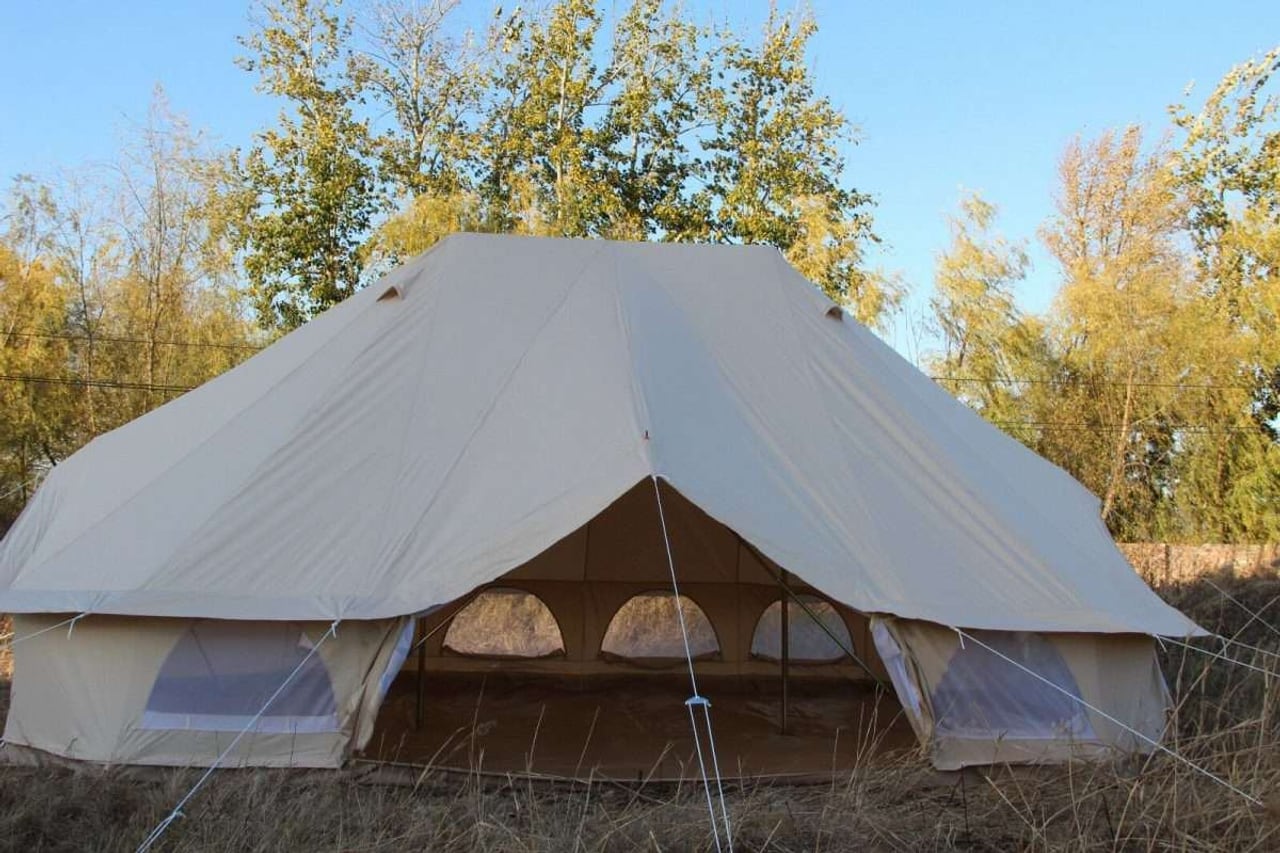
Space and standing height make a difference to price. Guests remember whether they could stand up straight everywhere, where they put their luggage and whether two people could get dressed at the same time. The Swiss Cottage 12 × 24 adds a seating area to the bedroom, which is often enough to sell it as a family or long-stay unit at a higher rate.
Set rates by day, season and occupancy
A single rate all year leaves money on the table at busy times and leaves rooms empty at quiet times. Most sites use a simple grid and adjust it as bookings come in.
- Friday and Saturday usually carry the highest rate. Midweek rates, or a discount for three midweek nights, help fill the quieter days.
- Define peak, shoulder and low seasons from local school holidays, events and weather, and set a rate for each.
- A two-night minimum at weekends protects against single Saturday bookings that leave Friday empty. Relax it close to the date if gaps remain.
- Price for two adults and add a charge per extra guest, so a family in a 6 m bell tent pays more than a couple.
- If peak dates are selling much faster than last year, raise the rate. If they are slow, run an offer rather than cutting the published rate across the board.
Protect the margin from commissions and fees
Online travel agents and listing platforms bring guests, but they take a share of each booking, and the terms vary between platforms and change over time. Read each platform’s current host or partner terms and put the real figure into your break-even calculation. A direct booking through your own website usually costs only a payment fee, so it is worth making direct booking easy and rewarding, for example with a small perk rather than a lower price, if the platform’s rate-parity terms restrict price differences.
Cancellation policy is part of the price. A flexible policy can win bookings; a strict one protects revenue on a small site where one cancelled weekend is a real loss. Many sites offer both, with the flexible option priced higher.
Add-ons that raise revenue per stay
Extras add to the spend per booking without increasing housekeeping. The ones that tend to sell are those that make the stay easier or more memorable: breakfast or barbecue hampers, firewood, a cast iron fire pit evening, late check-out, celebration packages, guided walks and private use of a hot tub. A Yoga & Meditation Pavilion on site lets you sell classes and retreat packages midweek, when rooms are otherwise hard to fill.
When the market rate is below your break-even
If local rates simply will not cover your costs at a realistic occupancy, cutting your price will not fix it. Change one of the inputs instead. Lengthen the season with insulated units, add rooms to spread the fixed costs, lower capital cost per room, or move up a tier with a better unit and sell to a different guest. We can help with the specification side of each of those. Send your plan through the contact page, or try sizes and shapes in the custom tent configurator.
Questions buyers ask
How much should I charge per night for a glamping tent?
Enough to cover your break-even rate at a realistic occupancy, and in line with what comparable stays nearby charge for what you offer. Work out both before you publish a rate.
Should glamping be priced per tent or per person?
Most sites price per tent for two adults and add a charge for each extra guest. That keeps the headline rate simple and still charges families fairly.
How often should I change my nightly rates?
Set a seasonal grid once a year and review booking pace weekly in busy periods. Small, frequent adjustments work better than large cuts close to the date.
Do I need dynamic pricing software for a small site?
Not usually for a handful of units. A simple seasonal grid, a weekend premium and a watch on booking pace covers most of the benefit.
Can I charge more for a yurt than a bell tent?
Usually, yes. A yurt’s lattice walls, insulating liner and solid feel tend to command a higher rate than a single-pole tent of similar size.