How many tents does a glamping site need?
Most commercial glamping sites need enough units to cover the fixed costs of staff, utilities, insurance and marketing. For many operators that means at least five tents, with ten to twenty the range where a site starts to behave like a small hotel. The right number for you is set by four limits: what the planning authority will allow, how much private space the land gives each tent, what shared facilities you can afford, and how many staff the site needs to run.
6 min read · Updated
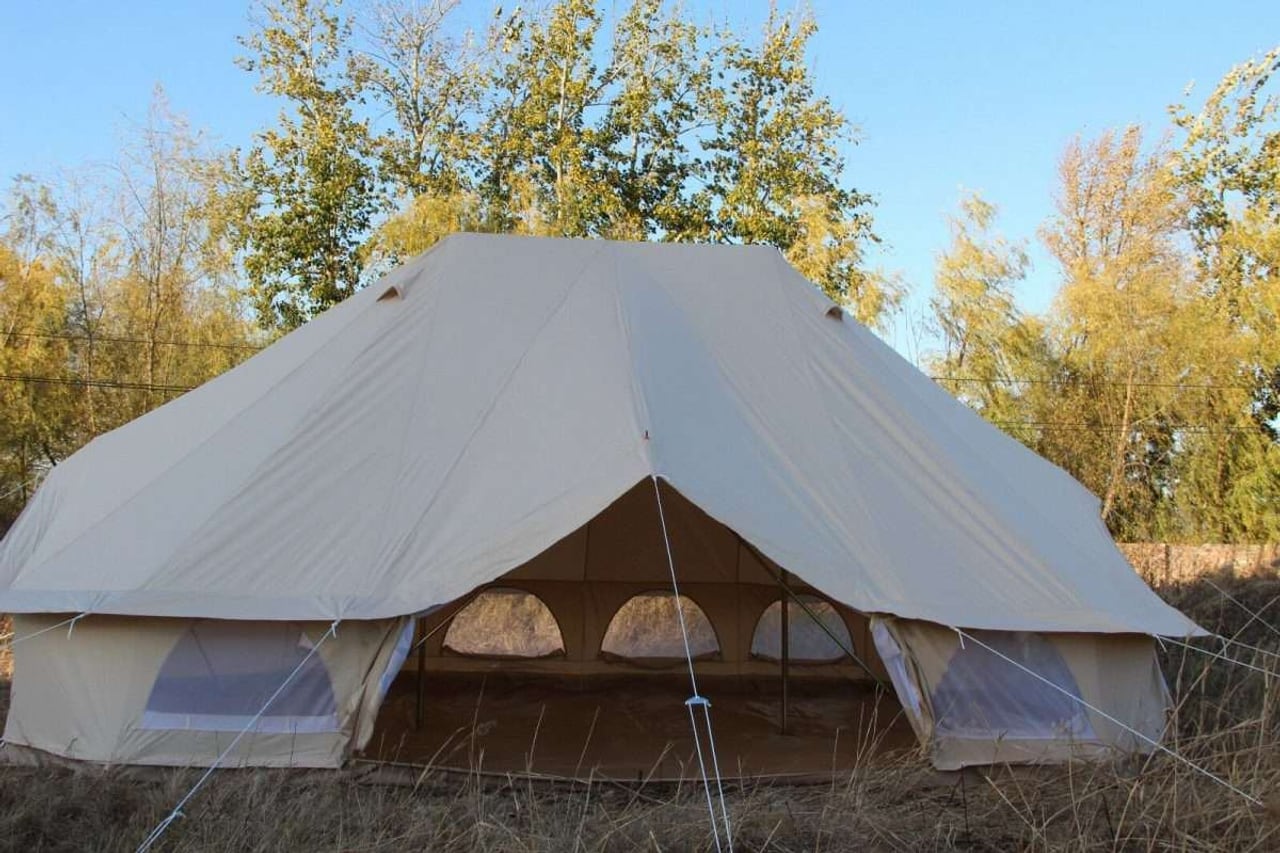
Why the number of tents decides whether a site pays
Every site carries costs that do not care how many rooms it has. A manager, a website, insurance, a booking system, a laundry contract, a water connection and a road all cost roughly the same for four tents as for eight. Spread over too few rooms, they swallow the profit. That is the main reason our five-tent resort package is described as the smallest that makes a property viable: below that, a site usually only works when the owner does the work.
Adding units brings its own costs too. Beyond a certain point you need a reception, a communal space, a second housekeeper, a bigger wastewater system or a planning category with stricter standards. Each of those is a step up in cost, so plan a unit count that sits comfortably below one of those thresholds rather than just above it.
Typical site sizes and how they run
These bands are a loose rule of thumb, drawn from the kinds of projects we supply. Where a site sits depends on its rate, its location and how much the owner does personally.
| Units | How it usually runs | Typical tents | What changes |
|---|---|---|---|
| 1-4 | Owner-run, side income, often alongside a farm or home | Bell tents, a yurt or one safari tent | Simplest permissions; profit depends on owner labour |
| 5-10 | Small business with one or two staff | Safari or Swiss cottage, bell tents with a shower block | Needs booking systems, laundry contract, back-of-house space |
| 10-20 | Small resort with a communal tent and some food | Matched safari or Swiss cottage rows | Reception, dining tent, staff accommodation, larger utilities |
| 20+ | Hotel-style operation | Mixed: standard keys, family keys, flagship suites | Full team, restaurant, formal fire and health compliance |
How much land each tent needs
Guests pay for privacy as much as for the bed. A tent that looks into another tent sells for less than one that looks at a view, however good the canvas is. As a rule of thumb, allow for the tent footprint, a deck or terrace, a path, a parking space if cars come to the unit, and enough distance and planting that guests cannot hear the neighbours’ conversation. On open ground that often means tens of metres between units; with mature trees or a slope, units can sit closer.
Fire and planning rules may also set minimum separation distances between tents and from boundaries. Ask your local authority for its figures before you draw the layout, because they can reduce the number of units a site can hold. Our guide to glamping site layout covers spacing, paths and service routes.
Staffing thresholds
Housekeeping drives staffing on most glamping sites. Changing a canvas room takes longer than changing a hotel room: linen is carried along paths, floors pick up grass and grit, and every tent needs airing. Work out how many changeovers one person can do in a day on your layout, then size the number of units to make full use of each person you hire. Remember that changeovers bunch up: on a weekend-heavy site, most rooms turn over on the same morning, so plan staff for the busiest changeover day, not the weekly average.
Someone also needs to be on call overnight and in bad weather. On a four-tent site that might be the owner; on a twelve-tent site it is a paid role, and that person needs somewhere to live. A Staff Quarter Tent (priced on enquiry) is a cheap way to house a season’s team.
Mixing tent types on one site
A single site does not need to have one kind of tent. A common pattern is a row of standard keys, a couple of family units and one flagship. For example, six Swiss Cottage 10 × 20s at $530, two Swiss Cottage 12 × 24s at $650 for families, and a Yurt 20 FT (priced on enquiry) as the honeymoon or wellness unit. The mix lets you sell at several price points without complicating housekeeping too much.
Keep the mix small. Every additional type means another set of spares, another deck design and another set of photographs. Two or three types is plenty for most sites.
Phase the build and leave room to grow
If you are not sure of demand, plan and service the site for the full number but buy the first phase only. Run the trunk water, power and drainage to every future pitch in phase one, because trenching twice costs far more than over-sizing once. Get planning consent for the full scheme if you can, so phase two does not depend on a fresh application.
Order phase two from the same specification so the units match. We keep drawings and cloth records for repeat orders. When you have a draft layout and a unit count, send it through the contact page and we will quote by phase.
Questions buyers ask
What is the minimum number of tents for a profitable glamping site?
There is no fixed minimum, but many staffed sites need at least five units to cover fixed costs. Owner-run sites can work with fewer because the owner’s labour is not on the payroll.
How many glamping tents fit on an acre?
It depends on planning rules, separation distances, terrain and how much privacy you want to sell. Draw the layout with real spacing rather than dividing the area by the tent footprint.
Should every tent have an ensuite?
At higher rates, guests usually expect one. At lower rates, a good shared block works and keeps capital costs down.
Is it better to buy all the tents at once?
Buying at once saves freight and keeps units matched. Phasing reduces risk; if you phase, service the whole site at the start.
Do resort packages include staff tents?
Our ten-tent resort package includes back-of-house staff structures. The five-tent package covers guest units, and staff tents can be added.
Do I need a communal tent as well as guest tents?
Below about ten units most sites manage without one. Larger sites, or any site serving breakfast or dinner, usually need a covered communal space such as a dining marquee, which also gives guests somewhere to go when it rains.