Wholesale tents for retailers and importers
Buying tents wholesale from a manufacturer works best when you start narrow: one or two core structures, the accessories that go with them, and enough spares to support customers. There is no minimum order with us, and trade pricing applies on volume. Build your retail price from a full landed cost, not the ex-works figure, and check the product safety and labelling rules in your market before the first shipment.
6 min read · Updated
Which tents work for retail and distribution
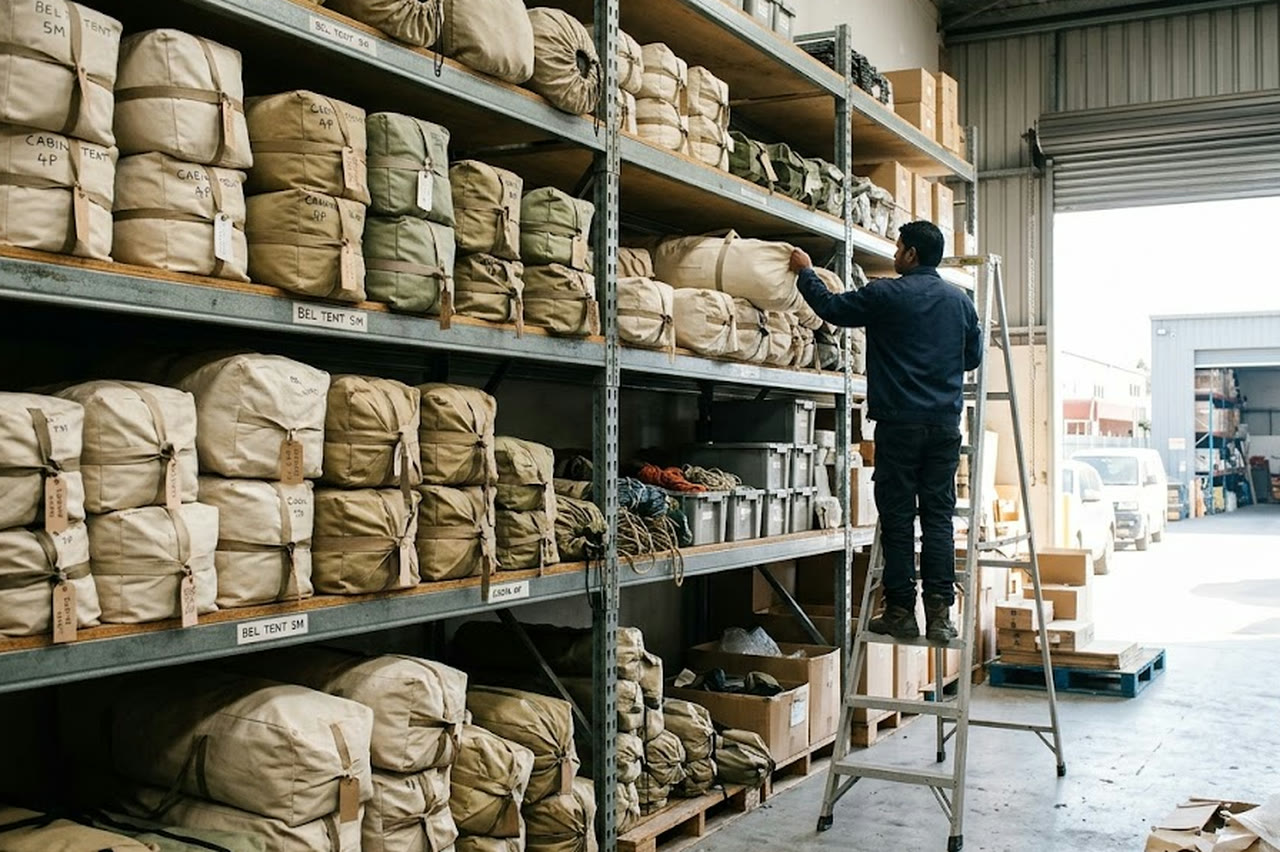
The canvas lines that suit retail are the ones a customer can pitch without help and carry home or have delivered in a few boxes. Bell tents are the obvious core: the 4M Bell Tent from $275 and the 5M Bell Tent from $350, both in 360 gsm treated cotton canvas with a zip-in groundsheet. Tipis, garden canopies and the children’s play tents widen the range without adding much complexity.
Large framed structures such as safari tents and Swiss cottages sell differently. They are project sales to resorts and campsites, usually with a site visit and installation, so importers who handle them tend to work as distributors with a trade sales team rather than through a shop.
How to build a first wholesale range
A first order spread thinly across a dozen products leaves you short of the sizes that sell and long on the ones that do not. Most importers do better with one hero size, a smaller and a larger option, and the accessories that raise the basket value.
- Core: a 5 m bell tent, the size the trade keeps coming back to.
- Range: a 4 m for couples and smaller plots, a 6 m for families or premium buyers.
- Add-ons: groundsheets, storage bags, pole and peg bags.
- Comfort: lanterns, camp chairs, sleeping bags and mattress covers.
- Spares: zips, guy lines, pegs and poles, held in stock for your customers.

Working out the landed cost of a tent
Your margin lives in the gap between landed cost and retail price, so build the landed cost line by line before you set a price. Our catalogue prices are ex-works guide figures, and we quote packing and freight as separate lines so you can see them.
| Element | Where the figure comes from | Notes |
|---|---|---|
| Ex-works unit price | Our quotation | Trade pricing applies on volume |
| Export packing | Our quotation | Retail cartons or barcoding add cost |
| Freight and insurance | Our quotation or your forwarder | Per unit falls sharply as the order fills a container |
| Import duty | Your official tariff, confirmed by a broker | Depends on classification and origin |
| Import VAT or GST | Your tax authority | Often recoverable if you are registered |
| Brokerage and port fees | Your broker and forwarder | Partly fixed per shipment, so heavier on small orders |
| Inland delivery and warehousing | Your logistics provider | Include storage until sale |
Product safety, labelling and compliance
When you import goods to sell, you usually take on the legal duties of the importer in your market, including product safety and labelling. The rules depend on the product and the country, so check them with the relevant authority or a compliance consultant before the first order, not after the goods arrive.
Some points come up again and again. In the US, imported goods generally need country-of-origin marking, and several states have required camping tents to carry flame-resistance labelling referencing CPAI-84. Children’s play tents may count as toys or children’s products, which brings their own testing and labelling rules, such as the toy safety regime in the EU and UK and children’s product requirements in the US. Fibre content and care labelling rules also vary by market. Tell us what your market needs at the quotation stage and we will build labels, certificates and test reports into the order where we can.
Retail packaging and pitching instructions
Export packing protects goods in a container; retail packing has to work on a shelf, in a courier van and on a customer’s doorstep. Decide early whether you need retail cartons, barcodes, printed pitching instructions in your language and a branded storage bag. Each is easy to arrange before production and awkward afterwards. If you want your own brand on the product rather than ours, see private-label tents.
What to tell customers to cut returns
Most complaints about canvas tents come from two things customers were never told. The first is weathering. New cotton canvas lets a little water through at the seams and needle holes until it has been thoroughly wetted and dried, after which the fibres swell and close. A customer who pitches a new bell tent for the first time in a downpour and finds drips will think it is faulty. A line in the instructions telling them to pitch it and hose it down first prevents most of those returns.
The second is storage. Canvas packed away damp will grow mould within days, whatever treatment it had at the mill. Print “store dry” on the bag, in the instructions and on the product page. We can supply care and pitching text for your listings, and our quality assurance page explains the cloth in more detail.
Stock, selling seasons and spares
Tents are seasonal in most markets, so the order has to land before your selling season, with time to photograph and list it. Read tent manufacturing lead times and plan back from your season start. Canvas also needs dry storage: a warehouse that is damp or poorly ventilated will undo the mill treatment on stock that sits there for months.
Keep a small stock of spares from the first order. A customer whose zip fails in year two and gets a replacement in a week becomes a repeat buyer; one who waits two months does not. For trade terms on a first order, send us your range and quantities.
Questions buyers ask
What is the minimum wholesale order?
There is none. Every piece can be ordered as a single unit, and trade pricing applies on volume. Freight is more economical per unit on larger orders, which is usually what decides the size of a first order.
Do you offer trade or distributor pricing?
Yes. Trade pricing applies on volume and on repeat orders. Send your range and expected quantities and we will quote.
Can you supply retail-ready packaging?
Yes, if agreed at the quotation stage: retail cartons, barcode labels and printed instructions can be built into the order, at extra cost.
Who is responsible for product compliance in my country?
Usually the importer or brand owner placing the goods on the market. We supply the material data, test reports and labels you need, but check your local rules with the relevant authority.
Which tent sells best for retail?
Among our canvas range, the 5 m bell tent is the size most buyers start with, supported by a 4 m and a 6 m and the accessories that go with them.
Can I mix different tents and accessories in one shipment?
Yes. Mixed orders are normal and are consolidated into one shipment, with every package numbered on the packing list. The slowest item in the order sets the dispatch date unless you ask us to ship in stages.