Private-label tents: putting your brand on a manufactured tent
Private label means a manufacturer’s proven tent design sold under your brand, with your labels, colours, packaging and instructions. It is quicker and cheaper than designing a tent from scratch, because the pattern and frame are already tested. Agree the branding details and the specification in writing, approve a branded sample before the run, and remember that as the brand owner you usually carry responsibility for compliance in your market.
6 min read · Updated
Private label, OEM and custom tents: the difference
The words get used loosely, so agree definitions with your supplier early. In this guide, private label means one of our catalogue designs made with your branding. Made to your design means we produce a tent you have drawn, which is our Architect & Designer Commission. Custom means we design a new structure with you from a brief, which is the Custom Tent Commission.
Private label is where most new tent brands start. A design that has been pitched in monsoon, desert and snow already has its weak points worked out, and you can spend your money on brand, marketing and stock rather than on development.
Which tents suit a private-label range
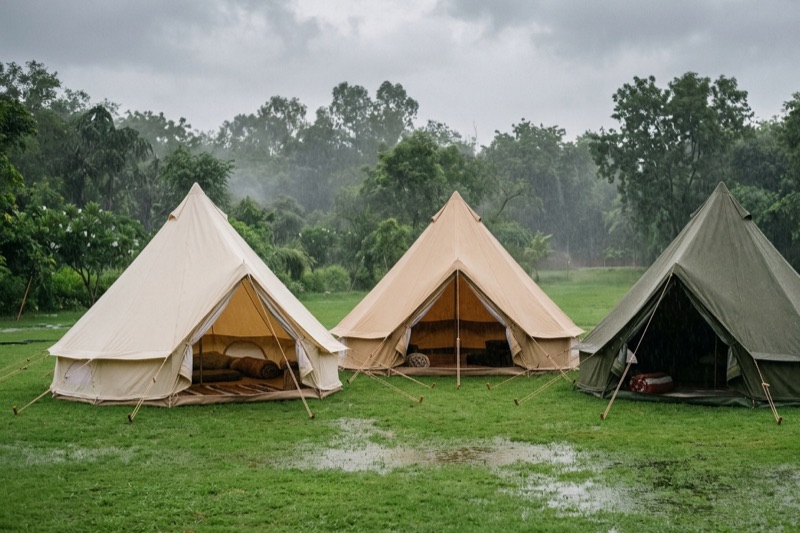
Bell tents are the natural starting point for a canvas brand. The 5M Bell Tent is the size buyers ask for most, and the 4 m and 6 m make a simple three-size range. Tipis, garden canopies and play tents work for lifestyle and children’s brands. Outdoor and expedition brands sometimes take polyester family or trekking tents as well. For hospitality suppliers, branded safari tents and Swiss cottages can be supplied, though these are usually sold project by project.
What parts of a tent can carry your brand
Branding is cheapest where it is added during manufacture rather than afterwards. Decide all of it before the sample is made.
- Woven or printed labels sewn into the door seam or inside the wall.
- A printed or embroidered logo on the door panel or canopy.
- Your own canvas colour, subject to a dye strike-off and enough cloth to make the run worthwhile.
- A branded storage bag, such as our heavy duck tent storage bag with your mark.
- Hang tags, care labels and printed pitching instructions in your languages.
- Retail cartons with your artwork and barcodes.
- Branded accessories: groundsheets, pole bags, peg bags.
Private-label costs, quantities and setup
We have no minimum order, so a private-label range can start small. What changes with quantity is the share of the setup cost each unit carries. Woven labels, embroidery files, printing screens, a custom dye lot and printed cartons each have a setup cost, and spread over five tents that cost is far more noticeable than over two hundred. A sensible first run often uses printed labels and a branded bag, and moves to custom colours once the range has proved itself.
| Option | Setup needed | Effect of quantity |
|---|---|---|
| Sewn-in woven label | Label design and weaving | Low cost per unit once labels are made |
| Printed or embroidered logo | Artwork file or screen | Setup spread over the run |
| Custom canvas colour | Strike-off and a dedicated dye lot | Most economical on larger runs |
| Branded storage bag | Artwork and print | Low per unit |
| Retail carton and barcodes | Artwork, barcode registration (yours) | Carton print runs favour volume |
| Translated instructions | Your approved text | Print cost only |
Branded sample approval
Before the run, approve a fully branded sample: the tent with labels, logo, bag, tags and packaging exactly as they will ship. Check logo placement on a pitched tent, because canvas under tension shows a logo differently from a flat drawing. Once approved, label and keep that sample as the reference for the order, and keep a written specification next to it. Tent samples and quality inspection explains what else to check.
Protecting your brand and tent designs
Register your trade mark in the markets where you sell. If you introduce changes of your own, such as a modified door, a new colourway or a distinctive print, agree in writing who owns them and whether the manufacturer may use them for other customers. A short written agreement, including confidentiality where you share plans, saves arguments later. Take advice from an intellectual property adviser in your own country on what can be protected and how.
Keeping a range consistent from order to order
The harder part of running a tent brand is making the tenth order match the first. Canvas is dyed in lots, and two lots of the same colour can differ slightly, which shows when an old and a new tent stand side by side on a customer’s lawn or in a shop window. Keep a reference swatch from your approved sample, and ask for each new lot to be checked against it before cutting.
Agree how changes are handled, too. If the manufacturer improves a zip, a hardware supplier or a stitching detail, you want to know before it appears in your stock, not after a customer points it out. Ask to be told of any change to cloth, hardware or pattern on a private-label product. Finally, plan spares under your own brand: a customer who needs a replacement door zip or pole section should be able to get it from you, in your packaging, years after the sale.
Compliance duties for the brand owner
When your name is on the product, you are usually treated as the producer or importer for product safety, labelling and consumer law in your market. That can include flammability labelling for tents in some US states, toy safety rules if you sell play tents, fibre and care labelling, and country-of-origin marking. Check the requirements with the relevant authority or a compliance specialist, and tell us what is needed at the quotation stage so test reports, certificates and labels are built into production.
We supply material specifications, test results for the fabric lot and the paperwork for fire-retardant cloth where it is used. To price a range, send us the products, branding and rough quantities.
Questions buyers ask
Is there a minimum order for private-label tents?
No. Private-label tents can be ordered in any quantity, though setup items such as woven labels, custom colours and printed cartons are more economical across larger runs.
Can you make tents in my own colour?
Yes, with a dye strike-off for approval. A custom colour is most economical on a larger run, so many brands start in a standard colour and add their own later.
Will my branded tent be identical to your catalogue tent?
The structure, cloth and build are the same unless you ask for changes. Only the branding, packaging and any agreed details differ.
Do you sell my design to other customers?
Catalogue designs remain available to others. Changes and branding you introduce should be covered by a written agreement on ownership and use, which we are happy to sign.
Who handles product compliance for a private-label tent?
Usually you, as the brand owner placing it on the market. We supply the specifications, test reports and labels you need to meet your local rules.