What is a Swiss cottage tent? Design, sizes and uses
A Swiss cottage tent is a rectangular, ridge-roofed resort tent on a galvanised steel frame, with vertical canvas walls, mesh-screened windows and a floor tray that seals it at ground level. The vertical walls make the whole floor usable, so it works like a compact hotel room. Ours come in 10 × 20, 12 × 24 and 14 × 28 ft, at $530, $650 and $780 ex-works.
6 min read · Updated
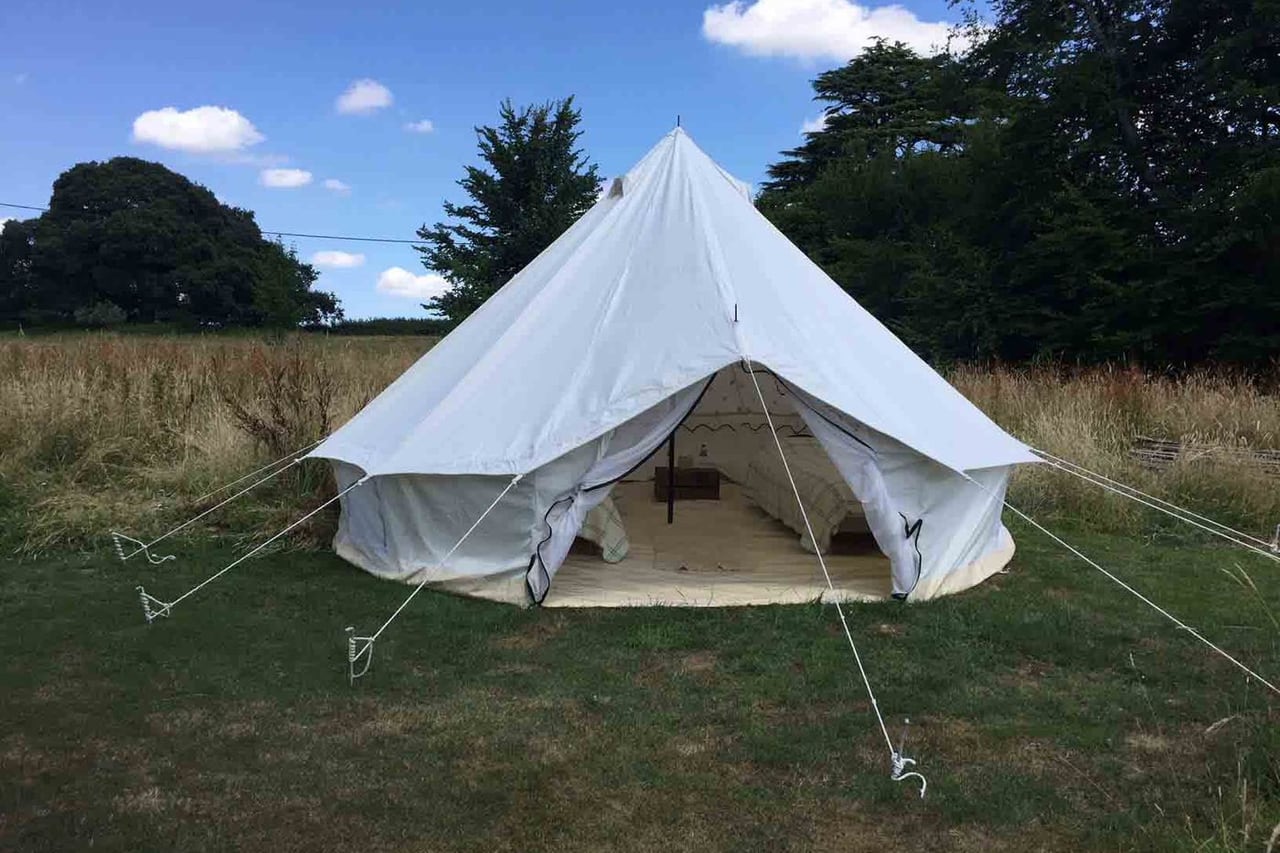
Why it is called a Swiss cottage tent
Swiss cottage is a trade name used across India and South Asia for a particular kind of framed resort tent. The name refers to its neat, cottage-like silhouette: straight walls, a pitched roof and a tidy rectangular plan. It has no particular link with Switzerland, and outside South Asia buyers sometimes call the same shape a frame wall tent or a canvas cottage.
In India the Swiss cottage is everywhere tents are used as rooms. Desert camps in Rajasthan, Himalayan adventure camps, wildlife resorts, pilgrimage sites and corporate retreat venues all use rows of them. That long local use is why the design has been refined for fast installation, simple maintenance and heavy occupancy.
How a Swiss cottage is built
The frame is galvanised steel tube: uprights at the corners and along the walls, a ridge and rafters for the roof, all joined with sockets or bolted fittings. The canvas is cut to the frame and tensioned over it, so the walls stand vertical and the roof keeps its pitch.
- Canvas: on ours, 440 gsm poly-cotton, or 480 gsm on the 14 × 28 ft, treated against rot, mould and UV.
- Floor: a PVC floor tray that turns up at the walls, keeping out surface water, dust and insects.
- Windows: mesh-screened, with canvas covers that roll up or tie back.
- Doors: zipped canvas doors at the front, often with a mesh inner.
- Roof: many Swiss cottages are made with a separate outer roof or fly over the inner, which helps in sun and rain. Ask what any quote includes.
Why Swiss cottages use poly-cotton canvas
We make our Swiss cottages in poly-cotton because the tent usually stays pitched for long periods. The blend keeps much of cotton’s breathability, so the room does not sweat the way a PVC tent can, while the polyester content makes the cloth stronger, more dimensionally stable and quicker to dry. That matters on a tent that stands through a monsoon or a season of desert sun. Our guide to cotton vs poly-cotton vs PVC tent fabric explains the trade-offs in more detail.
Sizes and layouts
Swiss cottages are sized by nominal footprint in feet. The areas below are calculated from those figures. Prices are ex-works catalogue guide prices; freight, duty, interiors and the base are extra.
| Size | Area (nominal) | Canvas | Typical layout | From |
|---|---|---|---|---|
| 10 × 20 ft | About 18.6 m² (200 sq ft) | 440 gsm poly-cotton | Double or twin room | $530 |
| 12 × 24 ft | About 26.8 m² (288 sq ft) | 440 gsm poly-cotton | Bedroom plus seating and luggage | $650 |
| 14 × 28 ft | About 36.4 m² (392 sq ft) | 480 gsm poly-cotton | Partitioned bedroom, sitting room, bathroom pod | $780 |
Choosing a size
The Swiss Cottage 10 × 20 is our most-ordered size. It takes a double or twin beds, bedside tables and a luggage rack, with a clear path to the door. Properties running twenty or more keys often specify this and nothing else, because every unit is identical to build, furnish and maintain.
The Swiss Cottage 12 × 24 adds a seating area. It is popular where a property wants a family key, or a superior room category, without building a second type of structure.
The Swiss Cottage 14 × 28 is a two-room key: a partitioned bedroom, a sitting room and space for an internal bathroom pod. It has a heavier frame and canvas. We see it specified for premium rooms and for accessible keys, where turning space and a level bathroom matter.
Swiss cottage bases: plinth or timber deck
Because of the floor tray, a Swiss cottage does not need a raised deck. Many Indian resorts set them on a raised concrete or stone plinth a little larger than the tent, with anchor points cast in. That is cheap, durable and quick to repeat across a site.
A timber deck is the better choice on wet, sloping or sensitive ground, and it adds a veranda for guests to sit out. Whichever base you choose, it must be level and drained, with fixings matched to the frame. Our platform and deck design guide goes through the options.
Bathrooms, power and interiors
A Swiss cottage takes a private bathroom in one of two ways. In the 14 × 28 ft an internal bathroom pod fits inside the tent. In the smaller sizes, the usual approach is a small built bathroom block at the rear, joined to the tent’s back door. Plan water, waste and electrics into the base before the tent goes up, and see our guide to the en-suite bathroom in a glamping tent.
For interiors, the vertical walls let you place a bed head, wardrobe and desk against the canvas, which is the main practical advantage over round tents. A ceiling fan or a split air conditioner is normal in hot regions. Keep electrical runs in conduit and fittings rated for outdoor use.
Where Swiss cottages work best
If you are planning a full property, our Ten-Tent Resort Package combines matched structures, interiors and back-of-house staff tents in one order. For a single unit or a quote on a mixed layout, use our contact page.
- Properties with ten or more keys that want identical, easily serviced units.
- Sites with a plinth or concrete base, or where a raised deck is too expensive.
- Hot dry climates and hill stations, where a well-ventilated tent with a fly is comfortable for much of the year.
- Family, accessible and premium categories, using the larger sizes alongside the 10 × 20 ft.
Questions buyers ask
What is the difference between a Swiss cottage tent and a safari tent?
Both are framed and standing-height. A Swiss cottage puts its footprint into enclosed, usable floor with vertical walls; a safari tent puts more into a veranda, a tall ridge and an attached bathroom annexe.
How long does a Swiss cottage tent last?
The galvanised frame lasts many years. The canvas lasts several seasons with good care, and longer in milder climates; it can be replaced without changing the frame.
Can a Swiss cottage tent have an attached bathroom?
Yes. The 14 × 28 ft takes an internal bathroom pod, and smaller sizes are usually joined to a small built bathroom at the rear.
Is a Swiss cottage tent good in rain?
With treated poly-cotton, a floor tray and correct tensioning it handles heavy rain well. In monsoon regions, a raised base and a good drainage fall around the tent matter most.
Can a Swiss cottage tent be made in fire-retardant canvas?
Yes, fire-retardant cloth can be specified where your authority or insurer requires it. Ask for the test certificate and confirm with them which standard applies.
How long does it take to install a Swiss cottage tent?
On a ready plinth, a trained crew can usually erect the frame and canvas within a day. The base and services take longer than the tent.