UV-resistant tent fabric: what sunlight does to canvas and how to specify against it
Ultraviolet light breaks down the polymers in every tent fabric, so a tent in strong sun loses strength and colour year by year. Solution-dyed acrylic and well-stabilised PVC resist UV best, polyester and poly-cotton sit in the middle, treated cotton depends heavily on its UV finish, and nylon degrades fastest. A heavier cloth, a mill-applied UV treatment, a light colour, a protective fly or roof cover, and striking the tent when it is not in use all extend its life.
6 min read · Updated
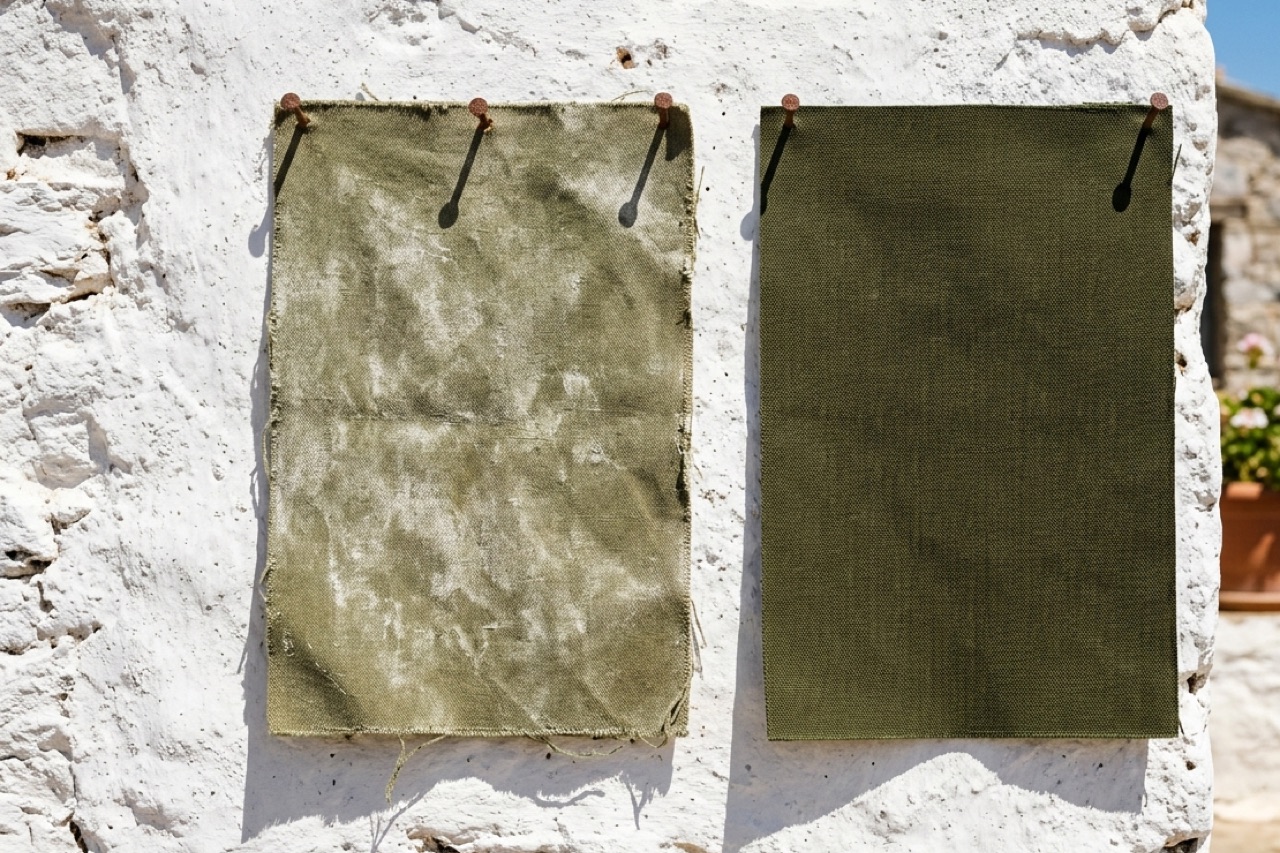
What UV does to tent fabric
Ultraviolet radiation carries enough energy to break the long molecular chains that give a fibre its strength. The damage is cumulative and it happens whether or not anyone is using the tent. First the colour fades and the surface chalks or greys. Then, more seriously, the cloth loses tensile and tear strength until one day a gust or a careless hand splits a panel that looked fine.
Keep the two kinds of damage separate. Colour fading is cosmetic, though it is often the first thing guests notice. Strength loss is structural and less visible. A cloth can hold its colour well and still be weakening, or fade early and stay strong, so a good specification asks about both.
Heat and moisture speed both processes up. In our own climate, a monsoon of standing water followed by months of hard sun is about as demanding a cycle as tent fabric meets anywhere, which is why we specify against it from the mill onward.
How each fabric handles sunlight
These are general rankings for good-quality material. A well-treated cloth of a weaker fibre can outlast a poorly made cloth of a stronger one.
| Material | UV resistance | Notes |
|---|---|---|
| Solution-dyed acrylic | Excellent | Pigment is in the fibre; holds colour and strength for years in full sun |
| PVC-coated polyester | Very good with stabilisers | Coating shields the base cloth; plasticiser slowly migrates out with heat and UV |
| Knitted HDPE shade cloth | Very good when stabilised | Designed for permanent sun exposure |
| Polyester and poly-cotton | Good | Polyester content holds strength better than cotton |
| Treated cotton canvas | Fair to good | Depends heavily on the UV finish and on cloth weight |
| Nylon | Poor | Loses strength quickly in strong sun; fine for packable shelter, not for standing camps |
How UV resistance is tested
Waiting years for real sunlight is impractical, so laboratories use accelerated weathering. A xenon-arc lamp reproduces the spectrum of sunlight at controlled intensity, temperature and humidity. Colour fastness to light is commonly assessed to ISO 105-B02 and graded against a blue wool scale, where higher numbers mean better light fastness. Strength retention is measured by testing tensile strength before and after a set exposure.
We run xenon-arc colour-fastness exposure of 1,200 to 1,500 hours on our cloth, as listed on our quality assurance page. Accelerated hours do not convert neatly into calendar years, because real sites differ so much in latitude, altitude, cloud and reflection. Use the results to compare fabrics against each other, not to predict an exact lifespan.
For shade products specifically, Australia and New Zealand use a UPF rating under AS/NZS 4399 to describe how much UV passes through to the people underneath. That is a measure of protection for skin, not of how long the fabric lasts.
Specifying a tent for high-UV sites
For desert and equatorial sites, our guide to the best tent fabric for desert climates goes further on heat as well as UV.
- Go heavier on the roof. It takes most of the sun. Moving from 360 to 400 gsm, or to a 440 to 480 gsm poly-cotton, gives the UV more material to work through.
- Insist on mill-applied UV treatment. On our treated tent canvas, rot, mould and UV treatment are applied at the mill and penetrate the fibre rather than sitting on the surface.
- Add a sacrificial layer. A fly sheet or roof cover takes the sun so the main canvas does not. On the Luxury Safari Tent the double-skin roof does this job and keeps the interior cooler.
- Choose colour deliberately. Lighter colours stay cooler. Darker colours hide fading less well than you might expect, because they show chalking.
- Check every component. Thread, zips, guy ropes, webbing and window film all age in the sun. A tent fails at its weakest component, and that is often the thread.
Thread and hardware: the parts that fail first
A tent can lose its stitching before its cloth. Cotton thread rots and weakens in sun; standard polyester thread is better; UV-stabilised bonded polyester or PTFE thread is used where seams face years of exposure, such as awnings and shade structures. Ask what thread a supplier uses on exposed seams. Zip tapes and sliders, plastic windows and elastic shock cord also deteriorate. These are replaceable parts, and a well-designed tent lets you replace them without remaking a panel.
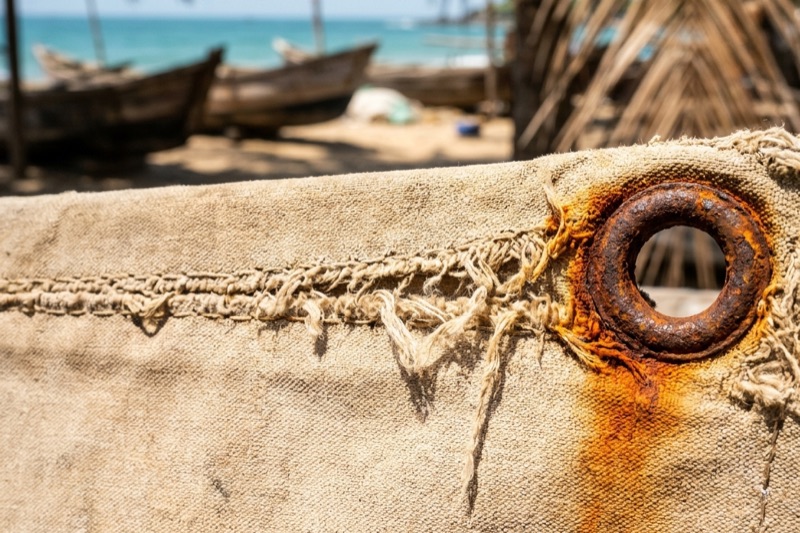
Making a tent last longer in the sun
The cheapest UV protection is not leaving the tent up when nobody is using it. A seasonal glamping field that strikes its bell tents in the off-season can double the useful life of the canvas compared with one that leaves them standing year-round. Where tents stay up, fit roof covers, keep the canvas clean (dirt holds moisture and speeds degradation), and inspect the sun-facing side of the roof each season by pinching and pulling a fold; healthy canvas resists, tired canvas feels papery.
For shade structures, cabanas and parasols, specify Marine Acrylic, solution dyed from the start. It costs more per metre than treated cotton (both are priced on enquiry) and repays that in colour and service life. Our guide to acrylic canvas for shade and outdoor furniture covers it in detail.
What to ask a supplier
Ask whether the UV treatment is mill-applied or sprayed on, what xenon-arc exposure the cloth has been tested to, and whether strength retention after exposure was measured as well as colour. Ask what thread is used on exposed seams and whether zips and windows are replaceable. If you are planning a long-term pitch somewhere sunny, tell us your site and we will suggest a cloth weight and roof arrangement.
Questions buyers ask
Which tent fabric is most UV resistant?
Solution-dyed acrylic, followed closely by UV-stabilised PVC-coated polyester. Among breathable tent canvases, poly-cotton generally holds strength better than all-cotton.
How long does canvas last in full sun?
It varies too much by site, cloth and care to give one figure. A heavier, mill-treated canvas with a roof cover, struck in the off-season, lasts many times longer than a light untreated one left standing.
Does UV treatment wear off?
Surface sprays wear off, especially at folds. Treatments applied at the mill penetrate the fibre and last far longer, but all fabrics still age in sunlight.
Is UPF the same as UV resistance?
No. UPF describes how much UV passes through to people underneath. UV resistance describes how well the fabric itself survives sunlight.
Why is nylon not used for glamping tents?
Nylon is light and strong but loses strength quickly in strong sun. It suits trekking and expedition tents that are pitched for days, not structures left up for a season.