Tents for snow and cold climates: what changes in the specification
A tent for snow and cold needs three things a summer tent does not: a structure and roof pitch that can carry or shed snow, insulation that does not trap condensation, and a safe way to heat it. Heavy cotton canvas of 480 to 520 gsm on a yurt or snow-rated frame, with an insulating liner and a raised floor, is the usual answer for camps that stay open through winter; nylon expedition tents suit parties on the move. Any structure left standing through snowfall should have its snow load checked by a qualified engineer for the site.
7 min read · Updated
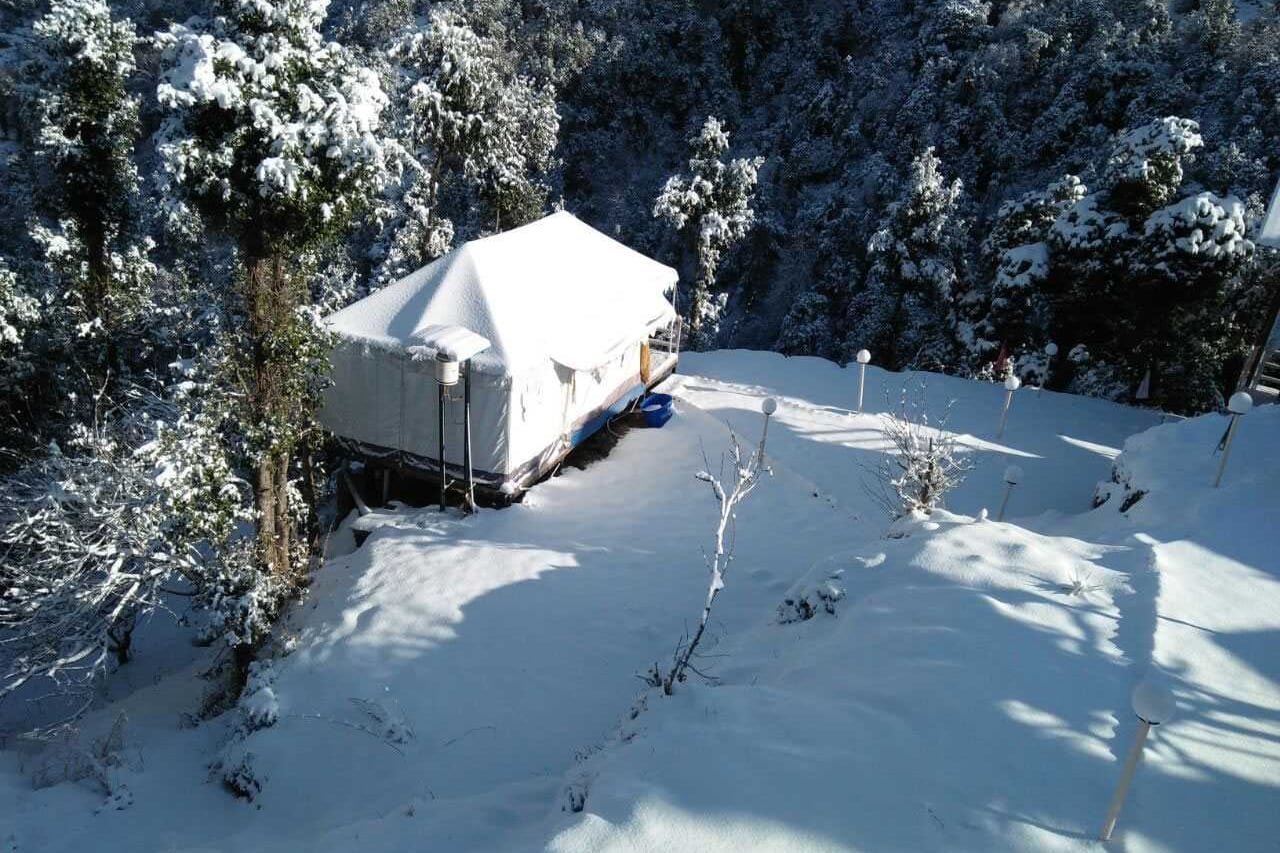
What cold and snow do to a tent
Cold on its own is a comfort problem. Snow is a structural one. A few centimetres of dry powder weigh little, but wet snow is dense, and drifting can pile far more on one side of a roof than fell on open ground. Canvas sags under that weight, the sag collects more snow, and if nobody clears it a pole or frame member eventually gives. Most winter tent damage starts this way rather than with the cold itself.
The second problem is moisture. People breathe, cook and dry clothes inside a tent, and that water vapour meets a cold roof and condenses. In a coated nylon or PVC shell it runs down the walls or freezes into frost that falls back on the occupants. Cotton canvas absorbs and passes some of that moisture, which is the main reason canvas is still preferred for long winter occupation.
Which tent structures cope best with snow
Steep, smooth roofs shed snow; flat or shallow ones hold it. Here is how the structures we make compare.
Our 20 ft yurt is skinned in 520 gsm treated cotton over a hardwood lattice and radial rafters, with a wool-blend insulating liner, and it is the structure we suggest first for a site that stays open through winter.
| Structure | Snow behaviour | Good for | Watch for |
|---|---|---|---|
| Yurt, 16 to 20 ft | Domed roof on rafters and a compression crown; strong and well insulated | Winter glamping, owner residences | Clearing the shallower upper roof after heavy falls |
| Bell tent | Steep cone sheds snow; short walls can be pushed in by drift | Short winter stays, events | One centre pole carries the load; keep walls and skirt clear |
| Tipi | Very steep; sheds snow well | Hearth tents, gathering spaces | Smoke flap management in wind |
| Framed safari or Swiss cottage | Depends on frame design and roof pitch | Year-round resort keys | Needs an engineer’s snow-load check for the site |
| Winterised relief tent | Snow-rated galvanised frame | Static camps, high altitude | Stove safety and guying |
| Expedition tent | Sleeved alloy poles and a snow valance | Mountaineering, mobile parties | Condensation in a nylon shell |
Snow load: get it checked, then manage it
Ground snow loads vary enormously from site to site and are set out in national building codes, which is why we do not quote a single snow rating that applies everywhere. If a tent will stand through winter as part of a business, ask us for the frame and roof drawings and have a structural engineer local to the site check them against the design snow load there. Your local authority may require that sign-off anyway for guest accommodation. On a custom commission we can adjust frame sections, rafter spacing and roof pitch once the engineer has a figure.
For relief and military camps, the Winterised Relief Tent combines a quilted liner, a snow-rated frame and a flued stove port with a heat-shield collar. Even an engineered tent needs managing. A practical winter routine:
- Clear snow from the roof during and after every significant fall, before it compacts. Push it off from outside with a soft broom or roof rake, never anything with a sharp edge.
- Keep snow away from the walls and skirt so drift does not push walls inwards or freeze the skirt to the ground.
- Keep the canvas taut. A sagging roof gathers snow and meltwater, so re-tension guys as temperatures change.
- If heavy snow is forecast and nobody can clear it, move guests out and consider lowering or striking the tent. An empty tent that collapses is a repair; an occupied one is an emergency.
- Inspect poles, rafters and frame joints after every heavy fall.
Canvas weight, liners and floors
Heavier cloth insulates a little better, resists wind better and holds its shape under load. For winter we use the top of our range: 480 gsm on the 16 ft Yurt, 520 gsm on the 20 ft, and 400 gsm on the 6M Bell Tent. The canvas is the weather layer; warmth comes from what you add inside it.
An insulating liner with an air gap behind it does most of that work. The floor matters as much as the roof, because cold ground draws heat away all night. Raise the tent on a deck with insulation beneath the boards, or at the very least lay a sealed groundsheet with an insulating layer and rugs on top. We go through this step by step in how to insulate a canvas tent for winter.
Condensation and ventilation in cold weather
Do not seal a winter tent completely. Without airflow, moisture from breath, wet boots and any heater builds up until it condenses on the coldest surface, soaks into liners and freezes overnight. Keep high-level vents partly open, air the tent during the day when the sun is on the roof, and dry liners and bedding regularly.
A fuel-burning heater turns ventilation into a safety matter, because it consumes oxygen and can produce carbon monoxide. A tent that feels stuffy is a tent that needs more air, whatever the temperature outside.
Heating a tent safely in the cold
For commercial sites the realistic options are a wood stove with a correctly fitted stove jack and flue, or electric heating where a proper supply exists. Either can work; neither is safe without the right fittings. A wood stove needs a fire-resistant jack in the roof or wall, the stove maker’s clearances to canvas, a spark arrestor and a carbon monoxide alarm. Never use an unflued gas or paraffin heater, or a barbecue, inside a tent. Our guide to using a wood stove in a canvas tent safely sets out the full list.
Good bedding narrows the gap a heater has to close. Our Nimbus −15°C Expedition Down bag is built for high camps where the margin is thin.
Cold-climate tents we have supplied
We have supplied cold-weather tents to the Indian Army for use in Ladakh, and tents to clients in Jammu & Kashmir, Ottawa and Montana. Each project started with the same questions: the lowest temperatures and heaviest snowfall the site sees, whether the tents stay up all winter or are struck, how they will be heated, and who will clear the roof.
If you can answer those, send them to us and we will suggest a structure and cloth. The 16 ft yurt and the Winterised Relief Tent are priced on enquiry, ex-works. Freight, duties and finishing change the landed cost.
Questions buyers ask
Can you use a canvas tent in snow?
Yes, canvas is the traditional material for winter camps. It breathes, so it handles condensation better than nylon, but the roof must be kept clear and the structure suited to the load.
What is the warmest type of tent for winter?
In our range, a yurt with its wool-blend liner on an insulated deck holds heat best. A bell tent with a liner and stove is a lighter, cheaper option for shorter stays.
How much snow can a tent hold?
There is no single figure; it depends on the frame, the roof pitch and the density of the snow. For a commercial structure left up in winter, have a local engineer check it against the site’s snow load, and clear the roof regardless.
Should I take my glamping tent down for winter?
If nobody will be on site to clear snow, or the tent is not designed for the load, yes. Strike it, dry it fully, store it and re-pitch in spring.
Why is my canvas tent wet inside in winter?
Almost always condensation from breath, cooking or heating meeting a cold roof. Improve ventilation, dry the liner regularly and keep the inner layer warmer with insulation.