Wind-rated tents and guying: how to keep a tent standing in wind
A wind rating on a tent only means something if you know how it was derived and how the tent was anchored at the time. What keeps a tent standing is the whole load path: pole or frame geometry, guy points sewn into structural seams, guy lines at a sensible angle, and anchors matched to the ground. For commercial and event structures, design wind speeds come from local codes and an engineer, and every site needs a set wind speed at which people leave the tent.
6 min read · Updated
What a tent wind rating means
There is no universal wind-rating scheme for tents. Some figures come from engineering calculations on a frame, some from wind tunnel or field testing, and some from the marketing department. A rating calculated for a frame ballasted with a stated weight on hard standing tells you nothing about the same frame on soft sand with half the ballast. Before relying on a number, ask how it was produced, at what gust speed, with what anchoring, and whether the walls were on or off.
For temporary event structures in Europe, EN 13782 is the standard that sets safety and design requirements for tents, including wind loading. Elsewhere authorities generally apply national building codes. Requirements vary by country and often by municipality, so confirm with your local authority what applies and whether an engineer’s certificate is needed. For permanent glamping keys, the design wind speed in the local building code for your site is the figure that matters.
Shape and frame decide most of it
A low, rounded shape sheds wind; a tall, flat-sided one catches it. Geodesic domes spread load across many crossing poles, which is why our Halo 4P Geodesic Dome stays up in conditions that flatten a two-hoop dome. Expedition tunnels such as the Vanguard 2P Expedition use sleeved alloy poles, which cannot part company with the fly the way a clip frame can.
Large canvas tents behave differently. A bell tent’s cone handles wind from any direction well once it is guyed all round. Framed safari and Swiss cottage tents have tall vertical walls and a gable that acts like a sail, so their frames, bracing and anchorage need more thought, especially where a veranda roof adds uplift.
Guy points and guy lines
A tent in wind usually fails first at a single guy point. When one tears out, its load moves to its neighbours and the failure travels round the tent. That is why we anchor every guy point to webbing that runs into a structural seam, never to the face of the cloth, and why our expedition shells carry sixteen of them. When you inspect any tent, look at how the guy points are made before you look at the canvas weight.
- Angle: as a rule of thumb, run guys out at roughly 45 degrees, in line with the seam they pull on. Too steep and the guy lifts; too shallow and it wastes length and trips people.
- Tension: firm and even all round. Canvas tightens when wet and slackens in sun, so check morning and evening in changeable weather.
- Line: low-stretch rope or cord with good UV resistance. Replace anything frayed or sun-bleached.
- Runners: wooden or alloy runners must grip. Replace any that slip under load.
- Storm guys: many tents have extra mid-height guy points. Rig them when strong wind is forecast, not once it has arrived.
Choosing anchors for the ground
An anchor is only as good as the ground it sits in. Use the table as a starting point, and test pull-out on your own site before you rely on it.
For framed structures such as the Outdoor Dining Marquee 10 × 20 or the Exhibition Clear-Span Hall, the ballast or anchor load at each leg should be specified by the supplier or an engineer for the expected wind, not guessed on the day of the build.
| Ground | Suitable anchors | Notes |
|---|---|---|
| Firm soil, grass | Steel pegs, long rebar or angle stakes | Drive at an angle away from the tent; go longer for larger tents |
| Loose sand | Sand stakes, buried deadman anchors, screw anchors into a firmer layer | Short pegs will not hold |
| Rock or gravel | Rock pegs, drilled anchors, ballast | Free-standing tents help where pegs fail |
| Timber deck | Through-bolted deck rings or eyes | Fix into joists, never only into deck boards |
| Tarmac or concrete | Ballast weights, drilled anchors where permitted | Ballast mass should come from a calculation |
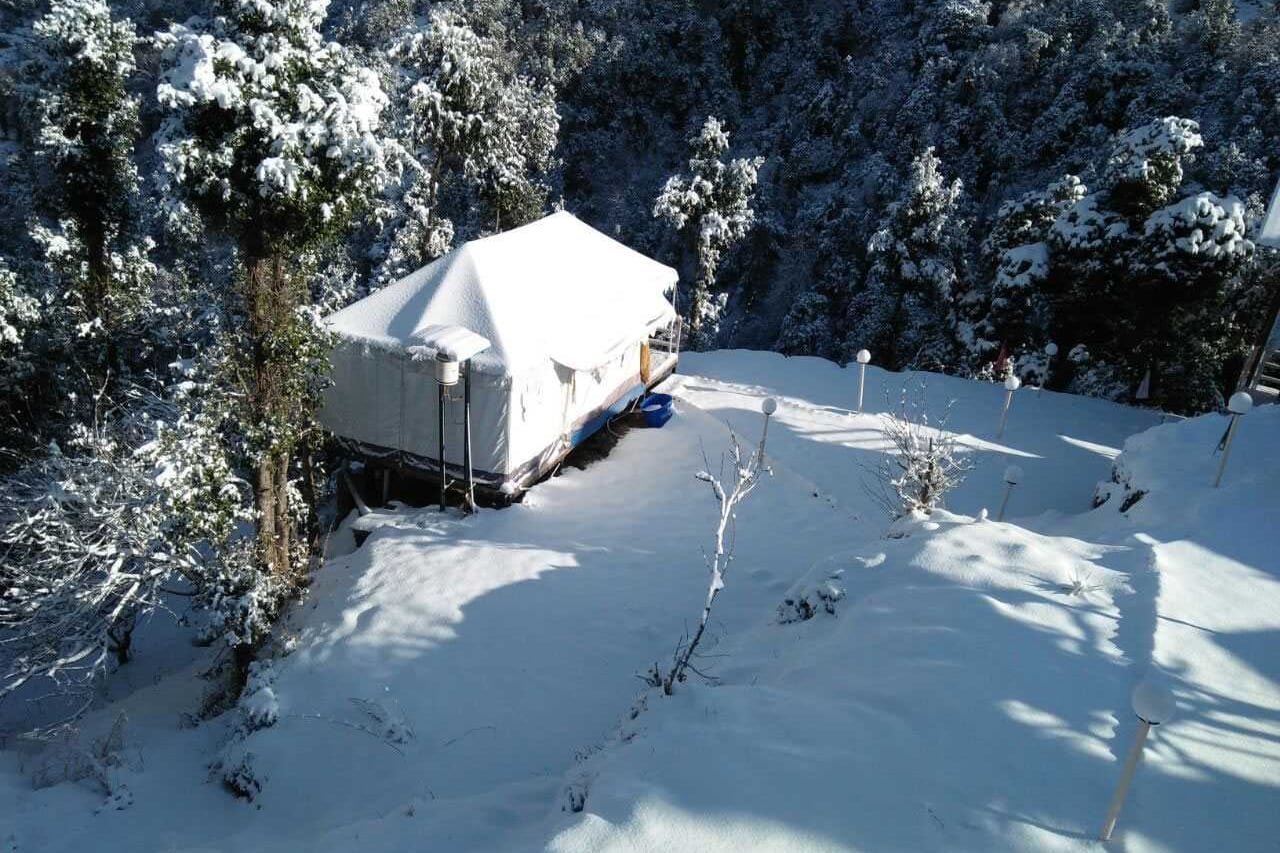
| Snow | Snow stakes, buried deadmen | Anchors freeze in overnight; dig out with care |
Pitching and orientation for wind
Where you have a choice, pitch with the narrowest, lowest end into the prevailing wind and put doors on the lee side. Use natural shelter such as hedges, walls and the lee of a slope, but keep clear of trees that could drop branches; a falling limb is a greater danger than the wind itself.
Close doors and windows before strong wind arrives. A tent open on one side fills like a sail and is pushed up from inside, which is when frames bend and floors tear away.
Operating limits and when to leave the tent
Every commercial tent site should have a written wind procedure. Set a wind speed, taken from the manufacturer’s or engineer’s figures, at which guests move to a solid building, and a lower one at which staff walk the site checking guys and anchors. Keep a reliable forecast service and an anemometer on hand. Event structures especially need this agreed in advance, because clearing a crowd takes time.
When severe weather is forecast, striking the canvas is often the safest course. Our guide to glamping in hurricane and cyclone regions covers the planning for that.
Specifying tents for an exposed site
If your site is exposed, whether on a coast, a ridge or an open plain, say so when you enquire. On a custom commission we design the anchoring for the site, and we check frame loading per structure as set out on our craftsmanship page. Where a local engineer must sign off, we supply drawings and material data for them to work from.
Start with the custom tent configurator or contact us with the location and use. The Outdoor Dining Marquee and the Halo 4P are priced on enquiry, ex-works; freight, duties and finishing change the landed cost.
Questions buyers ask
How much wind can a canvas tent withstand?
It depends on the tent’s shape, frame, guy points and anchoring, so treat any single figure with care. Ask how a rating was derived and with what anchoring, and set a site limit at which people leave.
What angle should tent guy lines be?
Around 45 degrees from the tent is a sound rule of thumb, in line with the seam the guy pulls on. Keep the tension even all round.
Should tent doors be open or closed in wind?
Closed. A tent open on one side fills with air and is lifted from inside, which strains the frame, the anchors and the floor.
What pegs are best for windy sites?
Long steel stakes in firm soil, screw anchors or buried deadmen in sand, and through-bolted fixings on decks. Test pull-out on your own ground before trusting any of them.
Do event tents need wind certification?
In many places they do. Requirements vary, so check with your local authority; in Europe, EN 13782 is the usual reference for temporary tent structures.