Tent samples and quality inspection: what to check before you pay
Sample in layers: a fabric swatch kit to confirm cloth and colour, a finished sample unit to judge the build, and a pre-shipment inspection before the balance is paid. Check canvas weight by weighing a measured square, look hard at seams, guy points, eyelets, zips and frame finish, and ask for the ISO 811 water-column result and any fire certificate for the actual fabric lot. Keep the approved sample as the reference the order is judged against.
6 min read · Updated
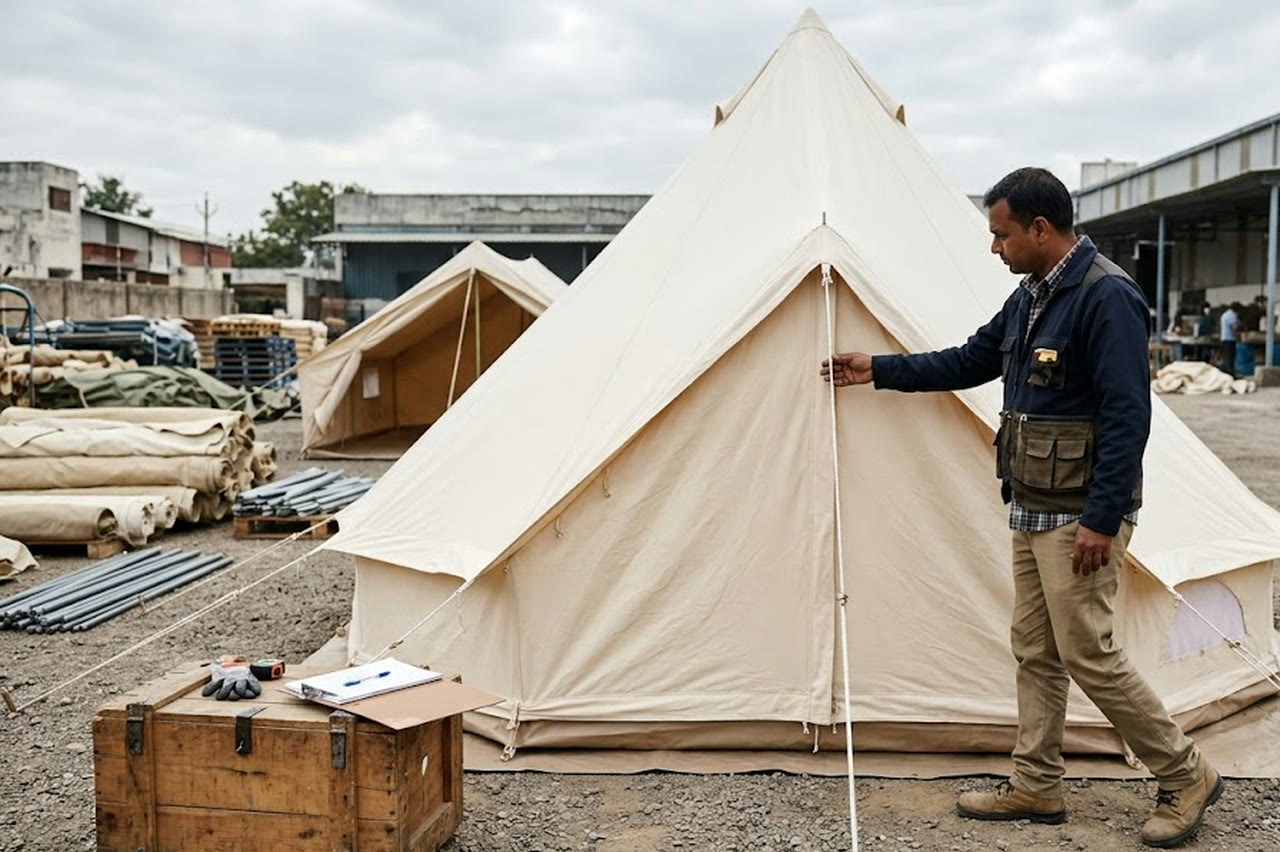
Four kinds of tent sample and when each is worth it
Not every order needs every kind of sample. Match the sampling to the risk: a repeat order of a catalogue tent needs little, a first order from a new supplier needs more, and a custom structure needs its new details proven before production.
- A swatch kit holds cuttings of each cloth with its data and confirms colour, hand and weight. Qualified trade enquiries receive ours at no cost, with a six-page technical deck.
- A strike-off is a printed or dyed test for a custom colour, a camouflage pattern or a logo, approved before the full run.
- A junction prototype is a made and tensioned version of the new details in a custom design. We do this on every bespoke commission.
- A full sample unit is one finished tent, pitched on your own site. With no minimum order, this is a normal single-unit purchase.
How to check tent canvas yourself
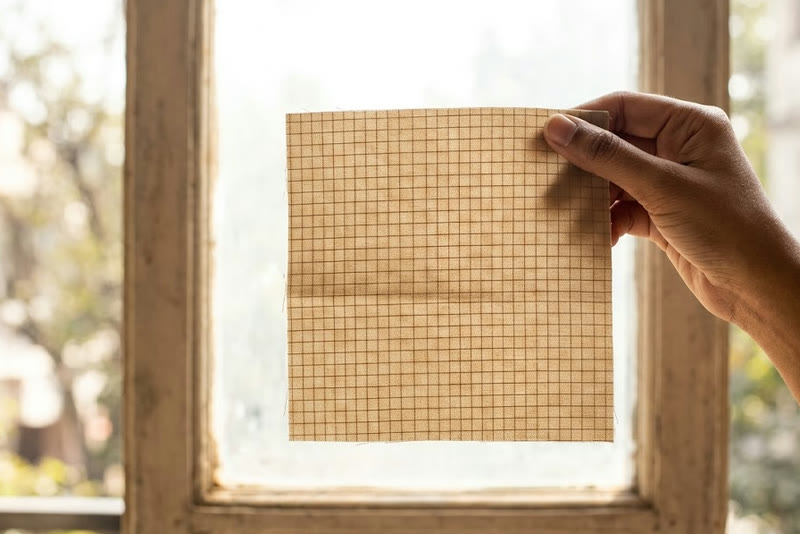
GSM is grams per square metre, and it is easy to check. Cut a 10 × 10 cm square from a swatch, weigh it on a kitchen scale that reads to 0.1 g, and multiply by 100. A 3.6 g square is 360 gsm cloth. Allow a few per cent either way for weave and finish, but a 360 gsm claim that weighs in near 300 is a different cloth.
Water resistance is not something you can judge by pouring a glass of water on a swatch. Ask for the hydrostatic head result to ISO 811 for the fabric lot. Our treated tent canvas holds a 1,500 mm water column; coated polyester and nylon hold 3,000 mm. Cotton also behaves differently when new: it swells shut on first wetting, so a brand-new cotton tent should be weathered before you judge it. Look at the weave against the light as well. An even, tight weave with no thin patches matters more than the colour.
What to inspect on a sample tent
Pitch the sample fully, guy it out, and leave it standing through some weather if you can. Then go over it with this list. The 6M Bell Tent and the safari range are good examples of what a properly finished structure should show.
| Check | How | What good looks like |
|---|---|---|
| Seams | Look along every structural seam, inside and out | Straight, even stitch length, no skipped stitches, double-stitched or felled where it carries load |
| Guy points | Pull hard on each one | Load runs into webbing sewn into a seam, not into the cloth face |
| Eyelets | Check material and fixing | Solid brass or rustproof, firmly set, reinforced patch behind |
| Zips | Run every zip fully, under tension | Heavy coil zips, smooth travel, storm flap over door zips |
| Frame | Inspect cut ends and joints | Even galvanising or powder coat, no bare cut ends, connectors that seat fully |
| Dimensions | Measure footprint and height | Matches the specification within a stated tolerance |
| Groundsheet | Check seams and the join to the wall | Welded seams, a raised edge or zip-in join that keeps water out |
Keeping the approved sample as the reference
Once you approve a sample, label it, photograph it and keep it. Write down anything you want changed and get the change confirmed in writing. The production order should then be judged against that sample and the written specification, not against memory. If you prefer, we keep a matching counter-sample in New Delhi so both sides refer to the same thing.
Pre-shipment inspection
For larger orders, many buyers appoint an independent inspection company to check goods before the balance is paid and the shipment leaves. Inspectors usually pick units at random using an acceptance sampling plan based on ISO 2859-1 (often called AQL), open them, and compare them with the approved sample and specification. Agree the plan and what counts as a major or minor defect before production, not on inspection day.
You do not have to use a third party. Some buyers check by live video, which works well for counting, measuring and looking at finish, or visit themselves. We are happy to host inspectors at our workshop in New Delhi.
Which test papers to ask for
Paperwork should relate to the fabric lot used in your order, not a generic sheet from years ago. Our routine checks are listed on the quality assurance page: water column to ISO 811 for each fabric lot, seam tensile strength for each construction, static and wind loading for each structure, and a check of every cut panel against its pattern.
For fire-retardant work, ask for the lot test certificate. Our fire-retardant canvas is supplied with it. Confirm with your venue, insurer or local authority which standard they accept, because a certificate to one standard does not satisfy a rule that names another.
Checking the order when it arrives
When the shipment lands, open one unit of each type before the installers start and compare it with the approved sample: cloth colour and weight, seam finish, hardware, and the count of poles, pegs and guy lines against the packing list. Pitch it if you can. A missing frame connector found on day one is a parcel by air; found on opening weekend, it is a closed tent.
If something does not match, photograph it next to the reference sample, note the package number and tell the manufacturer straight away. Clear evidence and a reference both sides agreed on make these conversations short. For anything you are unsure about before ordering, ask us for a swatch kit or a sample unit.
Questions buyers ask
Do you send free samples?
Fabric swatch kits and our technical deck go to qualified trade enquiries at no cost. A full sample tent is a normal single-unit purchase, since nothing in the catalogue has a minimum order.
How do I check canvas GSM without lab equipment?
Cut a 10 × 10 cm square, weigh it in grams and multiply by 100. A square weighing 3.6 g is 360 gsm.
Why does my new cotton sample tent let in a little water?
New cotton canvas needs weathering: it swells shut after its first thorough wetting and drying. Wet it down, let it dry fully, and judge it after that.
Can I send my own inspector to your factory?
Yes. Independent inspectors are welcome at our New Delhi workshop, and we can also do a live video walk-through of a finished order.
What is an AQL inspection?
It is a random sampling inspection based on ISO 2859-1, where the number of units checked and the number of defects allowed are set by the order size and the agreed quality level.