Shamiana tents: a buyer’s guide
A shamiana is an open-sided canopy on poles with a deep scalloped valance and a decorated underside, the standard cover for weddings and gatherings across north India. Judge one on its cloth, whether the decoration is real appliqué or a print, its frame, and how it links into larger bays. Our Rajasthani Shamiana is 6 × 6 m in 360 gsm cotton canvas with hand-appliquéd panels, priced on enquiry. It is a sun and dew canopy first, so plan for heavy rain separately.
6 min read · Updated
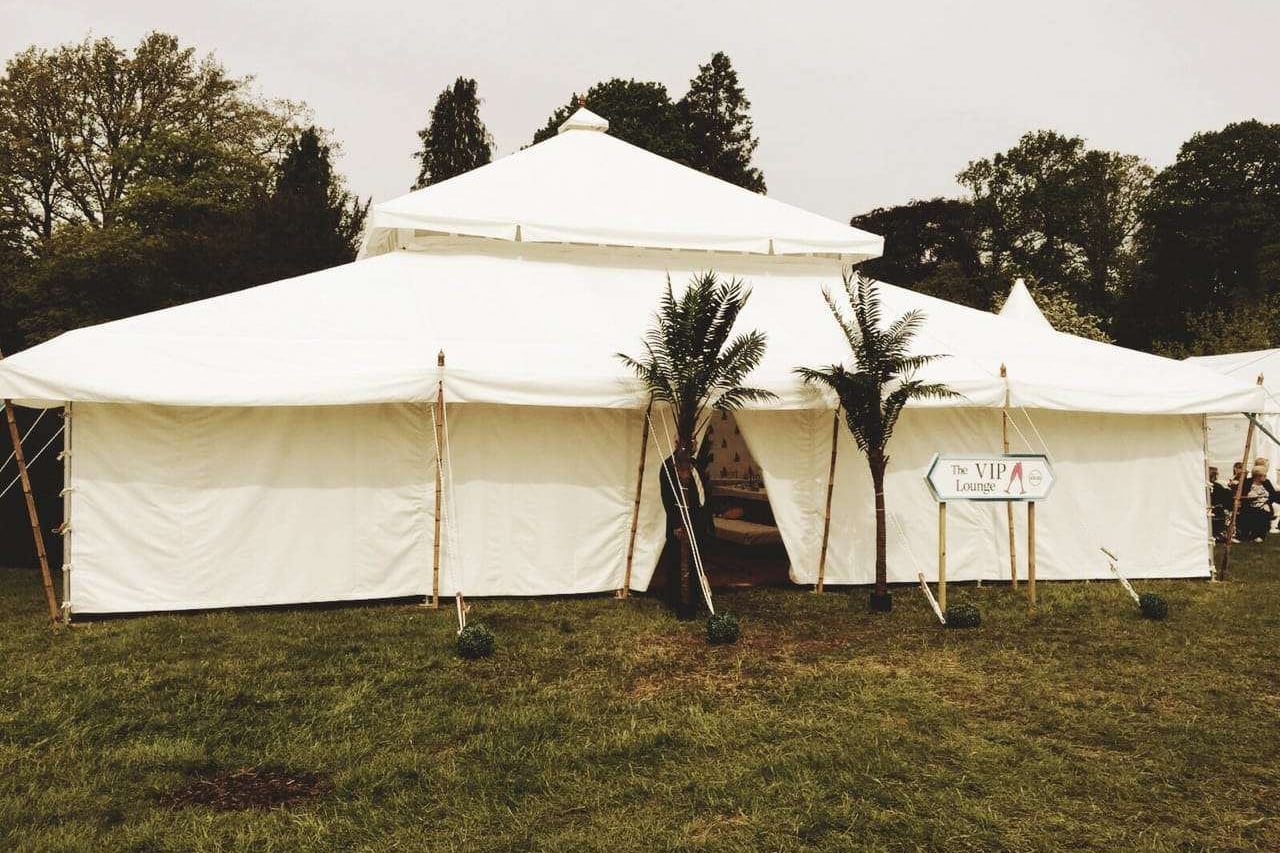
What a shamiana is, and how it differs from a marquee
A shamiana is a flat or gently crowned canopy held up on posts at the corners and along the edges, open on all sides unless screens are added. What makes it a shamiana rather than a plain canopy is the dressing: a deep valance cut into scallops around the edge, and an underside covered in appliqué, block print or painted work, so the ceiling is the decoration.
A marquee is built to enclose. It has a pitched roof that sheds rain, walls that close and usually a heavier frame. A shamiana is built to shade a crowd and look generous while doing it, which is why it remains the first choice for weddings, religious gatherings, community meals and garden receptions in India and among Indian families abroad. Traditionally the posts were bamboo or timber held with rope and pegs; ours use powder-coated steel posts with cotton rope and wooden pegs.
Parts of a shamiana: canopy, valance, kanats and posts
Suppliers use trade terms freely, so it helps to know what each piece is and what to ask about it.
- Canopy: the roof cloth. Ask for its weight in gsm and whether it is cotton, poly-cotton or PVC. Ours is 360 gsm cotton canvas.
- Underside or lining: the decorated face guests look up at. On a good shamiana this is the canopy itself or a fitted lining, not a loose sheet pinned beneath.
- Valance: the scalloped border, often called the jhalar. Deeper valances look richer and hide the frame; ours runs on all four sides.
- Kanats: the panelled side screens, used to close one or more sides for privacy, wind or a backdrop. Ours are available separately.
- Posts, ropes and pegs: corner and edge posts, guy ropes and ground pegs. On paving, ballast replaces pegs.
Hand appliqué, block print or a printed imitation
Decoration is where shamiana prices diverge most, and where buyers are most often disappointed. Hand appliqué means shapes cut from coloured cloth and stitched onto the base fabric one by one. It is slow, it lasts as long as the canvas, and the colours do not wash out because they are separate cloths. Turn a panel over and you will see stitch lines tracing every motif.
Hand block printing stamps the pattern with carved wooden blocks. Our Jaipuri Block-Print Canopy is printed by hand in Sanganer with azo-free dyes, and the repeat drifts slightly from block to block, which is how you tell it from a machine.
Screen or digital prints imitate both at a fraction of the cost. They are perfectly serviceable for a single season of hire, but the pattern sits on the surface and fades with sun. If a quote looks low for an “appliqué” shamiana, ask for a close photograph of the reverse.
Shamiana sizes, linked bays and how many people fit
Shamianas are sold by the bay. Ours is a 6 × 6 m bay with a 2.6 m eave, and further bays link to it for larger covers. Linking keeps the valance continuous on the outside, but there will be posts at the internal corners, so lay out tables around them. The capacities below use the usual industry rules of thumb of 0.6-0.8 m² per guest standing and 1.0-1.3 m² per guest seated at round tables. They are a starting point only: check them against your local fire and egress rules.
| Layout | Covered area | Standing | Seated at rounds |
|---|---|---|---|
| One bay, 6 × 6 m | 36 m² | 45-60 | 28-36 |
| Two bays, 6 × 12 m | 72 m² | 90-120 | 55-72 |
| Three bays, 6 × 18 m | 108 m² | 135-180 | 83-108 |
| Four bays, 12 × 12 m | 144 m² | 180-240 | 110-144 |
Is a shamiana waterproof? Rain and wind limits
Our shamiana canvas carries a 1,200 mm water column, so dew and a passing shower run off without trouble once the cotton has swollen. The weak point is the flat shape. A flat canopy lets water collect in any slack area, and a pool of rainwater is heavy enough to stretch the cloth and strain the posts. Keep the canopy taut, crown the centre slightly so water has somewhere to go, and in the monsoon months either fit a PVC waterproof tarpaulin as a hidden rain fly over the decorated canopy or choose a pitched structure for the main event.
Open sides mean the wind passes through, which is good, but the canopy still lifts like a sail. Every post needs its guy rope pegged out, and on hardstanding the ballast must be calculated for the site rather than guessed. Our guide to wind-rated tents and guying covers the principles.
Shamiana fire safety with havans, diyas and heaters
Weddings and religious gatherings bring flame under the cloth: a havan fire, diyas, cooking, heaters. Untreated cotton burns, and appliqué adds layers of it. If there will be any open flame, ask for flame-retardant treatment, keep the fire well below the canopy with open sides for smoke to escape, and use certified fire-retardant curtains for any screens near a stage or lighting. Many venues abroad will not admit a structure without a fabric certificate; read our guide to fire-retardant tent canvas and confirm the requirement with the venue or local authority before ordering.
Ordering, shipping and looking after it
Colours and appliqué patterns can be chosen at order, and we can match an existing set if you send photographs. A shamiana packs flat with its posts, so it ships economically by sea or air; our guide on importing tents from India covers the paperwork and the duty classification questions to ask.
Never pack a shamiana damp: appliqué traps moisture between layers and mildew follows within days. Dry it fully, fold it loosely and store it off the floor. Browse the traditional Indian tents range or send your guest count and site details through the contact page for a quote.
Questions buyers ask
Is a shamiana waterproof?
It sheds dew and light rain well, ours has a 1,200 mm water column, but a flat canopy can pond in heavy rain. For the monsoon, add a rain fly over it or use a pitched structure.
How many people fit under one shamiana?
A single 6 × 6 m bay holds roughly 28-36 seated at round tables or 45-60 standing by the usual rules of thumb. Confirm the figure with your local fire authority.
What is a kanat?
A kanat is a panelled side screen that closes one side of a shamiana for privacy, shelter from wind or as a decorated backdrop. They are sold separately from the canopy.
Can a shamiana be shipped outside India?
Yes. It packs flat with its posts and ships by sea or air. Freight, duties and local fire-certification requirements are the things to check before ordering.
How can I tell real appliqué from a print?
Look at the reverse. Real appliqué shows stitching around every motif, and the colours are separate pieces of cloth rather than ink on the surface.