Fire-retardant tent canvas and the standards that matter
Fire-retardant (FR) canvas is treated or made so that it resists ignition and stops burning once the flame source is removed; it is not fireproof. Which standard applies depends on the country, the use and the venue: CPAI-84 and NFPA 701 are common in the US, BS 7837 for UK marquees, EN 13501-1 classes in Europe and AS 1530.2 in Australia. Buy FR cloth with a lot test certificate that matches the delivery, and confirm the required standard with your local fire authority before you order.
6 min read · Updated
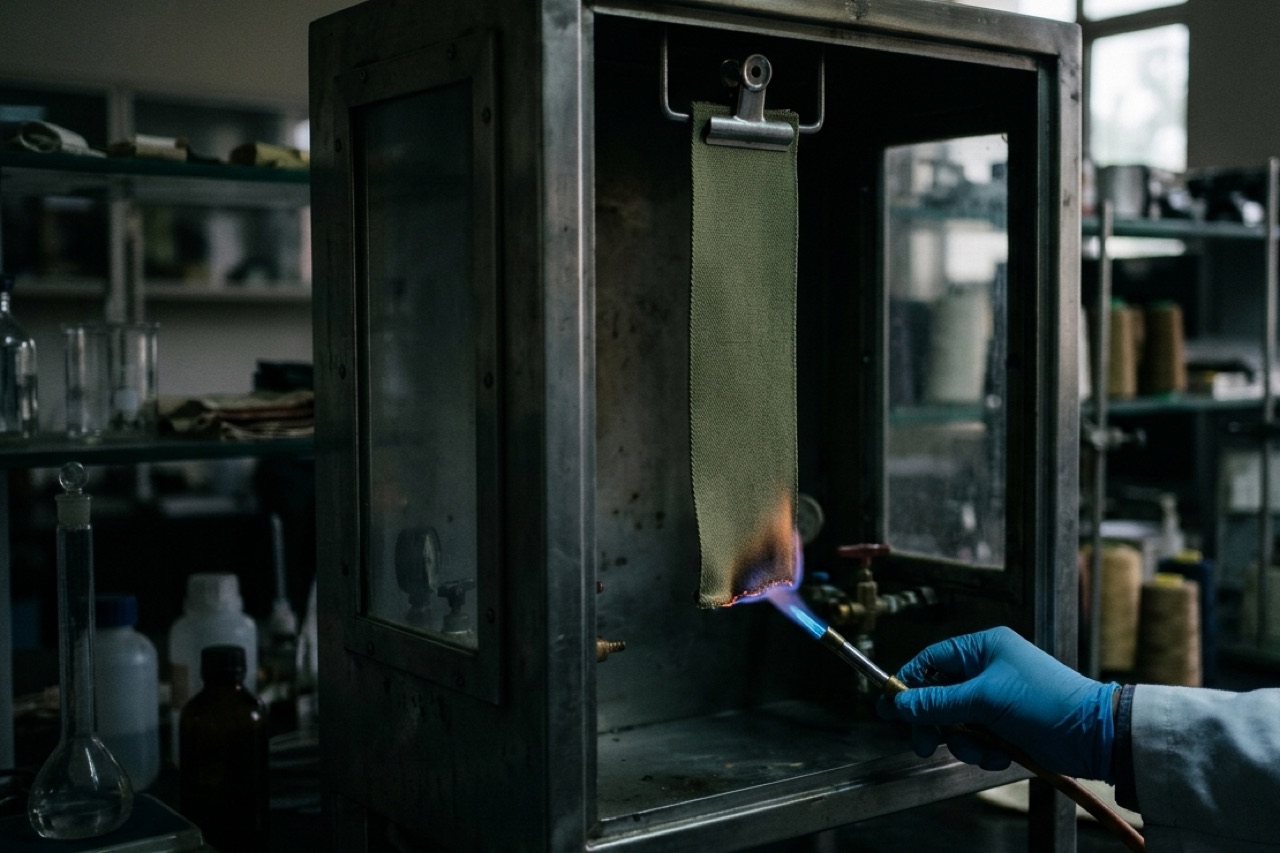
What fire-retardant means on tent canvas
Untreated cotton burns readily. A fire-retardant treatment changes how the fibre behaves in a flame: it chars rather than flaming, and the flame stops spreading and goes out once the ignition source is taken away. That buys time to get out and limits how far a fire travels across a roof or wall. It does not mean the cloth cannot burn. A sustained heat source, such as a heater against a wall or a fire beneath a canopy, will still destroy FR canvas.
Test methods measure things like after-flame time (how long it keeps burning after the flame is removed), after-glow, char length and whether burning droplets fall. Each standard sets its own pass levels, which is why one certificate does not automatically satisfy another jurisdiction.
The sample matters as much as the method. Tests are run on specific specimens, sometimes after a prescribed ageing, washing or weathering cycle, and in a stated orientation. A pass on new, unwashed cloth tells you less about a roof in its third season than a pass after accelerated weathering. When you compare certificates from two suppliers, check that they report the same standard, the same edition and the same conditioning, otherwise you are not comparing like with like.
Treated, durable and inherent FR
FR treatment usually adds some weight and stiffness and can slightly reduce tear strength, so a good FR canvas is specified with those effects in mind rather than treated as a free upgrade.
- Non-durable treatments are applied salts that work well until the cloth is washed or soaked repeatedly, then wash out. Fine for indoor drapes cleaned rarely; a poor choice for a tent that sees rain all season.
- Durable treatments are chemically fixed to the fibre and survive weathering and cleaning far better. This is what we use on Fire-Retardant Canvas, a cotton-polyester cloth that is also rot and mould treated.
- Inherently FR materials have flame resistance built into the polymer, and FR-grade PVC coatings are compounded with flame retardants. Our exhibition halls and the Fire-Retardant Tarpaulin use FR PVC-coated polyester.
The standards you are most likely to be asked for
This is a practical summary, not legal advice. Requirements change and vary by state, county and venue. Confirm with your local fire authority or venue before you specify.
| Region | Standard | What it is generally used for |
|---|---|---|
| USA | CPAI-84 | Flame resistance of materials used in camping tents |
| USA | NFPA 701 | Flame propagation of textiles and films; widely cited for tents, drapes and membranes in public assembly |
| California | Title 19 / State Fire Marshal registration | Flame-retardant fabrics and treatments used in places of assembly |
| UK | BS 7837 | Flammability performance of textiles for marquees and similar structures |
| UK | BS 5438 | Test method for vertically oriented textiles, referenced by other specifications |
| EU | EN 13501-1 | Reaction-to-fire classification for construction products, often asked for on semi-permanent structures |
| France / Germany | M-classes (NF P92-503) / DIN 4102 B1 | National classifications still commonly requested by venues |
| Australia | AS 1530.2 | Flammability test for materials, commonly referenced for tent and marquee fabrics |
Where FR canvas is required, and where it is sensible anyway
Requirements usually attach to public use: event marquees, exhibition tents, restaurant canopies, temporary venues, and in some places glamping units that count as guest accommodation. Our Exhibition Tents use FR-certified PVC as standard, the Command Post Tent is FR-treated, and the Restaurant Canopy Project is offered in FR cloth wherever the venue needs certification.
Even where it is not required, FR is worth considering for any tent with a stove, a kitchen, heavy electrical load or high guest turnover. It is no substitute for clearances, a proper flue kit and alarms; see using a wood stove in a canvas tent safely.

Certificates: what to ask for and what to check
A fire officer or venue manager wants paper, and the paper has to match the cloth. When you order FR fabric, ask for the test certificate for the production lot, not a generic certificate from years ago. Check that it names the standard and edition, the fabric description and weight, the colour if relevant, the test laboratory and the date. Keep a copy with the tent and label the tent so the lot can be traced.
We supply Fire-Retardant Canvas, the Fire-Retardant Curtain and the FR tarpaulin with the lot test paperwork. If your authority requires testing by a specific laboratory, or registration in your state, tell us before production so it can be arranged.
Keeping FR performance over the life of the tent
Durable treatments still wear over time. Aggressive cleaning, bleach, high-pressure washing and some waterproofing products can reduce FR performance. Clean with plain water and a soft brush, check any reproofer is compatible with FR fabric, and ask whether the certificate covers the cloth after weathering. Some jurisdictions expect FR fabric to be re-tested or re-treated at intervals; your fire authority will say how often.
Repairs matter too. A patch of untreated canvas on an FR roof is a weak spot, so use offcuts from the same lot or a certified FR patch fabric. FR thread and FR seam tape exist for the same reason.
Cost and ordering
Our Fire-Retardant Canvas costs more per metre than standard 360 gsm treated cotton; both are priced on enquiry, and freight, duties and certification requirements change the landed cost. On a whole tent the FR premium is a modest share of the price. Tell us the standard you need and where the tent is going, and we will confirm what we can certify to before you commit.
Questions buyers ask
Is fire-retardant canvas fireproof?
No. It resists ignition and stops burning when the flame source is removed, but it will still burn or melt under sustained heat. Clearances from stoves and heaters still apply.
Which fire standard does my tent need?
It depends on the country, the use and the venue. Ask your local fire authority or venue which standard and which edition they accept before you order.
Does FR treatment wash out?
Non-durable treatments do. Durable treatments survive weathering and cleaning far better, but harsh detergents, bleach and pressure washing can still reduce performance.
Can I make my existing canvas tent fire-retardant?
Spray-on FR products exist, but achieving and certifying a specific standard on an existing tent is difficult. For certified use, buy cloth that was treated and tested at the mill.
Do glamping tents need to be fire-retardant?
In some regions and licensing schemes, yes; elsewhere it is advisable rather than required. Check with your local authority and your insurer.