Pagoda tent vs frame marquee: which should you buy?
A pagoda is a square module, usually 3 × 3 to 6 × 6 m, with a tall peaked roof. It goes up quickly with two people and links into rows, but each unit is small and every join needs a gutter. A frame marquee is a structure of fixed width extended in bays, with no internal poles, so it gives one large uninterrupted room. Choose pagodas for stands, entrances, bars and flexible small spaces, and a frame marquee for seated dinners, launches and anything over about a hundred guests.
6 min read · Updated
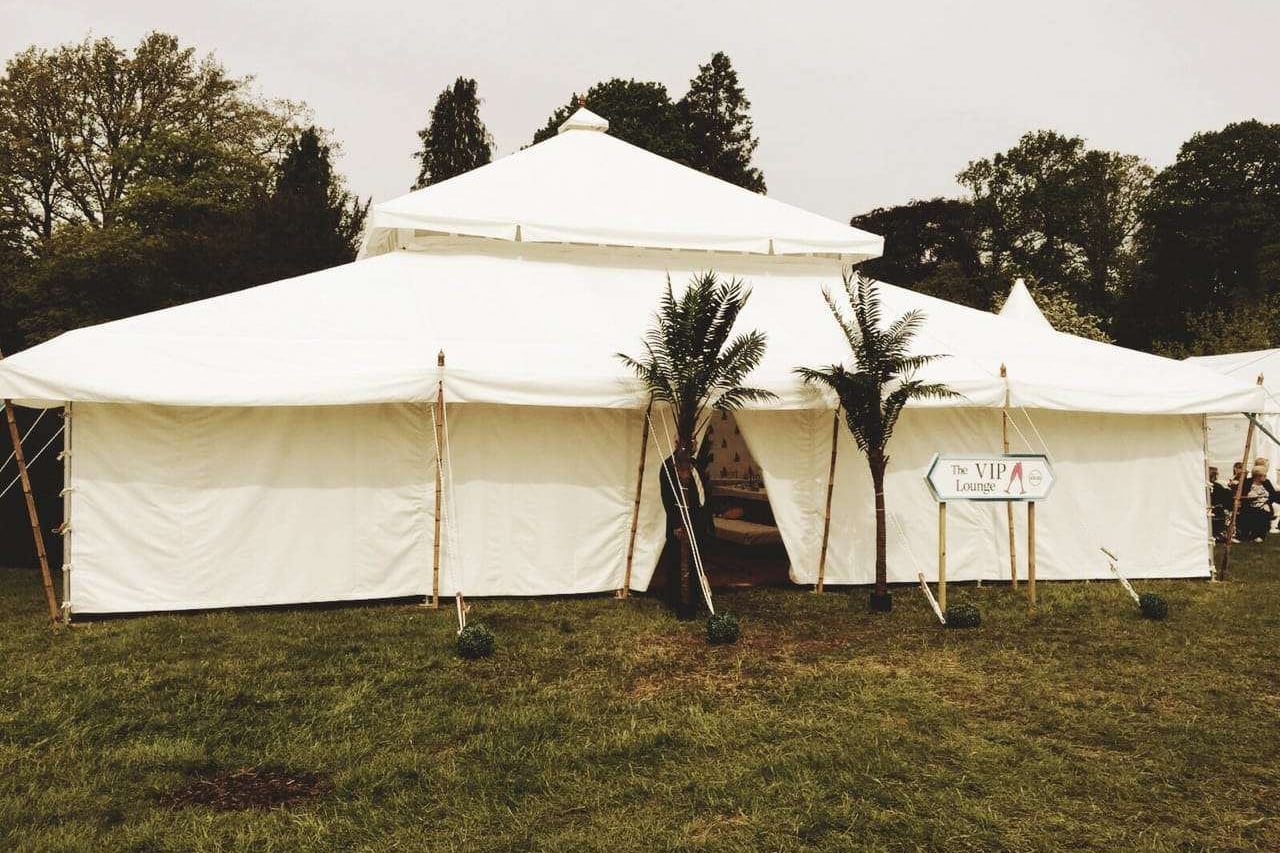
What is a pagoda tent, and what is a frame marquee?
A pagoda is a square aluminium frame with four legs and a roof that rises steeply to a central peak, giving that oriental silhouette. Our Pagoda Exhibition Tent 3 × 3 has a 2.4 m eave and a 4.0 m peak; the 5 × 5 model keeps the 2.4 m eave and lifts the peak to 5.0 m. Both use 550 gsm PVC-coated polyester, supplied with a fire-retardant certificate.
A frame marquee is built from portal frames, a pair of legs joined by roof rafters, set at regular intervals called bays. The width is fixed by the rafter; the length grows by adding bays. Because the frame carries itself, there are no poles in the middle of the floor. In the trade it is also called a clear-span tent, and our guide to clear-span tents goes deeper. Our Outdoor Dining Marquee is a compact steel version at 3 × 6 m; the Exhibition Clear-Span Hall is 10 m wide in 3 m bays.
Pagoda vs frame marquee: sizes, weights and prices
The figures here are from our own catalogue. Ex-works prices are a guide only; freight, duties, ballast and flooring change the landed cost.
| Pagoda tent | Frame marquee | |
|---|---|---|
| Shape | Square module, peaked roof | Rectangle, fixed width, extends in bays |
| Our sizes | 3 × 3 m and 5 × 5 m | 3 × 6 m steel; 10 × 15 m aluminium, extendable |
| Internal poles | None within a unit; legs at every join when linked | None along the full length |
| Height | 2.4 m eave, 4.0-5.0 m peak | 2.6 m eave, 3.8-4.8 m ridge |
| Build | About twenty minutes with two people (3 × 3) | A crew and a day or more for large halls |
| Roof cloth | 550 gsm FR PVC-coated polyester | 440 gsm poly-cotton or 650 gsm FR PVC |
| Weight | 62 kg (3 × 3), 118 kg (5 × 5) | 210 kg (3 × 6), 640 kg (10 × 15) |
| Best for | Stands, entrances, bars, market stalls | Seated dinners, launches, halls |
| Catalogue price | On enquiry | On enquiry |
When to choose a pagoda tent
Pagodas are flexible. Ten 3 × 3 m units can be ten separate stands at a trade fair one week and a continuous run of market stalls the next. Each one is light enough for two people to carry and build, and the steep peak reads from a distance across a busy field or hall, which matters when the tent is the sign.
They also suit the supporting roles at a larger event: an entrance canopy, a bar, a cloakroom, a VIP area beside the main marquee. Because the roof and wall panels can be printed to your artwork, a pagoda doubles as branding. For trade-fair use, our exhibition tent guide covers what organisers will ask for.
When to choose a frame marquee
Once the guest count passes fifty or so, people expect one room rather than a set of joined boxes. A frame marquee gives a continuous ceiling, which makes linings, lighting rigs and air-conditioning ducts straightforward, and a clear floor for round tables, a dance floor and a stage. One roof means no gutters over the guests’ heads.
Frame marquees also take walls better. A long, straight eave line accepts PVC, canvas, glazed or hard walls in standard panels, so the structure can be fully closed for a winter dinner or opened up in summer. For anything seated over a hundred guests, a frame marquee is almost always the cleaner answer. Size it with our marquee size guide.
Linking pagoda tents: gutters, rain and height steps
Our pagodas link flush to their neighbours, and the 5 × 5 m units join the 3 × 3 m units on the same connector. That flexibility comes with one weak point: wherever two roofs meet, rain from both runs into the join. Use a proper gutter at every link, make sure it falls to an end where the water can go, and never seat guests directly under a join in a forecast of heavy rain.
A row of mixed sizes has peaks at 4.0 and 5.0 m. Planned, that rhythm looks deliberate; unplanned, it looks like whatever was in the van. Draw the layout before you order.
Cost per square metre and running costs
Bigger structures cost less per square metre of cover: a large clear-span hall spreads its frame and cloth over far more floor than a 3 × 3 m pagoda does. The small steel marquee is the most expensive per metre because it is the most compact way to buy a frame structure at all. Ask us for a quotation on the sizes you are comparing and divide each by its floor area.
Running costs point the other way. Pagodas store in a small space, travel in a van and need two people. A clear-span hall needs a truck, a crew, ballast or anchors and usually flooring, and its long components need racking in the warehouse. Those costs belong in the comparison as well.
Using both on one site
Many event layouts combine the two: a clear-span hall as the main room, with pagodas as the entrance, the bar, a catering station and the covered link to the toilets. If you are building rental stock, owning both lets you quote for almost any brief. Browse the exhibition tents and event structures ranges, or send us a site plan through the contact page and we will suggest a mix.
Questions buyers ask
What is the difference between a pagoda and a marquee?
A pagoda is a square module with a high peaked roof, built to be linked in rows. A frame marquee has a fixed width and extends in bays to make one large room without internal poles.
Can pagoda tents be joined together?
Yes. Ours link flush, and the 5 × 5 m and 3 × 3 m units share a connector. Fit a gutter at every join to deal with rain.
Which is cheaper per square metre?
Large clear-span halls are cheapest per square metre of cover, and small pagodas the dearest. Our event structures are priced on enquiry, so ask us to quote the sizes you are comparing.
How long does a pagoda take to put up?
Our 3 × 3 m pagoda goes up in about twenty minutes with two people once they have done it a few times.
Are pagoda tents fire-retardant?
Ours use 550 gsm PVC-coated polyester with fire-retardant certification supplied. Check which standard your venue or local authority requires before ordering.