Safari tent vs Swiss cottage tent: how to choose for a resort
Both are framed, standing-height resort tents. A safari tent is built around a veranda, a high ridge and an attached bathroom annexe, and sells a premium, outdoorsy suite. A Swiss cottage is a rectangular ridge tent with vertical walls and a floor tray that gives usable space to the edges, and is the repeatable workhorse of resorts running many keys. Ours start at $1,200 (safari) and $530 (Swiss cottage 10 × 20 ft).
6 min read · Updated
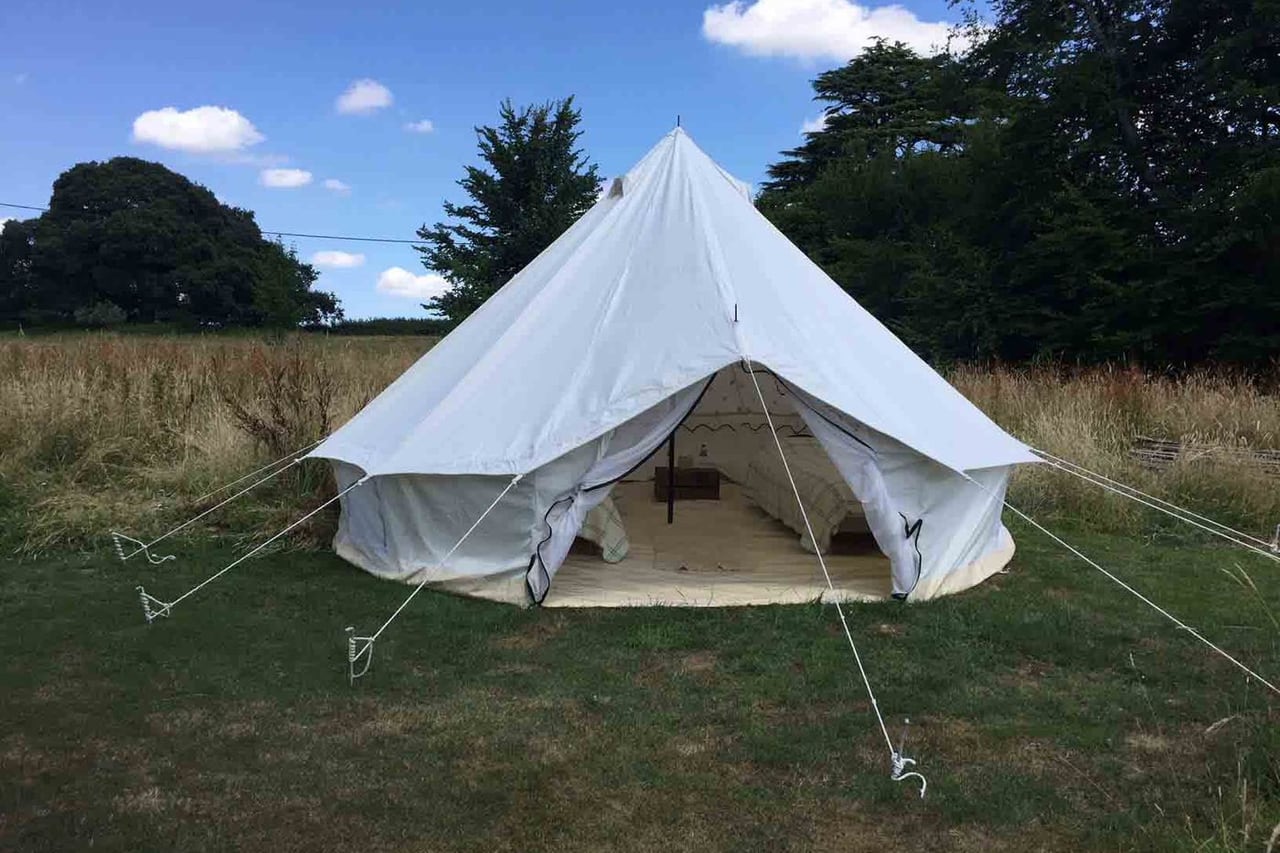
How a safari tent and a Swiss cottage differ
Buyers often put these two side by side because both are rectangular, both stand on steel frames and both give a guest full standing height. The difference is in what each is designed around.
A safari tent is designed around the experience of arriving: a deep covered veranda, a tall ridge, roll-up walls with mesh screening, and a bathroom annexe at the back. A Swiss cottage is designed around the floor plan. Its vertical walls and flat floor tray mean the bed, wardrobe and furniture can go right against the canvas, so every square foot is usable. That is why properties running twenty or more keys often standardise on our Swiss Cottage 10 × 20 and nothing else.
Frames, canvas and floors
Our safari tents use hot-dip galvanised steel frames and ripstop poly-cotton: 440 gsm on the Safari Suite and 480 gsm on the Luxury Safari, which also gets a double-skin roof and a blackout roof liner. They are meant to sit on a timber deck, with an optional deck interface supplied with the Safari Suite.
Our Swiss cottages use a galvanised tubular frame, 440 gsm poly-cotton (480 gsm on the largest size) and a PVC floor tray that turns up at the walls. The floor tray keeps rainwater and insects out at ground level, so a Swiss cottage can go on a concrete or paved plinth as well as on decking. That simpler base is one reason they are popular in Rajasthan desert camps and hill resorts, where a rough plinth is cheaper to build than a raised deck.
Ventilation works differently too. The safari tent’s tall ridge and roll-up mesh walls move a lot of air, and the double roof on the Luxury Safari keeps the inner ceiling out of direct sun. A Swiss cottage relies on its mesh-screened windows and doors, so in a hot region plan for a ceiling fan or air conditioning from the start. In monsoon country, the faster drying of poly-cotton is the reason both types use it rather than pure cotton.
Sizes and prices side by side
Swiss cottages are sold by nominal footprint in feet; our safari tents are sold as complete specifications. The table uses ex-works catalogue guide prices. Freight, duty, interiors and the base you build underneath are extra and vary widely by country.
| Model | Canvas | Layout | From |
|---|---|---|---|
| Safari Suite Tent | 440 gsm ripstop poly-cotton | Room, veranda, plumbing-ready annexe | $1,200 |
| Luxury Safari Tent | 480 gsm ripstop poly-cotton | Extended veranda, full en-suite annexe, double roof | $1,385 |
| Swiss Cottage 10 × 20 ft | 440 gsm poly-cotton | Single room, about 18.6 m² nominal | $530 |
| Swiss Cottage 12 × 24 ft | 440 gsm poly-cotton | Bedroom plus seating area, about 26.8 m² | $650 |
| Swiss Cottage 14 × 28 ft | 480 gsm poly-cotton | Partitioned bedroom, sitting room, bathroom pod, about 36.4 m² | $780 |
Bathrooms and services
Both types can have a private bathroom, but they do it differently. The safari tent’s rear annexe is part of the tent: on the Luxury Safari Tent it is a full en-suite, and on the Safari Suite it is ready for your plumber. A Swiss cottage either takes an internal bathroom pod (realistic in the 14 × 28 ft) or connects to a small built bathroom block at the back, which many Indian resorts construct in masonry.
Plan pipe runs, drainage falls and the waste route before you order. Our guide to the en-suite bathroom in a glamping tent goes through the options.
Which guests each tent suits
A safari tent feels like a wilderness lodge. Guests who book one are paying for the veranda view, the high canvas ceiling and the feeling of being outdoors with hotel comforts. It suits wildlife lodges, vineyards, beach and forest sites.
A Swiss cottage feels like a neat, tailored room. It photographs well in rows, works with a formal layout around a lawn or courtyard, and suits pilgrimage towns, adventure camps, corporate retreats and family resorts where guests want a clean, comfortable room and a predictable experience.
Running costs and repeatability
If you are building a large property, the Swiss cottage’s repeatability is worth a lot. Every unit takes the same plinth, the same furniture pack and the same spare canvas, which simplifies housekeeping and maintenance. Our Ten-Tent Resort Package is priced on exactly that logic, with back-of-house staff tents included.
Safari tents cost more per key, but each one can carry a higher rate. Many resorts mix the two: a block of Swiss cottages for standard rooms, a few safari tents as the premium category.
Safari tent or Swiss cottage: which to choose
Send your site plan and target key count through our contact page and we will suggest a mix and a shipping plan. If neither fits your plot, our custom tent configurator is the place to start a bespoke drawing.
- Choose safari tents for a smaller, premium property where the veranda and en-suite justify a higher rate.
- Choose Swiss cottages for a larger property, a plinth or concrete base, or where usable floor area per dollar matters most.
- Choose the Swiss Cottage 14 × 28 ft for family and accessible keys that need a partitioned bedroom and internal bathroom.
- Mix both when you want two room categories without two different maintenance regimes for frames.
Questions buyers ask
Why is it called a Swiss cottage tent?
It is a trade name used across India and South Asia for a rectangular ridge-roof tent with vertical walls, named for its cottage-like silhouette. It has no particular connection with Switzerland.
Is a Swiss cottage tent waterproof?
Ours use treated poly-cotton with a water-repellent finish and a PVC floor tray. Correctly pitched and tensioned, they shed heavy rain; seams and zips should be checked each season.
Which has more usable floor space, a safari tent or a Swiss cottage?
For the same price, a Swiss cottage usually gives more usable interior floor because its walls are vertical and there is no veranda. A safari tent puts more of its footprint into outdoor living space.
Can a Swiss cottage stand on concrete?
Yes. The PVC floor tray and anchor plates make a concrete or paved plinth a common base. A raised timber deck is still better on wet or uneven ground.
Do safari tents need a deck?
In a resort, yes. The deck keeps the floor dry, takes up slope and gives the frame something solid to fix to.
Which is quicker to install?
A Swiss cottage on a ready plinth is usually quicker, because the frame is simpler and there is no deck or annexe plumbing to finish. Safari tents take longer per unit, mostly because of the work around them.