Buying glamping tents for the US market
For a US glamping site, specify the tent for the region’s weather first, then check what your county building department and fire marshal require before you order, because permanent tents are often treated as structures. Import through a licensed customs broker, file the Importer Security Filing for ocean freight, and confirm the duty in the US Harmonized Tariff Schedule. Buy electrical fittings locally to US standards.
6 min read · Updated
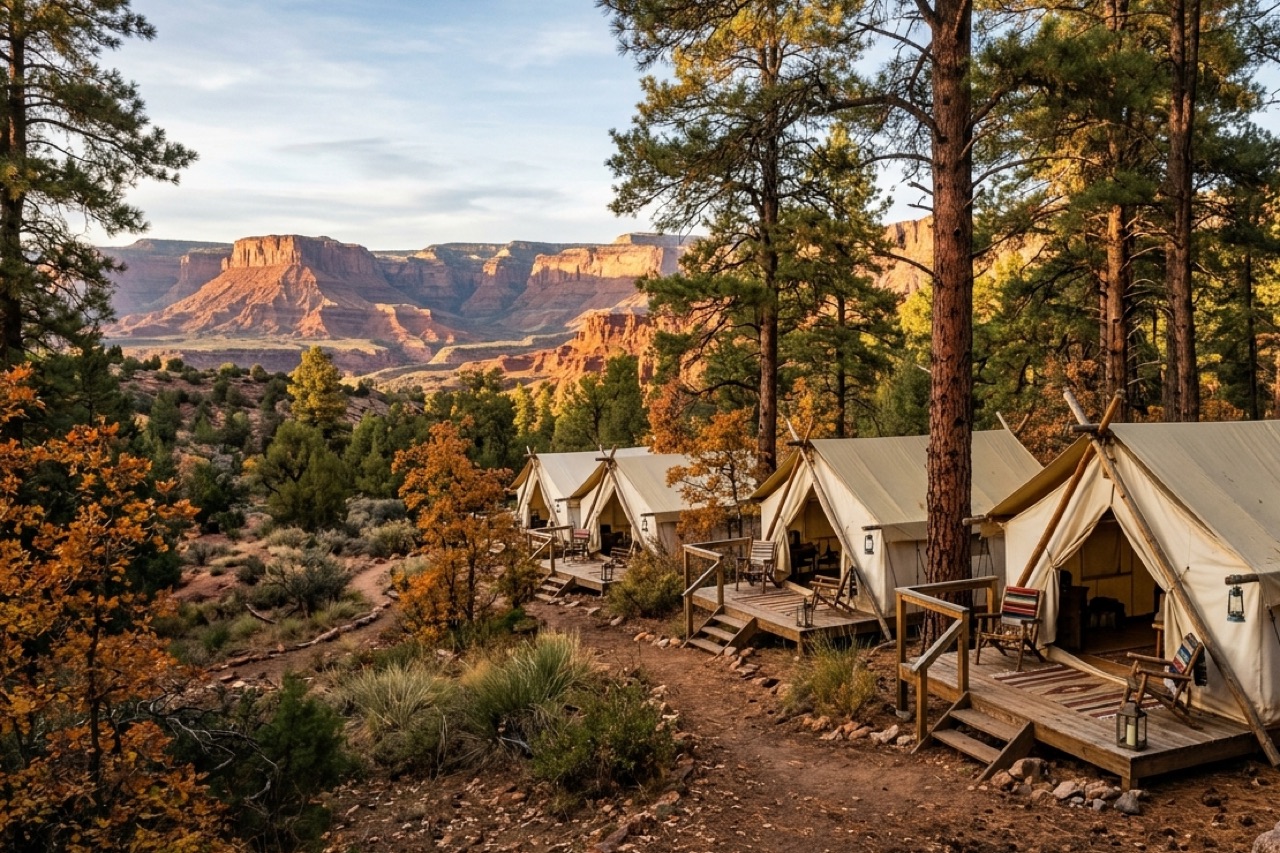
Matching the tent to the US region
The United States covers deserts, rainforest, hurricane coast and mountain snow, and one specification does not suit all of them. We have supplied tents to California, Oregon, Montana, Florida and Massachusetts, and the briefs were quite different. Start from the weather your tents will face in their worst month, not their best.
| Region | Main concern | What to specify |
|---|---|---|
| Southwest and inland California | UV, heat, wildfire risk | UV-treated cloth, double roof or liner, fire-retardant canvas where required |
| Pacific Northwest | Long wet seasons | Ripstop poly-cotton, steep roof pitch, raised deck, good ventilation |
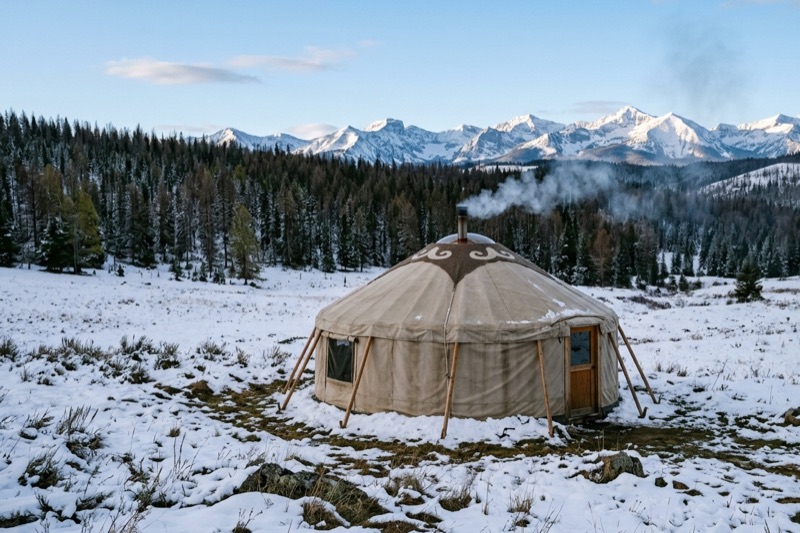
| Mountain West | Snow load, cold | Heavy canvas, snow-rated frame, insulating liner, flued stove port |
| Florida and the Gulf | Humidity, mould, hurricanes | Mould-treated cloth, mesh screening, engineered tie-downs, a storm plan |
| New England | Freeze-thaw, autumn storms | Heavier frame, winter strike or winterising plan |
Which tents suit US glamping sites
US guests expect a bed they can walk around and space for luggage, so framed tents with vertical walls are popular. The Swiss Cottage 10 × 20 and 12 × 24 are already sized in feet, and the Luxury Safari Tent, from $1,385, has a ridge high enough for a ceiling fan and an ensuite annexe. For cold sites, the Yurt 20 FT, priced on enquiry, in 520 gsm canvas with a wool-blend liner, is warmer and quieter than any pole tent.
Bell tents are sized in metres. A 4 m bell tent is about 13 ft across, a 5 m about 16.4 ft and a 6 m about 19.7 ft. The 5 m takes a king bed with room for chairs.
US fire codes and flame-retardant canvas
Fire rules for tents in the US are set locally, usually by adopting the International Fire Code, which has a chapter on tents and membrane structures, with local amendments. Fire marshals commonly ask for fabric tested to NFPA 701 for tents used by the public, and CPAI-84 is the industry standard often referenced for camping tents. California also keeps a register of approved flame-retardant fabrics through the State Fire Marshal. Ask your local fire marshal which standard applies to your use before ordering, and get the answer in writing.
If fire-retardant cloth is required, it must be specified at the quotation stage, because it changes both the cloth and the price. Our fire-retardant canvas is supplied with the test certificate for the lot.
Zoning, building permits and engineering
Whether a glamping tent needs a building permit depends on your county or city, how long it stays up, and whether it has plumbing, electrics or a permanent deck. Many jurisdictions treat a tent that stands for more than a set number of days as a structure, subject to the locally adopted building code and to wind and snow loads for the site. Some will ask for drawings stamped by an engineer licensed in the state.
Talk to the planning and building departments early, before you buy. We provide installation drawings and frame details for our structures, which your engineer can use, but the local approval is yours. Glamping planning permission and permits covers the wider questions.
Importing into the United States
Imports are handled by US Customs and Border Protection. Most commercial shipments of tents go through formal entry, which normally needs a customs bond, and your licensed customs broker can arrange both. For ocean freight, an Importer Security Filing (often called “10+2”) must be lodged before the cargo is loaded at the foreign port, so give your broker our invoice and packing list early.
Classification and duty come from the Harmonized Tariff Schedule. Tents generally sit in heading 6306, with the line depending on the fabric, but your broker should confirm the full ten-digit code. US duties include additional tariffs that have changed several times recently, so check current HTS and CBP guidance at the time of shipment as well as at quotation. Imported goods also generally need country-of-origin marking, so tell us how you want the goods and packaging marked. Tent import duties and HS codes explains how classification works.
Power, plumbing and fit-out in the US
The US uses 120 V at 60 Hz, with its own plugs, wiring rules and listing requirements for fixtures. We supply the tent, frame and soft goods; buy lighting, fans, heaters and air conditioning locally, listed by a recognised testing laboratory, and have a licensed electrician install them. The same applies to plumbing in an ensuite annexe. Battery lighting such as our brass camp lantern avoids wiring altogether where a site is off-grid.
Planning the order from India
Ocean freight from India reaches both coasts, with common arrival ports including Los Angeles and Long Beach, Oakland, Seattle and Tacoma on the West Coast and New York and New Jersey, Savannah and Houston to the east and south. Choose the one nearest your site and let your forwarder advise on routing.
Plan back from your opening date. Production time is confirmed in your quotation, and sea freight and clearance come on top. A five- or ten-tent resort package arrives as consolidated freight with matched interiors. When you have a site and a unit count, send us the details for a quote with freight shown separately.
Questions buyers ask
Do glamping tents need to be fire-rated in the US?
Often, for tents used by the public, but the requirement is local. Ask your fire marshal which standard applies, commonly NFPA 701 or CPAI-84, and specify fire-retardant cloth at the quotation stage if needed.
Do I need a building permit for a glamping tent?
It depends on your county or city, how long the tent stays up and whether it has a deck, plumbing or electrics. Check with your local planning and building departments before buying.
What is the import duty on tents into the US?
Check the current US Harmonized Tariff Schedule and CBP guidance, and have a licensed customs broker confirm the classification. Additional tariffs have changed recently, so confirm at the time of shipment.
Do you sell tents in US sizes?
Our Swiss cottages, tipis and yurts are sized in feet, and bell tents in metres (a 5 m bell tent is about 16.4 ft). Custom sizes can be drawn to your dimensions.
Can you ship to an inland US site?
Yes, on a delivered term such as DAP, with your customs broker clearing the goods, or to a port for collection by your own forwarder.
Which glamping tent is best for a US site with snow?
A yurt or a framed tent with a snow-rated frame, heavy canvas, an insulating liner and a flued stove port. Have the frame checked against your site’s snow load by a local engineer.